INTP karşı INFP
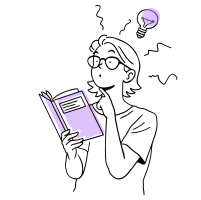
Both are introspective, creative, and unconventional thinkers who live largely in their inner world, but one builds internal logical systems while the other cultivates a deep internal value landscape.

Bu Tipler Neden Karıştırılır
- ✓Both are quiet, introspective, and prefer deep thinking over surface-level interaction
- ✓Both are highly imaginative and spend significant time in their inner world
- ✓Both value intellectual and personal freedom and resist conformity to arbitrary norms
- ✓Both can appear absent-minded, disorganized, and detached from practical daily life
- ✓Both are open-minded explorers of ideas who dislike rigid dogma or close-mindedness
Bilişsel İşlev Yığınları
INTP
Builds intricate internal logical models, constantly refining understanding of how systems and ideas work at a fundamental level
Explores multiple possibilities and connections between ideas, fueling the logical analysis with creative hypotheses
Developing ability to organize personal experience and maintain practical routines
Weakest area; may struggle with expressing emotions, reading social cues, and navigating group dynamics
INFP
Maintains a rich, deeply personal value system that serves as a moral compass and the core of their identity
Explores possibilities and connections through the lens of meaning and human potential
Developing ability to draw on personal memories and maintain comforting routines
Weakest area; may struggle with external organization, assertive communication, and structured productivity
Temel Farklılıklar
Core Inner World
Inner world is a complex web of interconnected logical models, theories, and conceptual frameworks being constantly refined and tested
Inner world is a rich emotional and moral landscape of deeply held values, personal meanings, and idealized visions of how things should be
When you're lost in thought, are you more often building and testing logical models in your head, or exploring feelings, values, and visions of what could be?
What Triggers Passion
Becomes passionate when encountering an elegant logical framework, a fascinating intellectual puzzle, or an idea that fundamentally changes how something is understood
Becomes passionate when something rings true with their core values, when they witness injustice, or when they find art or ideas that capture the depth of human experience
What makes you genuinely light up: discovering a brilliant logical insight that changes how you understand something, or encountering something that deeply moves you emotionally?
Response to Emotion
Experiences emotions but instinctively tries to analyze and categorize them logically; may feel confused by their own feelings and prefer to reason through them
Experiences emotions as a primary source of information and meaning; trusts feelings deeply and uses them to navigate decisions and understand the world
When you feel a strong emotion, is your first instinct to analyze why you feel that way, or to sit with the feeling and let it inform you?
Identity Foundation
Identity is built around intellectual capability — being accurate, understanding complex systems, and having a precise logical framework matters most
Identity is built around authenticity and personal values — being true to themselves and living in alignment with their beliefs matters most
What would be more devastating: being proven fundamentally wrong about something you thought you understood, or being forced to act against your deepest values?
Creative Expression
Creativity manifests through intellectual innovation — designing systems, building theories, writing analytical pieces, or solving problems in novel ways
Creativity manifests through emotional and artistic expression — writing poetry or fiction, creating visual art, composing music, or expressing inner experiences
Does your creativity tend to produce ideas and systems that explain how things work, or art and expressions that capture how things feel?
Gerçek Dünya Örnekleri
Senaryo: Reading a Novel
Appreciates the cleverness of the plot structure, evaluates whether the world-building is logically consistent, and might get frustrated by plot holes that break internal logic
Becomes deeply absorbed in the characters' emotional journeys, projects themselves into the story, and may cry over a fictional character's struggles because they feel real
Senaryo: Choosing What to Study
Gravitates toward subjects that satisfy intellectual curiosity — computer science, philosophy, mathematics, linguistics, or theoretical physics — regardless of career prospects
Gravitates toward subjects that click with their values and allow self-expression — literature, psychology, art, creative writing, or social justice — even if they're not traditionally practical
Senaryo: Processing a Personal Loss
Intellectualizes the grief initially, may research the psychology of loss or analyze the existential implications, and is surprised when emotions hit unexpectedly and with intensity later
Feels the loss deeply and immediately, needs significant time alone to process the emotional weight, may channel grief into creative work or writing as a way to make meaning of the experience
Hızlı Kontrol: INTP karşı INFP?
Tipinizi netleştirmeye yardımcı olmak için bu soruları yanıtlayın
Hızlı Kontrol: INTP karşı INFP?
1/8You encounter a philosophical question about the meaning of life. What is your approach?
Sık Sorulan Sorular
Several factors contribute. Both share Ne-Si as their middle functions, giving them a similar outward appearance of dreamy, idea-exploring introverts. Both are unconventional, open-minded, and can appear scattered. The critical difference — Ti vs Fi as the dominant function — operates internally and is invisible to outside observers. Additionally, INTPs can appear sensitive (through inferior Fe) and INFPs can appear analytical (through inferior Te), further blurring the lines.
Yes, and this is precisely why the confusion exists. INTPs can develop strong values, especially about intellectual honesty and fairness, but they arrive at those values through logical analysis rather than emotional intuition. INFPs can be surprisingly logical, especially when defending their values or using their inferior Te, but logic serves their value system rather than the other way around. The question is always: which comes first and which serves the other?
INTP creativity tends toward invention — novel theoretical frameworks, original systems, unconventional solutions to complex problems, and ideas that challenge how things are understood. INFP creativity tends toward expression — capturing emotional truths through art, writing characters that feel achingly real, creating music that moves people, and making the invisible world of feelings visible. One innovates systems; the other illuminates souls.
INTPs feel lonely when they can't find anyone who can follow their thinking or engage with their ideas at the depth they crave. Their loneliness is intellectual isolation — being surrounded by people who can't understand the frameworks they build. INFPs feel lonely when they can't find anyone who truly sees and accepts who they are at their core. Their loneliness is emotional isolation — being surrounded by people but feeling deeply unseen and unknown.
Daha Fazla Öğren
Daha Fazla Karşılaştırma
Gerçek Tipinizi Bulun
Hâlâ emin değil misiniz? Kapsamlı kişilik testimiz dört boyutu ve kimlik tipinizi analiz eder.
Testi Al