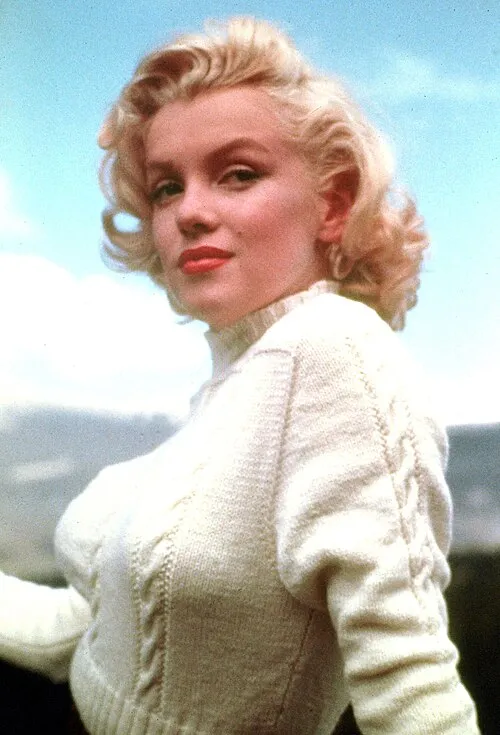
Marilyn Monroe was born Norma Jeane Mortenson on June 1, 1926, in Los Angeles, California, into circumstances that would have crushed a lesser spirit. Her mother, Gladys Pearl Baker, suffered from serious mental illness and was institutionalized for much of Monroe's childhood. Her father was unknown. She spent much of her youth in grow care and the Los Angeles Orphans Home, experiences of instability and longing that she never fully escaped but that contributed to the quality of emotional transparency — the inability to fully conceal what she was feeling — that would make her screen presence so compelling and so haunting. She married at sixteen to avoid returning to the orphanage, and by her early twenties had begun the modeling career that would lead to Hollywood.
The transformation from Norma Jeane Dougherty to Marilyn Monroe was a collaborative act of reinvention conducted with more intentional artistry than is usually acknowledged. She lightened her hair, worked with vocal coaches, studied the specific mechanics of the walk and the glance and the pause that would become her signature, and developed a persona that somehow combined sexual availability with genuine vulnerability — a combination that confused and entranced audiences in equal measure. Her early career was built on this persona, with a succession of comedic roles in films like Gentlemen Prefer Blondes and How to Marry a Millionaire that required her to play a version of herself — beautiful, sexually magnetic, apparently ingenuous — with considerable comic skill. She was much funnier than critics acknowledged, a natural physical comedian who understood timing with the precision of someone who had studied every aspect of performance.
Monroe's artistic ambitions exceeded what Hollywood was willing to offer her, and her founding of Marilyn Monroe Productions in 1954 — an act of considerable commercial and creative independence for a woman in that era — represented her attempt to control her own image and pursue more serious work. Her collaboration with the Actors Studio and Lee Strasberg, her marriage to Arthur Miller and absorption into the intellectual Left, her performance in Bus Stop and later The Misfits, all represented an actress attempting to expand beyond the confines of the sex symbol role. The paradox of her career is that the Actors Studio work and the serious ambitions produced some of her least successful films, while her comedy performances — derided by herself as lightweight — remain among the most accomplished in Hollywood history.
Monroe's personal life was marked by the same quality of emotional intensity that made her screen presence so affecting: three marriages (to James Dougherty, Joe DiMaggio, and Arthur Miller), a succession of affairs with powerful men, chronic insomnia, dependence on barbiturates and alcohol, and a relationship with her own fame that oscillated between exploitation of its pleasures and genuine suffering under its weight. She died on August 4, 1962, of an overdose of barbiturates, at thirty-six. The circumstances remain disputed, but the fact of a life that burned with extraordinary brightness and ended too early does not. Her image has only grown in cultural resonance since her death — she has become an archetype of the beautiful woman destroyed by the desires she inspired, though this reading flattens a person who was considerably more complicated, more ambitious, and more deliberately constructed than the archetype suggests.