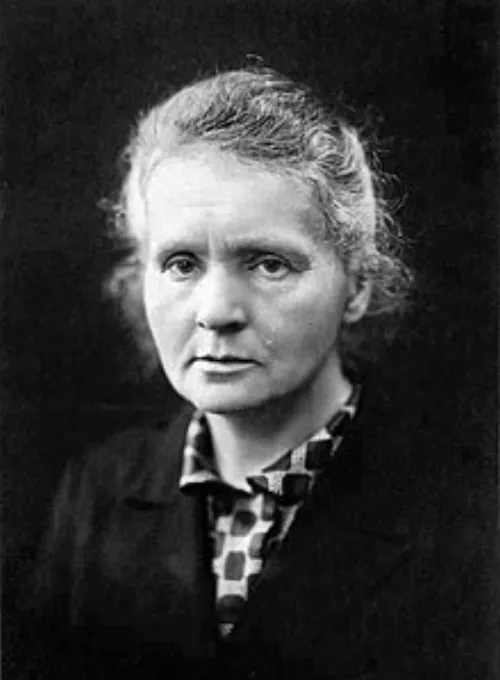
Marie Curie - INTP Personality Type

Marie CurieINTP - Lógico

Physicist, Chemist

Origem

Poland/France

Confiança da Tipagem

amplamente aceito

Quick Facts

Born
November 7, 1867
Birthplace
Warsaw, Kingdom of Poland (Russian Empire)
Nationality
Polish / French
Height
5'2" (157 cm)
Zodiac Sign
Education
University of Paris (Sorbonne) — Physics & Mathematics
Known For
Radioactivity ResearchTwo Nobel PrizesPoloniumRadiumFirst Female Nobel Laureate

Who is Marie Curie?

Maria Sklodowska was born on November 7, 1867, in Warsaw, then under Russian rule, the youngest of five children in an educated but financially struggling family. From childhood, she displayed exceptional academic ability and a focused, almost austere dedication to learning — traits that would define her entire life. Under Russian occupation, higher education for women in Warsaw was illegal, but Maria and her sister Bronia attended the clandestine 'Flying University,' which secretly educated women in rotating private apartments. Maria worked as a governess for years, sending money to Bronia for medical school in Paris, with the agreement that Bronia would reciprocate. In 1891, at twenty-four, Maria finally arrived in Paris, enrolled at the Sorbonne as 'Marie,' and quickly distinguished herself as one of the finest physics students the university had seen.

Marie Curie's scientific career accelerated when she met Pierre Curie, a brilliant physicist who would become her scientific partner and husband. Their collaboration was extraordinary — a rare meeting of two INTP-adjacent minds, both consumed by the pursuit of understanding over recognition. Together they investigated the mysterious phenomenon that Henri Becquerel had observed in uranium — what Marie would name 'radioactivity.' Working in a leaking shed with primitive equipment, in conditions that regularly made them ill, they isolated two new elements: polonium (named for Marie's occupied homeland) and radium. In 1903, Marie became the first woman to win a Nobel Prize — in Physics, shared with Pierre and Becquerel.

When Pierre was killed in a street accident in 1906, Marie could easily have retreated into grief. Instead, she took over his professorship at the Sorbonne — becoming the first female professor in the institution's history — and continued her research with renewed intensity. In 1911, she won a second Nobel Prize, this time in Chemistry, for her work isolating radium. No scientist before or since has won the Nobel Prize in two different scientific disciplines. During World War I, she developed mobile X-ray units (nicknamed 'petites Curies') that brought battlefield diagnosis to the front lines, personally operating them and training radiologists.

Curie was quintessentially INTP in her absolute subordination of personal comfort to intellectual pursuit. She was famously indifferent to recognition, money, and social convention — refusing to patent the radium isolation process so that other researchers could benefit freely, and declining most awards and honorary memberships. Her insatiable need to understand the mechanism behind phenomena, her extraordinary tolerance for tedium (she spent years manually processing tons of pitchblende ore), and her preference for facts over fame all define the INTP at its most elevated. She died in 1934 of aplastic anemia — almost certainly caused by decades of radiation exposure — her lab notebooks so radioactive they remain in lead-lined boxes to this day.
Tipo de Personalidade INTP de Marie Curie

Marie Curie, conhecido(a) por seu trabalho como Physicist, Chemist, exibe os traços clássicos de um tipo de personalidade INTP - Lógico. Este perfil de personalidade é caracterizado por uma combinação única de funções cognitivas que moldam como eles percebem o mundo e tomam decisões.

Principais Traços INTP em Marie Curie

Como um INTP, Marie Curie demonstra as características centrais associadas a este tipo de personalidade. Esses traços desempenharam um papel significativo em seu sucesso e persona pública como Physicist, Chemist. Compreender seu tipo de personalidade fornece insights sobre suas motivações, pontos fortes e a perspectiva única que trazem para seu campo.

Por Que Marie Curie é Tipado como INTP

O tipo de personalidade INTP é um dos 16 tipos Myers-Briggs, e o comportamento público de Marie Curie, padrões de tomada de decisão e estilo de comunicação se alinham estreitamente com esta classificação. Indivíduos INTP como Marie Curie são conhecidos por sua abordagem distintiva para resolução de problemas e relacionamentos interpessoais.

Marie Curie's Key Discoveries

1898

Discovery of Polonium and Radium

Named radioactivity and isolated two new elements from pitchblende ore

1903

First Nobel Prize (Physics)

First woman to win a Nobel Prize; shared with Pierre Curie and Henri Becquerel

1906

First Female Professor at the Sorbonne

Took over Pierre's chair after his death

1911

Second Nobel Prize (Chemistry)

First person ever to win Nobel Prizes in two different sciences

1914-1918

Mobile X-ray Units (WWI)

Developed battlefield radiography that saved countless lives

1922

Curie Institute founded

Established a major cancer research center in Paris

Awards & Recognition

\u2605Nobel Prize in Physics (1903)\u2605Nobel Prize in Chemistry (1911)\u2605Davy Medal (1903)\u2605Matteucci Medal (1904)

Marie Curie's Mystic Profile

Discover Marie Curie's cosmic connections through zodiac, tarot, crystals, and spirit animals.

scorpio

Zodiac Prediction

As a Scorpio, Marie Curie represented the sign's deepest paradox: drawn to the hidden and invisible forces beneath the surface of the world, willing to be destroyed by what she uncovered. Scorpio rules transformation and the underworld — and radioactivity is the ultimate Scorpionic phenomenon, a force that transforms matter from within, invisible to the eye yet capable of destroying what it touches. Curie pursued this power with the complete Scorpionic disregard for personal safety that the sign is famous for. The scorpion does not hesitate at the edge of danger.

🃏

the high priestess

Tarot Card Match

The High Priestess sits between two pillars — the known and the unknown — and it is in that threshold that Curie spent her entire scientific life. The High Priestess does not reveal her secrets to those who are not ready; Curie likewise published only after years of grueling verification, refusing to announce discoveries until the evidence was unimpeachable. She is the guardian of the deeper mystery, and radioactivity was exactly that: a mystery at the heart of matter itself.

💎

moldavite

Crystal Match

Moldavite — the extraterrestrial glass formed from a meteorite impact 15 million years ago — carries life-changing, high-vibration energy said to accelerate change in whoever uses it. Nothing in the mineral kingdom better represents the powerful power of radioactivity than moldavite: a stone formed by cosmic impact, by forces beyond the human scale, reshaping whatever it touches. Curie, too, was an impactor — her work reshaped physics, medicine, gender norms, and the nature of scientific collaboration forever.

🦁

phoenix

Spirit Animal

The phoenix rises from its own ashes — transformed, not destroyed, by fire. Curie rose repeatedly: from poverty and occupation in Warsaw, from Pierre's death, from social ostracism (the French Academy of Sciences infamously refused to admit her because she was a woman), from the scandal of her relationship with Paul Langevin. Each time, she returned to her laboratory and to her work, reborn through the pure fire of scientific purpose. The phoenix also carries the paradox of Curie's life: the force that defined her — radioactivity — was also the force that killed her.

Mais Personalidades INTP Famosas

Sobre Esta Análise

Esta análise do tipo de personalidade de Marie Curie é baseada em informações publicamente disponíveis, entrevistas, relatos biográficos e observações comportamentais. A tipagem INTP representa uma avaliação fundamentada por entusiastas e especialistas em tipos de personalidade, mas não deve ser considerada oficialmente confirmada, a menos que declarado de outra forma. A personalidade é complexa e multifacetada, e as personas públicas podem diferir das personalidades privadas.