Mark Twain - ENTP Personality Type

Mark TwainENTP - Debatedor

Author

Origem

USA

Confiança da Tipagem

amplamente aceito

Quick Facts

Born
November 30, 1835
Birthplace
Florida, Missouri, USA
Nationality
American
Height
5'8" (173 cm)
Zodiac Sign
Education
Elementary school; largely self-educated as printer's apprentice
Known For
Adventures of Huckleberry FinnAdventures of Tom SawyerThe Prince and the PauperA Connecticut Yankee in King Arthur's Court

Who is Mark Twain?

Samuel Langhorne Clemens was born on November 30, 1835, in Florida, Missouri, the sixth of seven children of John Marshall Clemens, a Virginia-born lawyer and judge, and Jane Lampton, a Kentucky native. The family moved to Hannibal, Missouri, a small town on the Mississippi River, when he was four — and it was the river, with its steamboats and its complex social world of commerce, slavery, adventure, and violence, that would be the primary imaginative source for his greatest work. His father died when he was eleven, and he was apprenticed to a printer almost immediately. By fifteen he was working for his brother Orion's newspaper, contributing humorous sketches under pseudonyms, and by eighteen he had left Hannibal permanently, working as an itinerant printer in St. Louis, New York, Philadelphia, and Cincinnati.

The years between 1857 and 1861, when Clemens worked as a licensed steamboat pilot on the Mississippi, represented his most formative adult education. The river required an absolute command of an extraordinarily complex and constantly changing system of information — depths, currents, snags, weather patterns, the mood and behavior of different kinds of human beings in stressful situations — and gave him a professional confidence and an acute observational ability that translated directly into his literary voice. The pen name Mark Twain, which he adopted for good in 1863, came from the river: 'mark twain' was the leadsman's call indicating two fathoms of depth, safe water for a steamboat. He began his literary career in Nevada after the Civil War, writing for newspapers with a combination of comic exaggeration, precise social observation, and a particular gift for rendering spoken American English that no previous American writer had achieved.

The Adventures of Tom Sawyer (1876) and Adventures of Huckleberry Finn (1884) established Twain as the defining voice of American fiction in the nineteenth century. Huckleberry Finn — in which a white boy and an escaped Black man float down the Mississippi River together, navigating the moral universe of the antebellum South — is the novel that Ernest Hemingway claimed all modern American literature descended from. Its achievement is technical as much as moral: Twain gave Huck a voice so precisely calibrated to the rhythms and moral contradictions of uneducated white Southern speech that the character could hold simultaneously the genuine warmth of his friendship with Jim and the inherited racial assumptions of his culture, creating a portrait of American moral consciousness that remains disturbing precisely because Huck is a good person. A Connecticut Yankee in King Arthur's Court (1889) and The Adventures of Tom Sawyer (1876) added social satire and time-travel to his range.

Twain's ENTP quality manifested most directly in his public persona as the great American satirist: the person whose role in the culture was to say what everyone was thinking and no one could quite get away with saying, dressed in enough humor to pass the censor of social convention. His lectures — enormously popular across three continents — were essentially extended improvisational performances of wit and observation, where the audience never knew quite where he was going until he arrived. His famous aphorisms — 'The reports of my death are greatly exaggerated,' 'It's easier to fool people than to convince them they have been fooled,' 'A person who won't read has no advantage over one who can't read' — are ENTP formulations: paradoxes designed to produce sudden clarity by reversing the expected relationship between their elements. He died on April 21, 1910, having correctly predicted that he would arrive and depart with Halley's Comet.
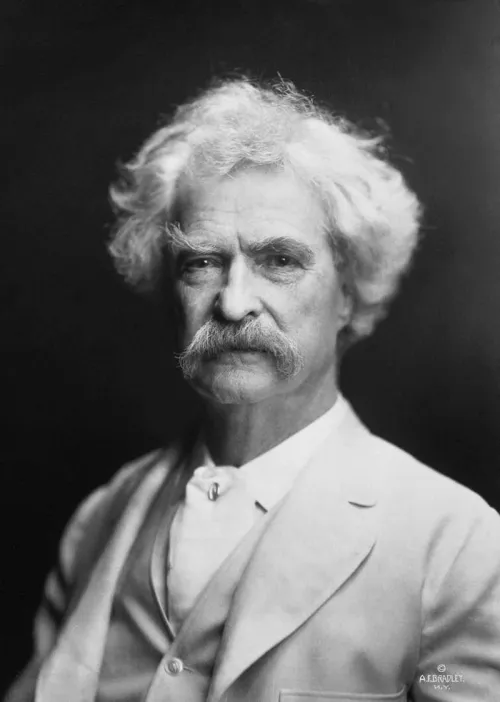
Tipo de Personalidade ENTP de Mark Twain

Mark Twain, conhecido(a) por seu trabalho como Author, exibe os traços clássicos de um tipo de personalidade ENTP - Debatedor. Este perfil de personalidade é caracterizado por uma combinação única de funções cognitivas que moldam como eles percebem o mundo e tomam decisões.

Principais Traços ENTP em Mark Twain

Como um ENTP, Mark Twain demonstra as características centrais associadas a este tipo de personalidade. Esses traços desempenharam um papel significativo em seu sucesso e persona pública como Author. Compreender seu tipo de personalidade fornece insights sobre suas motivações, pontos fortes e a perspectiva única que trazem para seu campo.

Por Que Mark Twain é Tipado como ENTP

O tipo de personalidade ENTP é um dos 16 tipos Myers-Briggs, e o comportamento público de Mark Twain, padrões de tomada de decisão e estilo de comunicação se alinham estreitamente com esta classificação. Indivíduos ENTP como Mark Twain são conhecidos por sua abordagem distintiva para resolução de problemas e relacionamentos interpessoais.

Mark Twain's Notable Works

1865

The Celebrated Jumping Frog of Calaveras County

Established his national reputation in humor

1869

The Innocents Abroad

Best-selling American travel book of the 19th century

1876

The Adventures of Tom Sawyer

The beginning of his iconic American boyhood chronicles

1884

Adventures of Huckleberry Finn

Called 'the source of American literature' by Hemingway

1889

A Connecticut Yankee in King Arthur's Court

Pioneering satire of romanticism and industrial capitalism

Awards & Recognition

\u2605Oxford Honorary Degree (LLD) (1907)

Mark Twain's Mystic Profile

Discover Mark Twain's cosmic connections through zodiac, tarot, crystals, and spirit animals.

sagittarius

Zodiac Prediction

As a Sagittarius, Mark Twain reflected the sign's most essential qualities: the love of philosophical inquiry expressed through storytelling rather than abstraction, the fundamental optimism about human potential paired with a merciless eye for human hypocrisy, and the nomadic nature of a man who spent his adult life in perpetual motion across continents. Sagittarius rules philosophy and higher truth, and Twain's satire was always in service of philosophical questions: what is human freedom? What are the actual rather than stated moral values of American civilization? What does a good man do when society's law and his conscience point in opposite directions?

🃏

the fool

Tarot Card Match

The Fool is the card of the comedian who says what cannot otherwise be said — who uses the license of apparent foolishness to speak truth that would be dangerous in any other mouth. Twain understood this function precisely: his humor was never merely entertainment but a delivery mechanism for observations that the culture's defensive structures would otherwise have rejected. Huckleberry Finn required the Fool's license to enter places that straightforward moral argument could not reach.

💎

carnelian

Crystal Match

Carnelian — the stone of bold expression, creative confidence, and the courage to speak — connects with Twain's entire career as a public voice. It is the crystal of the storyteller, associated with warmth, humor, and the ability to hold an audience in the palm of your hand. Carnelian also carries the orange warmth of the American sunset and the riverboat lantern — the colors of the Mississippi world that made him.

🦁

coyote

Spirit Animal

The coyote is the trickster of North American mythology — the creature that operates by disrupting the established order and revealing the arbitrary nature of the rules that govern it, often at considerable personal cost. Twain was the American coyote: the satirist who made the culture laugh at itself, who revealed through humor what more direct approaches could not penetrate, and who paid for his wisdom with bankruptcy, loss, and the endless financial chaos of a man constitutionally incapable of not investing in the next interesting thing.

Mais Personalidades ENTP Famosas

Sobre Esta Análise

Esta análise do tipo de personalidade de Mark Twain é baseada em informações publicamente disponíveis, entrevistas, relatos biográficos e observações comportamentais. A tipagem ENTP representa uma avaliação fundamentada por entusiastas e especialistas em tipos de personalidade, mas não deve ser considerada oficialmente confirmada, a menos que declarado de outra forma. A personalidade é complexa e multifacetada, e as personas públicas podem diferir das personalidades privadas.