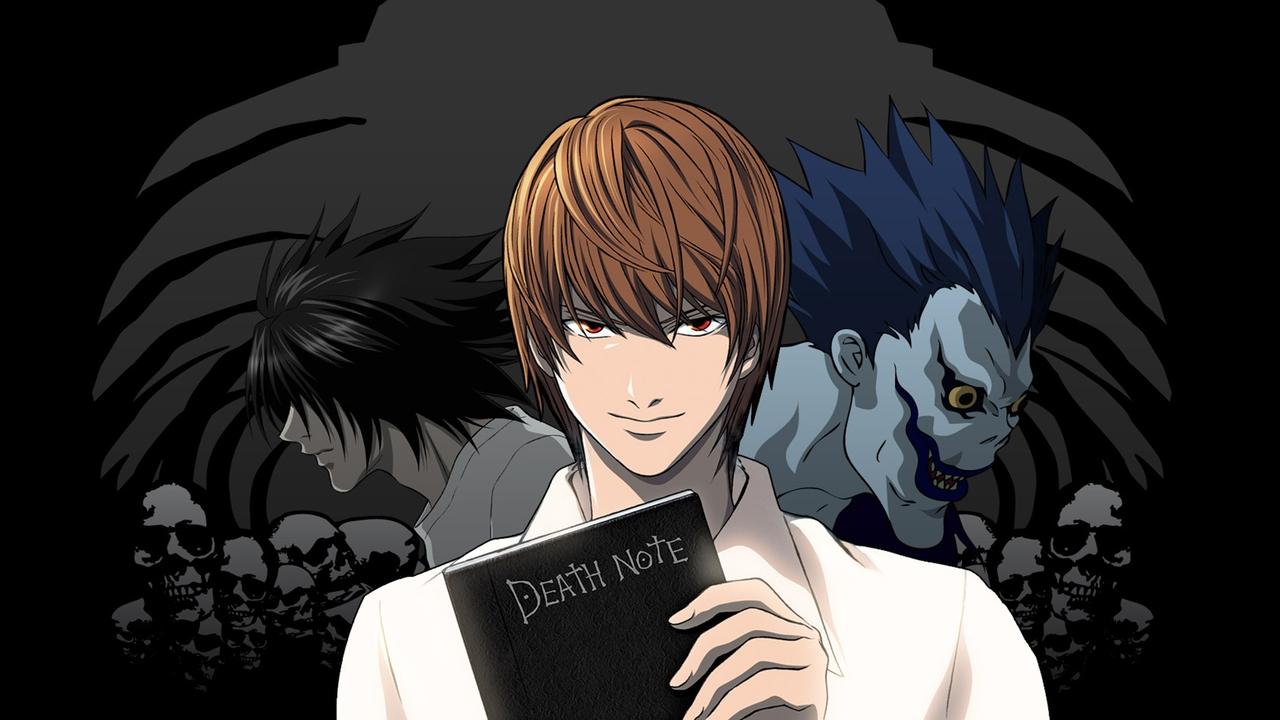
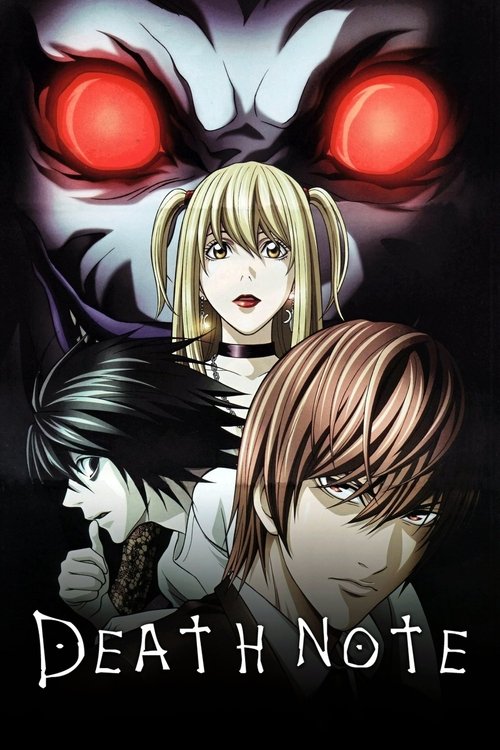
Death Note
Discover the MBTI types of Death Note characters — Light Yagami, L, Misa Amane, and more
Analitycy
Light Yagami
AnalystLight Yagami exemplifies the INTJ archetype taken to its darkest extreme. His dominant Ni manifests as an all-consuming vision of a purified world, conceived the very moment he picks up the Death Note and immediately grasps its long-term potential rather than reacting impulsively. His auxiliary Te executes this vision with terrifying precision — he constructs elaborate contingency plans, manipulates the task force from within, and treats every person as a variable in his equation, as seen when he orchestrates L's death through Rem by calculating emotional leverage across multiple parties simultaneously. Light's tertiary Fi surfaces in his genuine belief that he is morally righteous, creating the self-justifying God complex that defines Kira's ideology. His inferior Se appears in rare moments of panic when plans unravel — notably his frantic behavior when cornered by Near in the warehouse, where his composed strategic mask shatters into desperate, physically erratic reactions. Light's character arc traces the corruption of an INTJ's visionary potential, transforming from a brilliant student who genuinely wants justice into a megalomaniac whose Ni-Te loop severs him completely from human empathy.
“I am justice! I protect the innocent and those who fear evil. I'm the one that will become the god of a new world that everyone desires!”Learn about INTJ →
L Lawliet
AnalystL Lawliet is one of anime's most iconic INTP portrayals, driven by an insatiable Ti-dominant need to solve the ultimate intellectual puzzle. He constructs elaborate logical frameworks to narrow down Kira's identity, such as his brilliant broadcast trap using Lind L. Tailor to confirm Kira's location and killing method within minutes. His auxiliary Ne fuels his unconventional investigative methods — chaining himself to Light, testing the 13-day rule, and constantly generating new hypotheses that he tests and discards with scientific rigor. L's tertiary Si manifests in his peculiar personal rituals: his specific sitting posture that he claims boosts reasoning by 40%, his obsessive sugar consumption, and his attachment to familiar routines despite his chaotic thinking style. His inferior Fe emerges in his socially awkward attempts at connection, most poignantly in his rain-soaked rooftop conversation with Light where he admits he considers Light his first friend — a moment of genuine emotional vulnerability from someone who typically views relationships through an analytical lens. L's character arc is ultimately tragic: his Ti precision correctly identifies Kira, but his underdeveloped Fe leaves him unable to navigate the emotional manipulation that leads to his death.
“There are many types of monsters in this world. Monsters who will not show themselves and who cause trouble. Monsters who abduct children. Monsters who devour dreams. Monsters who suck blood, and monsters who always tell lies.”Learn about INTP →
Kiyomi Takada
AnalystKiyomi Takada displays the ENTJ cognitive stack through her composed, ambitious navigation of power structures. Her dominant Te manifests in her commanding public presence as Kira's spokesperson — she delivers his message with authoritative precision, manages media appearances with professional control, and organizes her role within Kira's operation with executive efficiency. Her auxiliary Ni drives her strategic understanding of how to position herself at the center of influence; she recognizes that aligning with Kira provides the platform for power she has always sought, leveraging her relationship with Light from their university days. Takada's tertiary Se surfaces in her polished, image-conscious presentation — she is acutely aware of how she appears to the public and maintains an impeccable external persona that serves her strategic goals. Her inferior Fi emerges in her genuine emotional attachment to Light, which ultimately clouds her judgment; when kidnapped by Mello, she contacts Light expecting rescue and protection, revealing the vulnerable personal feelings beneath her controlled exterior. Takada's arc illustrates the ENTJ's susceptibility to manipulation when their ambition aligns with a charismatic leader's agenda — Light uses her Te competence and her suppressed Fi attachment as tools, and she proves as disposable to him as every other piece on his chessboard.
“I am Kira's chosen spokesperson. I will deliver his message to the world.”Learn about ENTJ →
Ryuk
AnalystRyuk perfectly captures the ENTP trickster archetype driven to its most detached extreme. His dominant Ne manifests as an existential boredom with the Shinigami Realm — he drops the Death Note into the human world not out of malice but purely to generate interesting possibilities, treating the entire Kira saga as an entertainment experiment. His auxiliary Ti allows him to observe Light's schemes with intellectual fascination while maintaining complete emotional detachment, analyzing human behavior like a scientist watching lab subjects without ever intervening in the outcome. Ryuk's tertiary Fe appears in his superficial social engagement — he enjoys Light's company and their conversations about morality and justice, but this connection is shallow and easily discarded, as demonstrated when he writes Light's name without hesitation once the game becomes boring. His inferior Si shows in his utter disregard for tradition, rules, or consequences; he broke Shinigami protocol by deliberately dropping the notebook, and he shows no attachment to the established order of his realm. Ryuk's character arc is uniquely static for an ENTP — he begins and ends as a pure observer, reinforcing the theme that to him, the entire Death Note saga was simply the most interesting thing that happened in an otherwise tedious eternity.
“Humans are so interesting.”Learn about ENTP →
Dyplomaci
Rem
DiplomatRem embodies the INFJ type through her singular, unwavering devotion to protecting Misa Amane. Her dominant Ni manifests as a profound understanding of the Death Note's broader implications and an almost prophetic awareness of how events will unfold — she perceives Light's manipulative nature long before others and foresees the inevitable danger to Misa with crystalline clarity. Her auxiliary Fe drives her self-sacrificial decision-making; she prioritizes Misa's emotional wellbeing and safety above her own survival, ultimately killing L and Watari knowing full well it will end her own existence. Rem's tertiary Ti appears in her logical assessment of Light's schemes — she analytically deconstructs his manipulations and understands exactly how he has engineered the situation to force her hand, recognizing the trap even as she walks into it. Her inferior Se manifests in her disconnection from self-preservation instincts; she is so consumed by her Ni-Fe protective vision that she cannot prioritize her own physical existence. Rem's arc is a tragic illustration of the INFJ's self-destructive potential — her capacity for deep, empathetic connection becomes the weapon Light uses against her, exploiting her devotion to orchestrate both L's death and Rem's own dissolution in a single calculated move.
“I will not let Misa die. If it means killing you, Light Yagami, that is what I will do.”Learn about INFJ →
Sidoh
DiplomatSidoh represents the INFP cognitive stack in its most anxious, conflict-averse form. His dominant Fi manifests as a deeply personal sense of injustice about his stolen notebook — the grievance is not logical or strategic but profoundly felt, a violation of what belongs to him that he experiences as an emotional wound rather than a practical problem to solve. His auxiliary Ne fuels his anxious imagination, causing him to envision countless possible negative outcomes and complications rather than focusing on a single course of action; he worries extensively about what Ryuk might do, what the humans might do, and how everything could go wrong. Sidoh's tertiary Si appears in his attachment to the familiar — he wants things returned to how they were, finds the disruption to his routine distressing, and draws on his understanding of Shinigami rules and precedents when trying to reclaim his property. His inferior Te is strikingly underdeveloped; he struggles to organize a practical plan for recovering the notebook, cannot assert himself effectively against the humans who possess it, and ultimately relies on others' cooperation rather than taking decisive command of the situation. Sidoh's character provides comic relief while also illustrating how an INFP's sensitivity and conflict avoidance can leave them paralyzed when confronted with direct confrontation, even when their cause is entirely justified.
“That's my notebook! I just want it back!”Learn about INFP →
Aiber
DiplomatAiber demonstrates the ENFJ cognitive stack through his masterful ability to read and influence people. His dominant Fe allows him to instantly assess the emotional atmosphere of any room and adapt his persona accordingly — as a professional con artist, he builds rapport with targets effortlessly, mirroring their emotional needs and presenting exactly the version of himself that will earn their trust. His auxiliary Ni manifests in his intuitive ability to anticipate how people will react, planning his social manipulations several steps ahead and reading underlying motivations that others miss entirely. During the Yotsuba investigation, Aiber infiltrates the corporate group with seamless social integration, demonstrating his Fe-Ni synergy in action. His tertiary Se surfaces in his adaptability to real-time social dynamics; he can pivot his approach mid-conversation when he senses a shift in the room's energy, adjusting his body language and tone with practiced ease. His inferior Ti appears in his willingness to serve L's logical framework without fully questioning the analytical underpinnings — he trusts L's reasoning and focuses on executing the interpersonal aspects of the plan rather than challenging its logical structure. Aiber's role in the series highlights how ENFJ charisma can be applied as a precise investigative tool, turning social intelligence into a weapon as effective as any deductive method.
“Reading people is my profession. It's what I do best.”Learn about ENFJ →
Matsuda Touta
DiplomatMatsuda Touta is the ENFP heart of the Kira task force, bringing warmth and idealism into an investigation dominated by cold logic. His dominant Ne manifests in his eagerness to explore unconventional ideas and his willingness to entertain possibilities others dismiss — he frequently suggests alternative theories and approaches, even when the senior investigators shut him down. His auxiliary Fi drives his deep emotional investment in the people around him; he genuinely believes in Light's innocence for most of the series because his value-driven perception cannot reconcile the young man he admires with a mass murderer. Matsuda's tertiary Te surfaces when he acts decisively under pressure, most notably during the Yotsuba arc where he improvises an undercover operation and talks his way through a dangerous corporate meeting with surprising tactical competence. His inferior Si appears in his difficulty learning from past mistakes and his tendency to repeat patterns of naive trust. The series climax delivers the most powerful ENFP moment in anime — when Light's identity as Kira is finally confirmed, Matsuda's shattered Fi erupts into a tearful, rage-filled shooting, representing the devastating collapse of an idealist's worldview when confronted with undeniable betrayal by someone he believed in completely.
“I believed in you, Light! We all believed in you!”Learn about ENFP →
Strażnicy
Near
SentinelNear demonstrates the ISTJ cognitive stack through his methodical, detail-oriented approach to the Kira investigation. His dominant Si manifests in how he builds upon L's established investigative framework rather than inventing new methods — he studies L's case files exhaustively, absorbs every detail of past evidence, and constructs his conclusions by systematically cross-referencing historical data points. His auxiliary Te drives his organizational precision, seen in how he coordinates the SPK with cold efficiency and structures his investigation into logical, step-by-step progressions that leave no variable unexamined. Near's tertiary Fi surfaces in his quiet but absolute moral conviction that Kira must be stopped — unlike L's intellectual curiosity, Near's motivation is a deeply internalized sense of right and wrong, evident in his warehouse confrontation where he calmly dismantles Light's ideology as morally bankrupt. His inferior Ne appears in his limited ability to improvise; he relies on Mello's chaotic, unpredictable actions to create the openings his own methodical approach cannot generate, which he openly acknowledges. Near's character arc reveals the ISTJ's greatest strength and limitation: his systematic patience ultimately catches Kira, but only because Mello's complementary chaos forced Light into making mistakes that a purely methodical investigation would never have provoked.
“If you can't win the game, if you can't solve the puzzle, you're nothing but a loser.”Learn about ISTJ →
Watari
SentinelWatari exemplifies the ISFJ type through his quiet, steadfast devotion to supporting L's mission from behind the scenes. His dominant Si manifests in his meticulous maintenance of established systems and routines — he manages L's complex technological infrastructure, maintains secure communication channels, and ensures every logistical detail of the investigation runs flawlessly based on years of accumulated operational experience. His auxiliary Fe drives his selfless caretaking role; he provides for L's eccentric needs without complaint, nurtures the Wammy's House orphans, and serves as the emotional anchor that L himself cannot be. Watari's tertiary Ti appears in his competent technical analysis and his ability to process complex information feeds during the investigation, quietly filtering and organizing data with understated precision. His inferior Ne surfaces in his limited questioning of L's methods — he trusts the established relationship and rarely challenges L's direction, even when the investigation takes dangerous turns. Watari's character arc culminates in his death at Rem's hand, a moment that underscores the ISFJ's ultimate vulnerability: his unwavering loyalty and predictable devotion made him an easy target within Light's scheme, and his final act is characteristically selfless — attempting to delete critical data to protect others even as he dies.
“I have served L faithfully for many years. I will continue to do so until the end.”Learn about ISFJ →
Soichiro Yagami
SentinelSoichiro Yagami represents the ESTJ at his most principled and duty-bound. His dominant Te drives his leadership of the task force with clear organizational authority — he delegates responsibilities, demands accountability, and makes decisive calls under extreme pressure, such as his unwavering decision to continue the Kira investigation even when most officers abandon it out of fear. His auxiliary Si manifests in his deep reverence for institutional justice and established law enforcement procedures; he fundamentally cannot conceive of operating outside the system, which is why the possibility of his son being Kira nearly destroys him psychologically. Soichiro's tertiary Ne appears in limited flashes of creative problem-solving, such as his dramatic fake execution scenario to test Light and Misa, though he is clearly uncomfortable stepping outside conventional methods. His inferior Fi surfaces in moments of profound personal anguish — the hospital scene where he collapses from the stress of suspecting Light reveals the deep internal values he normally suppresses beneath his Te-Si duty orientation. Soichiro's arc is fundamentally about an ESTJ whose institutional faith is tested to its absolute limit; his belief that the system produces justice collides with the horrifying possibility that his own son has perverted that system entirely.
“I will give my life to catch Kira. That is my duty as a father and as chief of police.”Learn about ESTJ →
Mikami Teru
SentinelMikami Teru represents the ESFJ cognitive stack channeled through fanatical devotion. His dominant Fe manifests as an overwhelming need for an external moral authority to validate and structure his worldview — he attaches himself to Kira's ideology with religious fervor because it provides the clear social justice framework he has craved since childhood, when he was bullied for trying to enforce fairness among his classmates. His auxiliary Si drives his extraordinarily rigid daily routine, which becomes the critical flaw that exposes Light's plan; Mikami follows the exact same schedule every single day, and any deviation is immediately noticeable and ultimately catastrophic when Near's team exploits this predictability. His tertiary Ne appears in his ability to extrapolate Kira's wishes and independently select victims, making judgment calls about who deserves deletion based on his interpretation of Kira's vision. His inferior Ti is glaringly underdeveloped — Mikami never logically questions whether Kira's ideology is internally consistent or whether his devotion is being exploited; he accepts the moral framework wholesale without analytical scrutiny. Mikami's arc serves as a devastating commentary on the ESFJ shadow: when Fe's need for social harmony and external validation attaches to a corrupted authority, the result is blind obedience that ultimately destroys both the follower and the cause he serves.
“Delete! Delete! Delete!”Learn about ESFJ →
Odkrywcy
Naomi Misora
ExplorerNaomi Misora demonstrates the ISTP cognitive stack through her independent, analytically sharp investigation of Kira. Her dominant Ti manifests in her ability to independently deduce critical information about Kira's killing method — she logically connects the bus hijacking incident to Kira's need for a name and face, constructing a precise analytical framework that surpasses even the task force's collective reasoning. Her auxiliary Se shows in her practical, observational approach to evidence gathering; she operates by directly engaging with the physical world, tracking movements and piecing together real-world observations rather than theorizing from a distance. Naomi's tertiary Ni surfaces in her intuitive suspicion of Light during their conversation — she senses something is wrong beneath his helpful demeanor, though she cannot fully articulate the threat. Her inferior Fe becomes her tragic vulnerability; Light exploits her emotional state after Raye Penber's death, manipulating her grief and trust to extract her real name. The encounter between Naomi and Light is one of the series' most chilling scenes precisely because it shows an ISTP's competent, logical mind being undermined not through intellectual failure but through emotional exploitation — her Fe blind spot allows Light to establish false rapport and ultimately destroy the person who came closest to exposing him early in the series.
“I was investigating on my own. I've found something important about Kira.”Learn about ISTP →
Wedy
ExplorerWedy embodies the ISFP type through her independent, value-driven approach to her craft as a professional thief. Her dominant Fi manifests in her strong personal code of conduct — she works alone, takes pride in clean execution, and chooses assignments based on her own internal standards rather than external authority or financial incentive alone. Her auxiliary Se drives her exceptional physical skills in infiltration and surveillance; she installs hidden cameras in the Yotsuba Group's meeting room with practiced precision, navigating physical environments with the fluid, in-the-moment awareness that defines Se mastery. Wedy's tertiary Ni surfaces in her ability to read the deeper significance of situations, understanding the broader implications of L's investigation without needing extensive explanation — she grasps the strategic picture intuitively and positions her contributions accordingly. Her inferior Te appears in her preference to avoid organizational structures and leadership roles; she contributes her specialized skills but resists being managed or integrated into team hierarchies, functioning best as an autonomous operator within L's loosely structured network. Wedy's character, though relatively minor in screen time, illustrates how the ISFP's combination of personal authenticity and physical competence can be channeled into highly specialized, independent work where individual skill matters more than collaborative planning.
“I work alone, and I work clean. That's my style.”Learn about ISFP →
Mello
ExplorerMello is a textbook ESTP whose dominant Se drives him to engage directly and physically with every challenge. Unlike Near's methodical desk work, Mello infiltrates the Mafia, orchestrates kidnappings, and uses explosive tactics — he needs to be in the action, responding to real-time developments with hands-on intensity. His auxiliary Ti manifests in his tactical intelligence; despite appearing reckless, Mello's plans demonstrate sharp logical analysis, such as his calculated use of the Death Note rules to pressure the investigation and his strategic alliance with criminals to access resources the SPK cannot. His tertiary Fe emerges through his intense competitiveness with Near — he craves external validation and recognition, and his emotional volatility when compared unfavorably to Near reveals how deeply social standing affects him. Mello's inferior Ni appears in his difficulty with long-term planning; he operates in explosive bursts rather than sustained campaigns, and his impulsive decision to kidnap Takada ultimately costs him his life. His character arc is deeply compelling because his Se-driven chaos proves essential to defeating Kira — his unpredictable actions create the pressure that Near's systematic approach alone could never achieve, and his final sacrifice demonstrates an ESTP channeling their action-oriented nature toward a cause greater than personal glory.
“I'll be the one to catch Kira. And I'll do it my way.”Learn about ESTP →
Misa Amane
ExplorerMisa Amane embodies the ESFP type through her dominant Se engagement with the world — she thrives as a model and pop idol, craving the spotlight, physical attention, and sensory stimulation that her celebrity lifestyle provides. Her auxiliary Fi drives her intense, unshakeable emotional devotion to Light, a bond so deeply personal that she willingly sacrifices half her lifespan twice to obtain the Shinigami Eyes, making decisions entirely from feeling rather than strategic calculation. Misa's tertiary Te surfaces in moments of surprising practical effectiveness, such as when she independently identifies and contacts Light as Kira, and when she competently serves as the second Kira by following Light's operational instructions with focused efficiency. Her inferior Ni is notably underdeveloped — she cannot see the long-term implications of her devotion or recognize that Light is manipulating her feelings, remaining locked in the immediate emotional experience rather than questioning his true intentions. Misa's arc is a cautionary tale of an ESFP whose powerful Se-Fi loop makes her vulnerable to exploitation; her authentic emotional capacity becomes a tool in someone else's calculated Ni-Te scheme, and she never develops the foresight to break free from it.
“I can't imagine a world without Light!”Learn about ESFP →
Znajdź swoją postać
Znasz swój typ MBTI? Znajdź swoje dopasowanie postaci poniżej.
Często zadawane pytania
Light Yagami is widely typed as INTJ — his strategic mastermind persona, long-term vision of creating a 'new world,' and ruthless execution through logical manipulation are hallmark traits of the Ni-Te cognitive stack. He plans several moves ahead and treats people as variables in his grand equation.
L Lawliet is commonly typed as INTP — his insatiable intellectual curiosity, unconventional deductive methods, and ability to construct elaborate theoretical frameworks while remaining emotionally detached are classic Ti-Ne traits. His quirky habits and disregard for social norms further support this typing.
Absolutely. Death Note is one of the most celebrated portrayals of INTJ vs INTP conflict in fiction. Light (INTJ) operates with a fixed vision and executes plans methodically, while L (INTP) approaches the case with open-ended curiosity and flexible theorizing. Their clash represents the fundamental difference between Ni-Te's convergent strategy and Ti-Ne's divergent analysis.
Odkryj więcej seriali
Znajdź swój własny typ
Odkryj swój typ osobowości MBTI i sprawdź, które fikcyjne postacie mają takie same cechy jak Ty.
Zrób test