
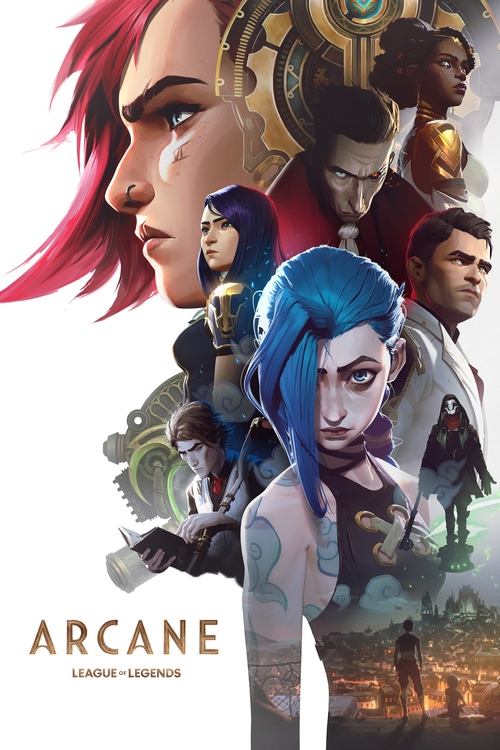
Arcane (League of Legends)
Explore the MBTI types of Arcane characters — Vi, Jinx, Caitlyn, Jayce, and more
Analitycy

Silco
AnalystSilco demonstrates the INTJ cognitive stack through decades of patient strategic execution driven by a singular transformative vision. His dominant Ni manifests as an unwavering conviction that the Undercity must become an independent nation—a vision he has pursued since Vander's betrayal nearly killed him, and every action over the subsequent years serves this single goal with remarkable consistency. His auxiliary Te drives ruthless efficiency in execution: building the Shimmer trade empire, cultivating loyal operatives, infiltrating Piltover's economy, and orchestrating political pressure campaigns with the methodical precision of a chess grandmaster who plans twenty moves ahead. Silco's tertiary Fi emerges unexpectedly and beautifully through his relationship with Jinx—the hardened crime lord who sacrifices pawns without hesitation discovers he cannot sacrifice his adopted daughter, revealing a deeply personal emotional core that ultimately overrides his strategic calculus. His inferior Se surfaces in his underestimation of immediate physical threats and his preference for operating through proxies rather than direct confrontation. Silco's arc subverts the typical INTJ villain trajectory: rather than being defeated by his strategic failures, he is undone by emotional growth, choosing Jinx over his life's mission in his final moments. His dying words to her represent the ultimate INTJ paradox—the visionary who discovers that personal love can outweigh any grand design.
“Power doesn't come to those who were born strongest. It comes to those who will do anything to achieve it.”Learn about INTJ →

Heimerdinger
AnalystHeimerdinger demonstrates the INTP cognitive stack shaped by centuries of accumulated knowledge and analytical caution. His dominant Ti drives an approach to science built on rigorous theoretical understanding—he doesn't reject Hextech out of ignorance but from a deeply reasoned analysis of magical technology's historical dangers, having personally witnessed civilizations destroyed by similar hubris over his extraordinarily long lifespan. His auxiliary Ne manifests in his genuine intellectual curiosity and love of exploration: his laboratory overflows with inventions and ongoing experiments, reflecting a mind that constantly generates new hypotheses and theoretical frameworks. Heimerdinger's tertiary Si provides the historical perspective that makes him both invaluable and frustrating to younger characters—his memories of past catastrophes create a cautious conservatism that conflicts with Jayce and Viktor's urgency, leading to his removal from the Council by people who cannot access his experiential wisdom. His inferior Fe is his most poignant weakness: despite genuine care for Piltover's citizens, he struggles to communicate his concerns in emotionally compelling ways, presenting logical arguments when others need emotional reassurance, and his inability to connect with Ekko's community on a feeling level initially leaves him isolated after his exile. Heimerdinger's arc illustrates INTP growth through humility—the greatest mind in Piltover learning that knowledge without emotional understanding is insufficient wisdom.
“I have seen the misuse of magic in the past.”Learn about INTP →

Ambessa Medarda
AnalystAmbessa Medarda demonstrates the ENTJ cognitive stack in its most unapologetically dominant form. Her dominant Te manifests as absolute command authority—she enters any room and immediately reorganizes its power dynamics, dismissing Piltover's Council as amateurs playing at governance while she has waged actual wars and built empires through military force. Her auxiliary Ni provides strategic depth that extends beyond immediate conflicts: she recognizes Hextech's potential as a weapon of mass destruction before Piltover's idealists even consider the possibility, traveling to the city specifically to secure this advantage for Noxus. Ambessa's tertiary Se surfaces in her physical imposingness and combat mastery—she is not merely a strategist but a warrior who leads from the front, and her fight sequences demonstrate decades of battlefield experience expressed through precise, lethal movement. Her inferior Fi is almost entirely suppressed in favor of strategic calculation: her relationship with Mel is instrumentalized into a tool of influence, and genuine maternal feeling surfaces only in rare unguarded moments that she quickly converts back into leverage. Ambessa's arc serves as a foil to Mel's development—she represents what ENTJ dominance looks like without moral evolution, a leader so consumed by Te efficiency and Ni vision of empire that she cannot recognize when her daughter's more nuanced approach to power might actually produce superior outcomes.
“Peace is the luxury of the strong.”Learn about ENTJ →

Ekko
AnalystEkko exemplifies the ENTP cognitive stack through brilliant improvisation and relentless innovation against impossible odds. His dominant Ne manifests in his extraordinary ability to see multiple possibilities where others see dead ends—he built the Firelights' hidden sanctuary from scavenged materials, invented time-manipulation technology from salvaged Hextech, and created a functioning resistance movement by seeing potential in people and resources that Silco's empire discarded. His auxiliary Ti provides the analytical precision to transform wild ideas into functional reality: the Z-Drive isn't just creative inspiration but a carefully engineered device requiring deep understanding of temporal mechanics and crystalline energy systems. Ekko's tertiary Fe drives his leadership of the Firelights—unlike Silco's fear-based command, he inspires genuine loyalty through emotional connection and shared purpose, creating a community where outcasts find belonging. His inferior Si surfaces in his relationship with Powder's memory: despite his forward-looking Ne nature, he cannot fully release his attachment to who Jinx used to be, and their fight scene on the bridge becomes a devastating collision between his Si nostalgia for their childhood friendship and the present reality of what she's become. Ekko's arc celebrates ENTP resilience—a mind that refuses to accept that circumstances are fixed, proving that creative intelligence combined with community leadership can challenge even the most entrenched power structures.
“I had to make every second count.”Learn about ENTP →
Dyplomaci
Arcane as INFJ
DiplomatArcane's narrative architecture resonates deeply with INFJ cognitive patterns through its symbolic density and moral complexity. The dominant Ni perspective finds rich material in the show's layered symbolism—the bridge between Piltover and Zaun represents the gap between privilege and oppression, Jinx's hallucinations externalize internal psychological fragmentation, and Silco's scarred face mirrors the Undercity's disfigured relationship with the surface. The auxiliary Fe connection appears in the show's insistence that every act of violence has an emotional cost: no character kills without consequence, and the audience is forced to empathize with every perspective, even antagonists. The tertiary Ti element manifests in the show's intellectual rigor—its political commentary about class, technology, and governance is logically consistent and rewards analytical engagement. The inferior Se dimension surfaces in the show's stunning visual artistry, using painterly animation to make abstract emotional and philosophical themes viscerally tangible. INFJs connect with Arcane's central thesis that trauma creates cycles of violence that only radical empathy can break, and its honest portrayal of how even the most insightful understanding of a problem doesn't guarantee the ability to solve it—a tension INFJs know intimately from their own lives.
“We lost ourselves in the pursuit of progress.”Learn about INFJ →
Arcane as INFP
DiplomatArcane resonates profoundly with INFPs through its unflinching exploration of identity, belonging, and the cost of authenticity. The dominant Fi connection is unmistakable—every major character struggles with the gap between who they truly are and who their circumstances force them to become: Powder becomes Jinx, Viktor becomes something post-human, Jayce becomes a politician, and each transformation involves a painful sacrifice of authentic self. The auxiliary Ne dimension appears in the show's creative worldbuilding and layered storytelling, presenting multiple perspectives on every conflict without declaring any single viewpoint as definitively correct. The tertiary Si element surfaces in the show's preoccupation with childhood memories and how past experiences shape present identity—the recurring flashbacks to Vi and Powder's childhood, Silco's drowning, and Vander's failed revolution all demonstrate how history imprisons or liberates characters. The inferior Te challenge manifests in the show's skepticism toward institutional solutions: neither Piltover's bureaucracy nor Zaun's underground power structures succeed in creating genuine justice. INFPs connect with Arcane because it validates the belief that authentic selfhood matters more than social position, while honestly portraying how devastating the pursuit of authenticity can be in a world that demands conformity.
“Is there anything so undoing as a daughter?”Learn about INFP →

Jayce Talis
DiplomatJayce Talis demonstrates the ENFJ cognitive stack through charismatic idealism that collides with political reality. His dominant Fe manifests as a genuine desire to uplift others through his work—he doesn't invent Hextech for personal glory but envisions it transforming lives, and his natural ability to inspire cooperation drives his rapid political ascent from outsider scientist to Council member. His auxiliary Ni provides the visionary framework: he sees Hextech's revolutionary potential before anyone else, pursuing abstract theoretical breakthroughs that others dismiss as impossible magic. Jayce's tertiary Se emerges in his willingness to take dramatic public action—destroying the Hextech bridge, wielding the hammer in direct combat, and making bold political moves that favor immediate impact over careful deliberation. His inferior Ti represents his greatest weakness: he lacks the detached analytical ability to see how his decisions create cascading consequences, repeatedly making emotionally driven choices that have unintended logical outcomes—backing Viktor's increasingly dangerous research out of loyalty, compromising with Silco without fully analyzing the implications. Jayce's arc illustrates the ENFJ's deepest struggle: the gap between inspiring vision and messy execution. He genuinely wants to save everyone but discovers that leadership requires impossible tradeoffs, and his journey from optimistic inventor to compromised politician shows how Fe idealism can be slowly eroded by institutional reality.
“I want to protect the city.”Learn about ENFJ →

Jinx / Powder
DiplomatJinx represents the ENFP cognitive stack shattered by catastrophic trauma into something beautiful and terrifying. Her dominant Ne manifests in explosive creativity—she doesn't just build weapons, she invents entirely new categories of destruction, her workshop a chaotic wonderland of half-finished projects and brilliant improvised devices like Fishbones and Pow-Pow, each reflecting a different creative impulse. Her auxiliary Fi drives everything: the desperate need for Silco's approval, the devastating pain of feeling abandoned by Vi, and the internal moral conflict that tears her apart are all expressions of deeply personal values screaming for validation. Jinx's tertiary Te surfaces in her surprising engineering competence—she successfully weaponizes the Hextech gemstone when trained scientists couldn't, demonstrating organized capability that emerges when her emotional chaos briefly aligns with a clear objective. Her inferior Si appears as traumatic flashbacks and hallucinatory conversations with dead figures from her past—she cannot process her history healthily, so it haunts her as literal voices and visions that distort present reality. Jinx's arc is a devastating portrait of ENFP disintegration: a personality type built for joyful exploration and authentic connection, warped by abandonment trauma into someone who can only express love through destruction, making her the show's most heartbreaking character precisely because we glimpse the person she could have been.
“I thought maybe you could love me like you used to.”Learn about ENFP →
Strażnicy

Caitlyn Kiramman
SentinelCaitlyn Kiramman embodies the ISTJ cognitive stack through disciplined methodology and principled determination. Her dominant Si manifests in her meticulous investigative approach—she builds cases by gathering evidence systematically, documenting findings carefully, and relying on established procedures, as seen when she methodically traces the Shimmer supply chain through records and interviews rather than impulsive raids. Her auxiliary Te drives efficient execution: she organizes resources, follows logical chains of evidence, and communicates findings clearly and directly to superiors, expecting the same procedural respect in return. Caitlyn's tertiary Fi emerges in her quiet moral conviction—she defies her mother and Piltover's Council not from rebellious impulse but from deeply held personal principles about justice that she discovers cannot coexist with institutional corruption. Her inferior Ne surfaces as initial difficulty imagining perspectives outside her privileged Piltover worldview: she genuinely cannot comprehend Zaun's reality until she experiences it firsthand, and this expansion of possibility represents her greatest growth. Caitlyn's arc demonstrates ISTJ development beautifully—she begins as someone who trusts systems and institutions implicitly, gradually learns that procedural correctness can enable injustice, and evolves into a leader who maintains her methodical nature while expanding her understanding of what justice truly requires beyond the boundaries of established order.
“I'm not running away from this.”Learn about ISTJ →

Marcus
SentinelMarcus demonstrates the ISFJ cognitive stack trapped in an impossible moral vise. His dominant Si binds him to institutional duty—he became an enforcer to uphold order and protect Piltover, and his sense of obligation to that role persists even as corruption corrodes every aspect of his position. His auxiliary Fe drives his deepest motivation: protecting his daughter and maintaining the social stability his family depends on, which Silco exploits mercilessly by threatening exactly those emotional pressure points. Marcus's tertiary Ti surfaces in his rationalizations—he constructs logical justifications for each compromise, convincing himself that cooperating with Silco prevents greater bloodshed, creating an internally consistent but morally bankrupt framework. His inferior Ne manifests as paralyzing anxiety about consequences: every decision fills him with dread about unpredictable outcomes, leaving him frozen between competing threats, unable to imagine a path that doesn't lead to disaster. Marcus's arc is a deeply uncomfortable portrait of ISFJ shadow behavior—the protector archetype corrupted by fear into enabling the very threats he was sworn to oppose. His guilt-ridden compliance with Silco while knowing children are dying from Shimmer illustrates how Si-Fe loyalty can become a prison when the institutions and relationships that anchor an ISFJ's identity become instruments of harm rather than safety.
“I'm trying to keep the peace.”Learn about ISFJ →
Arcane as ESFJ
SentinelArcane's emotional core resonates powerfully with ESFJ values through its portrayal of family bonds and the devastating consequences of broken social harmony. The dominant Fe connection is central—the show's most powerful moments involve relational fractures: Vi and Powder's separation, Vander's sacrifice for his adopted children, Silco's unexpected parental love for Jinx, and the bridge scene between Ekko and Jinx where shared childhood memories collide with present enmity. The auxiliary Si perspective appreciates the show's deep respect for history and its consequences: every current conflict traces directly to past events, and characters who forget or deny their history are doomed to repeat its worst patterns. The tertiary Ne dimension appears in the community-building aspects of the narrative—the Firelights creating a hidden sanctuary, Vander maintaining The Last Drop as a communal space, and Jackson building functional society all represent creative solutions to social fragmentation. The inferior Ti challenge surfaces in the show's portrayal of how emotional bonds can cloud rational judgment—Silco's love for Jinx overrides his strategic logic, Vi's protectiveness causes her to miss Powder's transformation, and Mel's feelings for Jayce compromise her political clarity. ESFJs recognize Arcane's truth that community is worth fighting for even when maintaining it demands painful sacrifices.
“You're my sister. Nothing is ever going to change that.”Learn about ESFJ →
Odkrywcy

Sevika
ExplorerSevika embodies the ISTP cognitive stack through unwavering pragmatism and action-over-words loyalty. Her dominant Ti drives a cold, analytical assessment of every situation—she doesn't follow Silco out of emotional attachment but because she logically evaluated both Vander's accommodationist strategy and Silco's revolutionary vision, concluding that Silco's approach offered the Undercity a realistic path to power. Her auxiliary Se manifests in exceptional combat ability: her fighting style is adaptive, efficient, and brutally practical, incorporating her Shimmer-powered mechanical arm as a seamlessly integrated tool rather than a flashy weapon. Sevika's tertiary Ni surfaces in her strategic patience—she can read the trajectory of power dynamics, knowing when to challenge Silco's decisions and when to wait, and she correctly identifies Jinx as a destabilizing liability long before Silco acknowledges it. Her inferior Fe appears in her minimal emotional expression: she communicates respect through action and presence rather than words, and her loyalty is demonstrated by showing up consistently rather than verbal declarations. Sevika's arc illustrates the ISTP principle of earned loyalty—she follows Silco because she respects his willingness to sacrifice for his beliefs, and her repeated confrontations with him about Jinx demonstrate that ISTP loyalty includes the obligation to deliver uncomfortable truths to those they respect.
“I chose the man who was willing to die for what he believed.”Learn about ISTP →

Vi
ExplorerVi exemplifies the ESTP cognitive stack through relentless physical engagement and instinctive tactical intelligence. Her dominant Se is impossible to miss—she navigates the world fists-first, reading environments with split-second precision during the Shimmer factory raid, the prison fights, and her battles across both Piltover and Zaun. Her auxiliary Ti provides the analytical edge beneath her brawler exterior: she quickly identifies structural weaknesses in opponents, adapts combat strategies mid-fight, and cuts through emotional complexity with blunt logical assessments. Vi's tertiary Fe emerges powerfully in her fierce protectiveness of Powder—her entire motivation is relational, and she instinctively takes leadership roles in groups, rallying others through emotional directness rather than strategic planning. Her inferior Ni surfaces as her greatest vulnerability: she struggles to see long-term consequences of her actions, and the gap between who Powder was and who Jinx has become represents a failure of intuitive vision that haunts her throughout the series. Vi's arc traces classic ESTP growth—from an impulsive fighter who acts before thinking to someone who learns that physical courage alone cannot solve every problem, gradually developing patience and strategic awareness through her partnership with Caitlyn.
“Here's to the new us.”Learn about ESTP →
Znajdź swoją postać
Znasz swój typ MBTI? Znajdź swoje dopasowanie postaci poniżej.
Często zadawane pytania
Jinx is commonly typed as ENFP — her wild creativity, emotional depth, and desperate need for connection reflect Ne-Fi, but twisted by severe trauma into chaotic and destructive patterns.
Vi is widely typed as ESTP — her physical prowess, direct communication, and ability to think on her feet in combat reflect Se-Ti at its most action-oriented.
Odkryj więcej seriali
Znajdź swój własny typ
Odkryj swój typ osobowości MBTI i sprawdź, które fikcyjne postacie mają takie same cechy jak Ty.
Zrób test