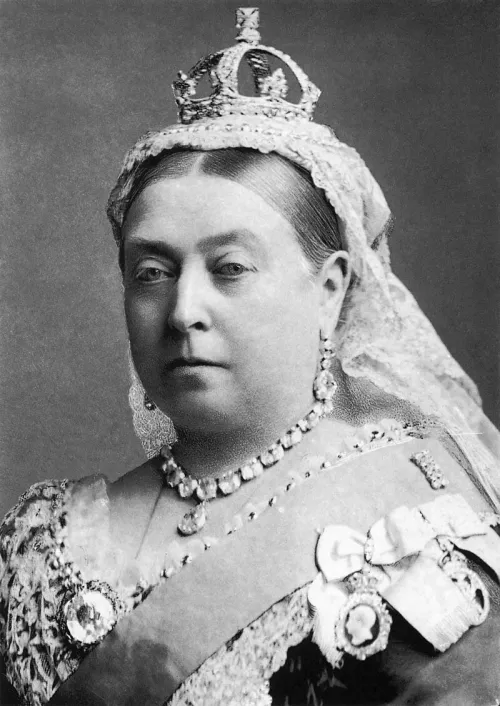
Queen Victoria - ISFJ Personality Type

Queen VictoriaISFJ - Obrońca

Queen of the United Kingdom

Pochodzenie

UK

Pewność typowania

powszechnie akceptowane

Quick Facts

Born
May 24, 1819
Birthplace
Kensington Palace, London, England
Nationality
British
Height
5'0" (152 cm)
Zodiac Sign
Education
Private tutoring
Known For
Longest-reigning British monarch (63 years)Victorian EraBritish Empire expansionDevoted wife and mother of nineGrief after Albert's death

Who is Queen Victoria?

Victoria Alexandrina, born on May 24, 1819, at Kensington Palace, London, became Queen of the United Kingdom at the age of 18 following the death of her uncle, King William IV. Her father, Prince Edward, Duke of Kent, died when she was only eight months old, leaving her to be raised almost exclusively by her German-born mother, Princess Victoria of Saxe-Coburg-Saalfeld, under the strict 'Kensington System' — an isolating regimen designed by her mother's comptroller, Sir John Conroy, that denied Victoria virtually all outside contact and independence. Despite this oppressive upbringing, the young princess displayed a determined, strong-willed character that would eventually assert itself the moment she became queen — famously dismissing Conroy and asserting authority over her own household within hours of her accession.

Victoria's reign, which stretched from 1837 to 1901 — the longest of any British monarch until Elizabeth II — coincided with a period of extraordinary industrial, cultural, and political transformation. She presided over the expansion of the British Empire to its widest extent, covering approximately one-quarter of the Earth's land surface and encompassing more than 400 million people. Yet Victoria herself was less an imperialist architect than a conscientious constitutional monarch who carefully maintained her relationships with successive prime ministers — most notably Lord Melbourne, Benjamin Disraeli, and William Ewart Gladstone. Her relationship with Disraeli was warm and collaborative; with Gladstone, it was famously strained. Her personal sense of duty and dignity set the tone for what became known as the Victorian era — a period defined by its moral seriousness, industrial ambition, and complex social codes.

The central relationship of Victoria's life was her marriage to Prince Albert of Saxe-Coburg and Gotha, whom she married in February 1840. Victoria was deeply, almost urgently in love with Albert — she proposed to him herself, as protocol required — and their partnership was one of genuine intellectual and emotional communion. Albert became her most trusted advisor, introducing administrative order to the royal household and becoming a guiding force in her political judgments. Together they had nine children, whose strategic marriages across European royal houses earned Victoria the nickname 'the grandmother of Europe.' Albert's sudden death from typhoid fever in December 1861, when Victoria was 42, devastated her strongly and permanently. She withdrew from public life for years, wearing black mourning dress for the remaining four decades of her life — an extreme of grief that alienated public sympathy and brought the monarchy to a low point in popular esteem.

Victoria's later years saw a partial return to public life, partly at the urging of Disraeli and partly through her own gradually renewed sense of duty. She became Empress of India in 1876 — a title she cherished. Her close friendship with her Scottish servant John Brown, and later with Abdul Karim, her Indian secretary, raised eyebrows at court and among her children, but Victoria refused to be governed by others' discomfort, maintaining these relationships on her own terms. She died on January 22, 1901, at Osborne House on the Isle of Wight, aged 81, surrounded by her family — with Kaiser Wilhelm II, her eldest grandson, holding her left arm as she passed. Her death ended the Victorian Age and the beginning of a new century felt, to many Britons, like a deep shift in the world's foundations.
Typ osobowości ISFJ — Queen Victoria

Queen Victoria, znany(a) ze swojej pracy jako Queen of the United Kingdom, wykazuje klasyczne cechy typu osobowości ISFJ — Obrońca. Ten profil osobowości charakteryzuje się unikalną kombinacją funkcji poznawczych, które kształtują sposób, w jaki postrzega świat i podejmuje decyzje.

Kluczowe cechy ISFJ w Queen Victoria

Jako ISFJ, Queen Victoria demonstruje podstawowe cechy charakterystyczne dla tego typu osobowości. Te cechy odegrały znaczącą rolę w ich sukcesie i publicznym wizerunku jako Queen of the United Kingdom. Zrozumienie ich typu osobowości daje wgląd w ich motywacje, mocne strony i unikalną perspektywę, którą wnoszą do swojej dziedziny.

Dlaczego Queen Victoria jest typowany(a) jako ISFJ

Typ osobowości ISFJ to jeden z 16 typów osobowości Myers-Briggs, a publiczne zachowanie Queen Victoria, wzorce podejmowania decyzji i styl komunikacji ściśle odpowiadają tej klasyfikacji. Osoby ISFJ, takie jak Queen Victoria, są znane ze swojego charakterystycznego podejścia do rozwiązywania problemów i relacji interpersonalnych.

Queen Victoria's Political Career

1837

Accession to Throne

Became Queen of the United Kingdom at 18 after uncle King William IV died without legitimate heirs

1840

Marriage to Prince Albert

Married her beloved cousin Prince Albert, beginning a deeply devoted 21-year partnership

1845-52

Irish Famine Response

Reign marked by controversial handling of the Great Famine; later known as 'the Famine Queen' in Ireland

1861

Prince Albert's Death

Albert's death plunged Victoria into 40 years of mourning; she wore black for the rest of her life

1876

Empress of India

Proclaimed Empress of India, a title she eagerly embraced; began study of Urdu

1887

Golden Jubilee

Celebrated 50 years on the throne with public celebrations that restored public affection

1897

Diamond Jubilee

Sixty years on throne; the British Empire at its greatest extent, covering a quarter of the globe

Awards & Recognition

\u2605Order of the Garter (1837)\u2605Order of the Thistle (1838)

Queen Victoria's Mystic Profile

Discover Queen Victoria's cosmic connections through zodiac, tarot, crystals, and spirit animals.

gemini

Zodiac Prediction

Queen Victoria's Gemini sun captures the paradox at her center: the deeply private woman who occupied the world's most public throne; the devoted homebody who ruled a global empire; the grieving widow who maintained, through sheer force of duty, the outward dignity of sovereign authority. Gemini rules duality and communication, and Victoria lived in perpetual negotiation between her emotional self — passionate, intense, desperately loving — and her public self: the composed constitutional monarch who understood her symbolic function and performed it with meticulous care. Her reign shows the Gemini capacity for adaptation across radically different contexts: tender mother of nine, hard-bargaining politician, imperial symbol, grief-stricken widow — all within the same person, simultaneously.

🃏

the empress

Tarot Card Match

The Empress — the tarot archetype of maternal power, fertility, nurturing authority, and the deep connection between love and sovereignty — is Victoria's card precisely. She mothered nine children and grandchildren who eventually sat on the thrones of half of Europe; she also mothered an empire, with all the complicated legacy that entails. The Empress represents the kind of power that flows through relationship and care rather than through force or logic alone — and Victoria's reign, whatever its contradictions, was sustained by her genuine, if limited, care for her subjects and her passionate care for her family. The card's shadow — the possessive, controlling matriarch — appeared in Victoria's difficult relationships with her children, particularly her eldest son Bertie.

💎

rose quartz

Crystal Match

Rose quartz — the stone of unconditional love, emotional depth, and the power of the heart — connects with Victoria's most defining characteristic: the intensity of her emotional attachments, particularly her devotion to Albert and her extraordinary grief at his loss. Rose quartz is the stone of those for whom love is not peripheral but central — the organizing principle around which a life is built — and Victoria's life was precisely organized around love, first joyfully and then in grief. The stone's gentle energy also speaks to Victoria's genuine, if often politically constrained, care for her family.

🦁

swan

Spirit Animal

The swan — creature of grace, fierce loyalty, lifelong pair-bonding, and the still surface that conceals powerful currents beneath — is Victoria's spirit animal. Swans are famously monogamous, often mourning when their partner dies, and Victoria's 40 years of mourning for Albert is one of history's most extreme expressions of this same quality. The swan moves through the world with composed, regal dignity — the surface always serene — while the feet work furiously beneath the waterline. This is Victoria's mode of sovereignty: public composure maintaining private intensity. The swan is also fiercely protective of its young, and Victoria — whatever her complicated relationships with her children — fought for their dynastic interests with remarkable tenacity.

Więcej znanych osobowości ISFJ

O tej analizie

Ta analiza typu osobowości Queen Victoria opiera się na publicznie dostępnych informacjach, wywiadach, relacjach biograficznych i obserwacjach behawioralnych. Typowanie ISFJ reprezentuje wykształconą ocenę entuzjastów i ekspertów typologii osobowości, ale nie powinno być uważane za oficjalnie potwierdzone, chyba że stwierdzono inaczej. Osobowość jest złożona i wielowymiarowa, a publiczny wizerunek może różnić się od prywatnej osobowości.