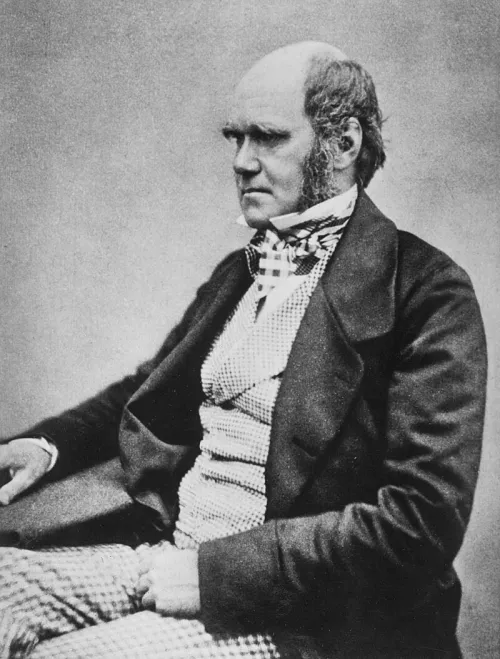
Charles Robert Darwin was born on February 12, 1809, in Shrewsbury, England, into a wealthy and intellectually distinguished family — his grandfather was Erasmus Darwin, whose proto-evolutionary poems had already hinted at transformism. As a child, Darwin was a passionate naturalist, collecting beetles, minerals, and shells with obsessive precision. He was a mediocre student by conventional measures — his father famously told him 'you care for nothing but shooting, dogs, and rat-catching, and you will be a disgrace to yourself and all your family' — but Darwin's curiosity about the natural world was bottomless and self-directed, the hallmark of the INTP learner.
Darwin enrolled at Edinburgh to study medicine but found the lectures 'intolerably dull' and the sight of surgery without anesthesia traumatic. He transferred to Cambridge to study for the clergy — not from religious conviction but because his father needed him to do something respectable. At Cambridge, he fell in with botanist John Stevens Henslow, who recognized his observational gifts and recommended him for the voyage that would change history: the circumnavigation of the globe aboard HMS Beagle from 1831 to 1836. During five years of collecting specimens across South America, the Galápagos, Australia, and South Africa, Darwin accumulated the evidence that would germinate into his theory of natural selection.
Darwin returned to England in 1836 and spent the next twenty-two years building his theory with painstaking thoroughness, aware that it would be among the most controversial ideas in human history. He was not a procrastinator — he was a perfectionist who understood the magnitude of what he was claiming and refused to publish prematurely. Only when Alfred Russel Wallace sent him a letter outlining nearly identical conclusions did Darwin and his colleagues arrange the simultaneous presentation of both theories in 1858. On the Origin of Species was published in 1859 and sold out its entire first print run on day one.
Darwin's genius was characteristically INTP: not in dramatic leaps of inspiration but in the patient, systematic assembly of enormous evidence into an elegant theoretical framework. His health was poor throughout his adult life — a mysterious chronic illness (possibly Chagas disease or psychosomatic anxiety about his theory's implications) kept him housebound for years, yet he produced a body of scientific work of staggering breadth. He was gentle, self-deprecating, and deeply empathetic — writing in a letter that he could not bear to think of the suffering of earthworms, let alone humans.