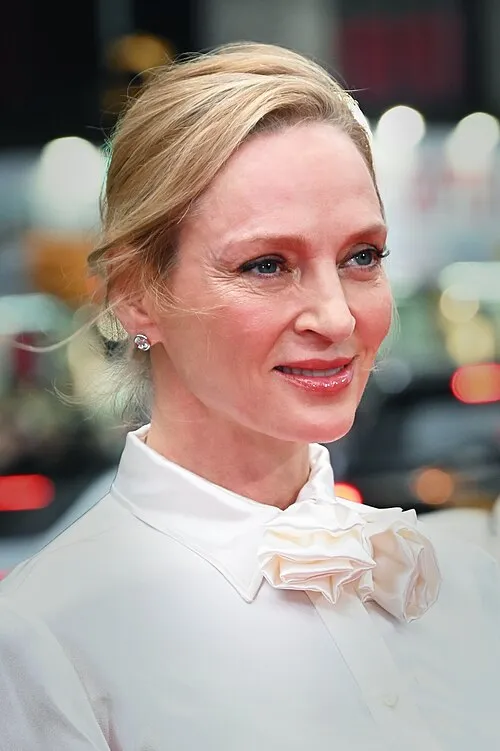
Uma Thurman - ESTJ Personality Type

Uma ThurmanESTJ - Menadżer

Actress

Pochodzenie

USA

Pewność typowania

popularnie typowane

Quick Facts

Born
April 29, 1970
Birthplace
Boston, Massachusetts, USA
Nationality
American
Height
5'11" (180 cm)
Zodiac Sign
Education
Northfield Mount Hermon School (attended; left for modeling)
Known For
Pulp Fiction (Mia Wallace)Kill Bill: Vol. 1 & 2 (The Bride)Batman & RobinDangerous LiaisonsHarvey Weinstein testimonyHenry, Anarchy & Me

Who is Uma Thurman?

Uma Karuna Thurman was born on April 29, 1970, in Boston, Massachusetts, the daughter of Robert Thurman, the first American to be ordained as a Tibetan Buddhist monk and later a Columbia University professor, and Nena von Schlebrügge, a Swedish model who had been married to Timothy Leary. She was raised in a Buddhist household in Woodstock, New York, and in Massachusetts, the middle of five children — an upbringing that was intellectually unusual and spiritually distinctive. She was visually striking from childhood and began modeling at 15, leaving school before graduation to work professionally — a decision that took her to New York and eventually to Los Angeles, where she made her film debut at 17 in Kiss Daddy Goodnight (1987). Her breakthrough came with Dangerous Liaisons (1988), directed by Stephen Frears, in which she played the innocent Cécile de Volanges manipulated by Glenn Close and John Malkovich's social predators.

Uma Thurman's collaboration with Quentin Tarantino produced the performances that define her career. In Pulp Fiction (1994), she played Mia Wallace — the mob boss's wife whose overdose scene is one of cinema's most viscerally effective sequences, and whose chemistry with John Travolta in the twist contest at Jack Rabbit Slim's created one of the decade's most iconic film moments. The role earned her an Academy Award nomination for Best Supporting Actress. Kill Bill: Volume 1 (2003) and Kill Bill: Volume 2 (2004) — in which she played The Bride, a former assassin seeking revenge against those who destroyed her life on her wedding day — were explicitly conceived by Tarantino as a vehicle for Thurman's particular combination of physical presence, emotional intelligence, and willingness to commit completely to demanding material. She trained extensively in martial arts for the role and performed many of her own stunts.

Uma Thurman's personal life has included two marriages — to Gary Oldman (1990-1992) and to actor-director Ethan Hawke (1998-2004), with whom she has two children, Maya and Levon — and a relationship with financier Arpad Busson with whom she has a third child. She came to public attention in 2018 as one of the women who publicly described experiences of sexual assault and misconduct by Harvey Weinstein, telling the New York Times about an assault at the Savoy Hotel in London and describing the way the power dynamics of the film industry had made it difficult to respond in the moment. Her account was notable for its combination of personal honesty, self-scrutiny (she acknowledged the complicated ways she had responded at the time), and the controlled fury of someone who had spent years deciding how to engage with the public record.

Thurman's career since Kill Bill has been more intermittent than her peak years, reflecting both the limited opportunities available to women of a certain age in Hollywood and her own selectivity about the work she pursues. She appeared in the television series Imposters (2017-2018), the Hulu series Chambers (2019), and in various films including Gattaca (1997), The Avengers (1998, a commercial catastrophe), Be Cool (2005), and My Super Ex-Girlfriend (2006). She has maintained a public presence that is more thoughtful and less celebrity-focused than many of her generation, and has written publicly about mental health and her relationship with her Buddhist upbringing. She is, by any measure, one of the more genuinely interesting film actors of her generation: possessed of a very large talent that has been deployed unevenly by a system that didn't always know what to do with someone who resisted easy categorization.
Typ osobowości ESTJ — Uma Thurman

Uma Thurman, znany(a) ze swojej pracy jako Actress, wykazuje klasyczne cechy typu osobowości ESTJ — Menadżer. Ten profil osobowości charakteryzuje się unikalną kombinacją funkcji poznawczych, które kształtują sposób, w jaki postrzega świat i podejmuje decyzje.

Kluczowe cechy ESTJ w Uma Thurman

Jako ESTJ, Uma Thurman demonstruje podstawowe cechy charakterystyczne dla tego typu osobowości. Te cechy odegrały znaczącą rolę w ich sukcesie i publicznym wizerunku jako Actress. Zrozumienie ich typu osobowości daje wgląd w ich motywacje, mocne strony i unikalną perspektywę, którą wnoszą do swojej dziedziny.

Dlaczego Uma Thurman jest typowany(a) jako ESTJ

Typ osobowości ESTJ to jeden z 16 typów osobowości Myers-Briggs, a publiczne zachowanie Uma Thurman, wzorce podejmowania decyzji i styl komunikacji ściśle odpowiadają tej klasyfikacji. Osoby ESTJ, takie jak Uma Thurman, są znane ze swojego charakterystycznego podejścia do rozwiązywania problemów i relacji interpersonalnych.

Uma Thurman's Filmography

1988
Dangerous Liaisonsas Cécile de Volangesfilm
1994
Pulp Fictionas Mia Wallacefilm
1997
Gattacaas Irene Cassinifilm
2003
Kill Bill: Volume 1as The Bride / Beatrix Kiddofilm
2004
Kill Bill: Volume 2as The Bride / Beatrix Kiddofilm
2017-18
Impostersas Maddie / The DoctorTV series

Awards & Recognition

\u2605Academy Award Nomination - Best Supporting Actress (Pulp Fiction) (1995)\u2605Golden Globe Nomination - Best Supporting Actress (Pulp Fiction) (1995)\u2605Saturn Award - Best Actress (Kill Bill: Volume 1) (2004)

Uma Thurman's Mystic Profile

Discover Uma Thurman's cosmic connections through zodiac, tarot, crystals, and spirit animals.

taurus

Zodiac Prediction

Uma Thurman's Taurus sun is the physical ground of her screen presence — the rootedness, the sensory fullness, the slow-burning intensity that makes her command the camera without effort. Taurus is the sign of reflected presence, of being fully, completely in the body and in the moment, and Thurman's performance quality is precisely this: the sense that she is completely present, not managing herself for the camera but actually being there. Her Taurus energy also explains her selectivity — the willingness to wait for material that is genuinely worthy rather than taking anything available — and the bull's refusal to move when it has decided not to. Kill Bill asked her to be bull-present for four hours of film, and she was.

🃏

strength

Tarot Card Match

The Strength card — the archetype of power exercised through inner authority rather than external force, of the capacity to face what is difficult without flinching — is Thurman's card. The Strength figure in tarot gently holds open the mouth of a lion: not by overpowering the animal but by being something that the lion recognizes as beyond force. Thurman's best performances have this quality: she does not confront her characters' violence or suffering with technique; she is present to it, completely, and the completeness of her presence is what makes the viewer also present to it. Her Harvey Weinstein testimony — the controlled fury, the self-scrutiny, the refusal to simplify what was actually complex — was Strength, not as absence of emotion but as emotion precisely governed by inner authority.

💎

rose quartz

Crystal Match

Rose quartz — the stone of unconditional love, emotional courage, and the willingness to remain open to the full experience of being human — is Thurman's crystal. Rose quartz is associated with those who feel deeply and who, despite the vulnerability that this creates, choose to remain open rather than protected. Thurman's performances are rose quartz performances: the fullness of emotional presence, the willingness to be seen in states of vulnerability or desire or grief that other actors might manage more carefully. The stone's gentle pink — softer than the harsh red of pure passion — connects with Thurman's particular screen quality: the softness that coexists with genuine power, the warmth that coexists with the capability for violence (The Bride in Kill Bill is both).

🦁

crane

Spirit Animal

The crane — the bird of grace, longevity, and the slow, deliberate movement that covers enormous distance with apparent ease — is Uma Thurman's spirit animal. Cranes are among the most physically striking of birds: their height, their slow, deliberate movement, the precision of their steps. Thurman's physical presence — 5'11", with the particular quality of stillness that makes her visible even when she is not doing anything — has the crane's quality: the kind of beauty that commands attention not through display but through the completeness of its presence. The crane is also associated with patience and selectivity — waiting for the right moment, the right fish, the right material — which reflects Thurman's career approach.

Więcej znanych osobowości ESTJ

O tej analizie

Ta analiza typu osobowości Uma Thurman opiera się na publicznie dostępnych informacjach, wywiadach, relacjach biograficznych i obserwacjach behawioralnych. Typowanie ESTJ reprezentuje wykształconą ocenę entuzjastów i ekspertów typologii osobowości, ale nie powinno być uważane za oficjalnie potwierdzone, chyba że stwierdzono inaczej. Osobowość jest złożona i wielowymiarowa, a publiczny wizerunek może różnić się od prywatnej osobowości.