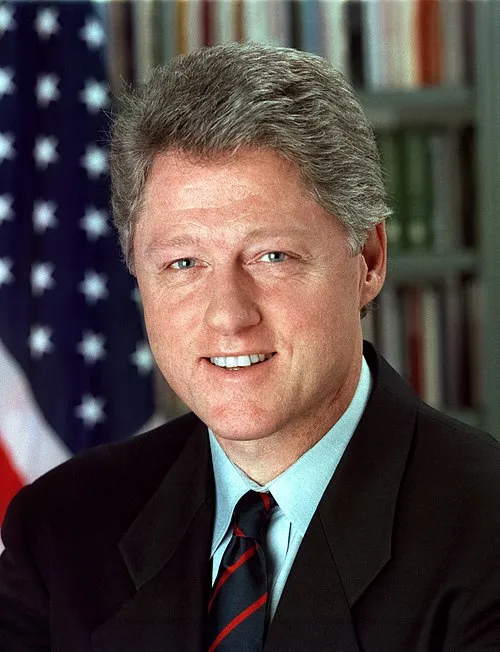
William Jefferson Blythe III was born on August 19, 1946, in Hope, Arkansas, three months after his father was killed in a car accident. He was raised initially by his maternal grandparents — who gave him an early education that included reading — and his mother, Virginia Dell Cassidy, who remarried Roger Clinton Sr., a car dealer, when Bill was four. Bill eventually took his stepfather's surname. He grew up in Hot Springs, Arkansas, where his stepfather's alcoholism and domestic abuse toward his mother required him to develop the conflict management and emotional intelligence that would define his political style. He met President John F. Kennedy in 1963 as part of the Boys Nation program's trip to Washington — a photograph of the handshake has become iconic — and identified politics as his vocation from that moment. He attended Georgetown University, was selected as a Rhodes Scholar to Oxford (where he avoided the Vietnam draft, a fact that would haunt his political career), and attended Yale Law School, where he met Hillary Rodham.
Bill Clinton's political career moved quickly: elected Arkansas Attorney General in 1976, Governor of Arkansas in 1978 (the youngest governor in the country at 32), defeated in 1980, and re-elected in 1982. His 1992 presidential campaign, which positioned him as a 'New Democrat' who could triangulate between liberal and conservative positions, overcame a primary scandal about his relationship with Gennifer Flowers and the draft controversy to defeat incumbent President George H.W. Bush in November. His victory — running against both Bush and independent Ross Perot, who received 19% of the popular vote — was a genuine political accomplishment that demonstrated the exceptional political skill he would deploy throughout his presidency.
Clinton's presidency (1993-2001) produced the longest economic expansion in American history: 115 consecutive months of GDP growth, the federal budget moving from deficit to surplus ($237 billion surplus in FY2000), the lowest unemployment rates since the 1960s, and welfare reform that produced significant declines in welfare rolls. NAFTA (the North American Free Trade Agreement), signed in 1993, remains controversial: praised by economists as expanding trade and criticized by labor advocates as contributing to manufacturing job losses. His foreign policy included interventions in Somalia (the Black Hawk Down incident), Haiti, Bosnia, and Kosovo. His presidency was fatally damaged by his affair with White House intern Monica Lewinsky and subsequent perjury — he was impeached by the House of Representatives in December 1998 on charges of perjury and obstruction of justice and acquitted by the Senate in February 1999.
Bill Clinton's post-presidential career has been defined by the Clinton Foundation and its global health, economic development, and climate initiatives, through which he has mobilized significant private sector resources for global challenges. His 2004 memoir My Life was a bestseller. He has remained a significant figure in Democratic Party politics — delivering keynote addresses at Democratic conventions and actively campaigning for Hillary Clinton's 2016 presidential run — and has continued to generate media attention through both his philanthropic work and his association with various controversies, including his relationship with Jeffrey Epstein (who flew him on Epstein's private plane, though Clinton has denied visiting Epstein's island). He had quadruple bypass surgery in 2004 and subsequent health issues. He remains one of the most politically gifted individuals in modern American political history — his ability to connect with people across demographic lines, to explain complex policy in accessible terms, and to make any room he enters feel smaller and warmer is genuinely extraordinary.