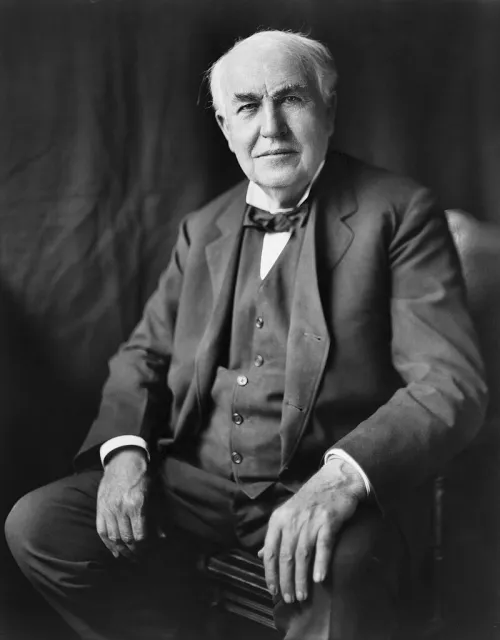
Thomas Edison - ENTP Personality Type

Thomas EdisonENTP - Dyskutant

Inventor

Pochodzenie

USA

Pewność typowania

powszechnie akceptowane

Quick Facts

Born
February 11, 1847
Birthplace
Milan, Ohio, USA
Nationality
American
Height
5'10" (177 cm)
Zodiac Sign
Education
Three months of formal schooling; self-educated
Known For
Light BulbPhonographMotion Picture CameraMenlo Park Laboratory1,093 US Patents

Who is Thomas Edison?

Thomas Alva Edison was born on February 11, 1847, in Milan, Ohio, the seventh and youngest child of Samuel and Nancy Edison. His formal education lasted a grand total of three months — his teacher declared him 'addled' and his mother, a former schoolteacher, pulled him from school and educated him herself. A childhood bout of scarlet fever, combined with recurrent ear infections, left him strongly hearing-impaired by adolescence. Rather than limiting him, his hearing loss contributed to an extraordinary capacity for sustained concentration, filtering out the social ambient noise that distracts most people from deep work. At twelve, he was selling newspapers and candy on the Grand Trunk Railroad, conducting chemistry experiments in a baggage car laboratory until a fire ended that arrangement. At fifteen, he rescued a three-year-old from the path of a freight car, and the grateful father — a station agent — taught him telegraphy in return.

As a telegraph operator through the 1860s, Edison worked the night shift by preference because it left his days free for reading and experimentation, and he turned the job itself into a series of inventive problems. He invented an automatic repeater that sent messages between stations without human assistance, and a device that simultaneously transmitted multiple messages over a single wire. When he arrived in New York City in 1869, broke and sleeping on the floor of a battery room at Western Union, he repaired a broken stock ticker at a critical moment and was hired immediately. His early commercial success selling improved telegraph technology gave him the capital for his first real laboratory.

In 1876, Edison built the world's first industrial research laboratory in Menlo Park, New Jersey — a deliberate factory for invention, staffed by skilled machinists, chemists, and experimenters working systematically toward commercial applications. It was here that he produced the phonograph (1877), the first device to record and reproduce sound, which astounded the scientific world. The incandescent light bulb (1879), developed after thousands of iterations testing different filament materials, was less an individual invention than the culmination of a managed research program. He then built the first commercial electrical power distribution system in lower Manhattan (1882), installing everything from generators to cables to meters — arguably the most consequential infrastructure project in American history. His Kinetoscope (1891) and subsequent work established the technical foundation of motion pictures.

Edison's ENTP fingerprint is visible throughout his career: an insatiable curiosity that leaped between domains, a gift for seeing what a technology could become rather than what it was, and a relentless willingness to challenge received wisdom through direct experimentation rather than theoretical argument. He was also the ENTP in his contradictions — the 'Wizard of Menlo Park' who could be extraordinarily inspiring and extraordinarily ruthless, who championed direct current with bitter stubbornness against Nikola Tesla's more mathematically elegant alternating current (a battle he lost), who could simultaneously credit his teams and appropriate their contributions. He held 1,093 US patents when he died in 1931, a record that stood for sixty years, and his laboratory model — systematic, commercial, collaborative — defined how innovation would be organized for the next century.
Typ osobowości ENTP — Thomas Edison

Thomas Edison, znany(a) ze swojej pracy jako Inventor, wykazuje klasyczne cechy typu osobowości ENTP — Dyskutant. Ten profil osobowości charakteryzuje się unikalną kombinacją funkcji poznawczych, które kształtują sposób, w jaki postrzega świat i podejmuje decyzje.

Kluczowe cechy ENTP w Thomas Edison

Jako ENTP, Thomas Edison demonstruje podstawowe cechy charakterystyczne dla tego typu osobowości. Te cechy odegrały znaczącą rolę w ich sukcesie i publicznym wizerunku jako Inventor. Zrozumienie ich typu osobowości daje wgląd w ich motywacje, mocne strony i unikalną perspektywę, którą wnoszą do swojej dziedziny.

Dlaczego Thomas Edison jest typowany(a) jako ENTP

Typ osobowości ENTP to jeden z 16 typów osobowości Myers-Briggs, a publiczne zachowanie Thomas Edison, wzorce podejmowania decyzji i styl komunikacji ściśle odpowiadają tej klasyfikacji. Osoby ENTP, takie jak Thomas Edison, są znane ze swojego charakterystycznego podejścia do rozwiązywania problemów i relacji interpersonalnych.

Thomas Edison's Career Highlights

1877

Invented the Phonograph

First device to record and reproduce sound

1879

Practical Incandescent Light Bulb

After 6,000+ filament experiments

1882

First Electrical Power Grid

Pearl Street Station, lower Manhattan — powered 85 buildings

1891

Kinetoscope

Foundation of motion picture technology

1914

Electrical storage battery

Over decade of work; 1,093 total US patents

Awards & Recognition

\u2605Congressional Gold Medal (1928)\u2605National Inventors Hall of Fame (1973)\u2605Presidential Medal of Freedom (posthumous) (1983)

Thomas Edison's Mystic Profile

Discover Thomas Edison's cosmic connections through zodiac, tarot, crystals, and spirit animals.

aquarius

Zodiac Prediction

As an Aquarius, Thomas Edison carried the sign's most fundamental quality in pure form: an absolute conviction that the future could be engineered into existence through systematic human effort. Aquarius is the sign of the inventor, the humanitarian technologist, the person who is perpetually living ten years ahead of their time. Edison's laboratories were Aquarian institutions — collective endeavors oriented toward transforming human life through applied intelligence. His hearing loss was itself Aquarian: paradoxically it cut him off from the ordinary social world and directed his attention entirely inward, toward ideas and experiments and the hum of machinery.

🃏

the magician

Tarot Card Match

The Magician has mastered all four elements — wand, cup, sword, pentacle — and can combine them to manifest anything he can envision. Edison was the Magician of American industry: a person who could marshal chemistry, mechanics, electricity, and commerce simultaneously, channeling each through his extraordinary will and organizational intelligence toward whatever outcome he had declared possible.

💎

amber

Crystal Match

Amber — fossilized tree resin, ancient, warm, containing the past within it — is the stone of patience in long-term projects and of preserving knowledge for the future. Edison's most celebrated quality was precisely his patience with failure: ten thousand failed experiments on the light bulb filament were not failures in his view but ten thousand successful demonstrations of what didn't work. Amber is also associated with electricity — the word itself comes from the Greek 'elektron,' referring to amber's static charge.

🦁

fox

Spirit Animal

The fox is the supreme problem-solver of the animal kingdom — adaptive, clever, persistent, and capable of approaching the same obstacle from multiple angles until one of them yields. Edison's method was essentially fox method: not the elegance of the wolf's direct attack or the eagle's aerial overview, but the fox's patient, experimental, endlessly creative approach to any barrier that stood between him and his objective. The fox also operates at night, which Edison preferred.

Więcej znanych osobowości ENTP

O tej analizie

Ta analiza typu osobowości Thomas Edison opiera się na publicznie dostępnych informacjach, wywiadach, relacjach biograficznych i obserwacjach behawioralnych. Typowanie ENTP reprezentuje wykształconą ocenę entuzjastów i ekspertów typologii osobowości, ale nie powinno być uważane za oficjalnie potwierdzone, chyba że stwierdzono inaczej. Osobowość jest złożona i wielowymiarowa, a publiczny wizerunek może różnić się od prywatnej osobowości.