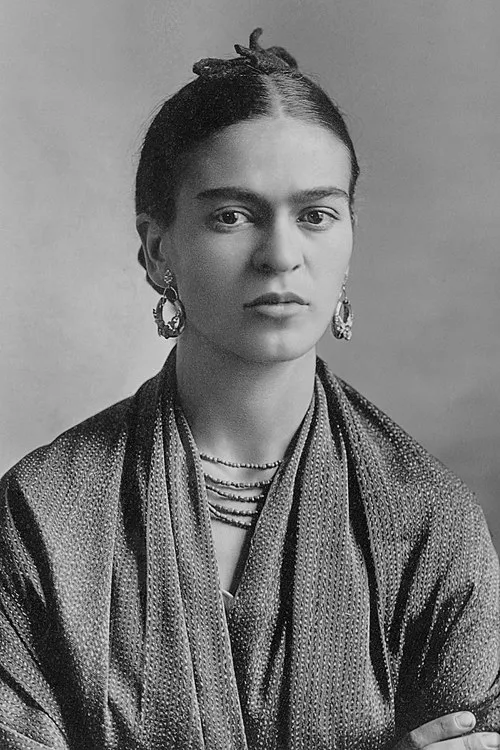
Magdalena Carmen Frida Kahlo Calderón was born on July 6, 1907 — though she later claimed 1910, the year of the Mexican Revolution, as if her birth should coincide with national transformation — in Coyoacán, a suburb of Mexico City. At age six she contracted polio, leaving her right leg thinner than her left and beginning a lifetime relationship with physical pain and medical intervention. At eighteen, she was involved in a catastrophic bus accident that fractured her spinal column, collarbone, ribs, and pelvis; shattered her right leg; and drove a metal handrail through her hip and out through her vagina. She spent three months in a full body cast, and it was during this recovery that she began to paint, working on a specially constructed easel that allowed her to work while lying down.
Frida Kahlo met Diego Rivera, the famous Mexican muralist, at the National Preparatory School when she was fifteen and he was painting a mural there. They met again in 1928, and their subsequent marriage — passionate, tumultuous, mutually unfaithful, briefly dissolved and then resumed — became both the central relationship of her life and a dominant subject of her art. Rivera, thirty years her senior and already famous, initially overshadowed her career; it was her independent engagement with the Surrealists in Paris in 1939, and André Breton's enthusiastic reception of her work, that established her as a significant artist in her own right. She always rejected the Surrealist label, claiming her paintings depicted her own reality rather than her unconscious.
Kahlo's approximately 150 paintings — of which about fifty are self-portraits — constitute one of the most personal and visually distinctive bodies of work in 20th-century art. She painted her pain literally: The Broken Column shows her corseted body split open to reveal a crumbling ionic column in place of her spine; The Two Fridas shows her doubled, one version connected to her ex-husband Diego by an artery he has severed; My Birth shows her own birth in close biological detail. The imagery drew on Mexican folk art traditions, pre-Columbian iconography, and European painting, creating a visual language that was simultaneously highly personal and rooted in specific cultural traditions.
Frida Kahlo died on July 13, 1954, at age forty-seven, of what was officially recorded as pulmonary embolism, though Rivera and others believed it was intentional overdose. Her last diary entry read: 'I hope the exit is joyful — and I hope never to return.' The posthumous construction of Kahlo as a feminist and political icon has in some ways obscured the specificity of her actual work and person: she was deeply particular, deeply political in ways that cannot be reduced to contemporary categories, and deeply committed to her own vision of Mexico's indigenous heritage. Her house, La Casa Azul in Coyoacán, is now a museum and receives over 25,000 visitors monthly.