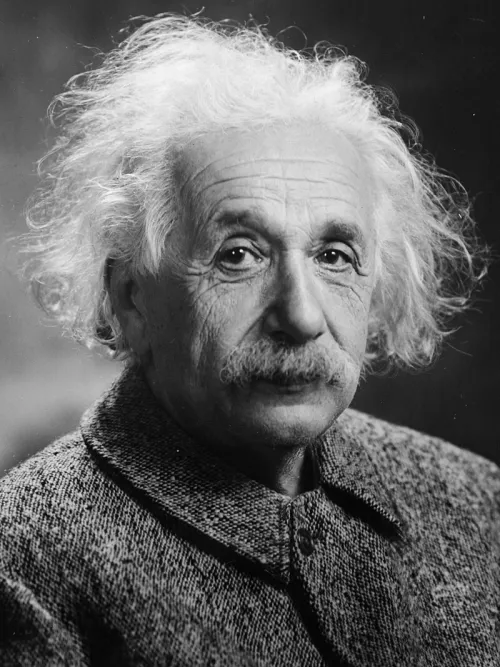
Albert Einstein was born on March 14, 1879, in Ulm, in the Kingdom of Württemberg in the German Empire. From an early age, he displayed an unusual intellectual curiosity — yet formal education bored him strongly. He struggled with rote memorization and authority-driven classrooms, preferring to imagine scenarios like riding alongside a beam of light. Despite popular myth, he was not a poor student in mathematics, but he deeply resented the mechanical, authoritarian structure of 19th-century German schooling. At fifteen, he renounced his German citizenship and eventually enrolled at the Swiss Federal Polytechnic in Zurich.
After failing his first entrance exam at the Polytechnic and spending a year at a preparatory school, Einstein graduated in 1900 with a teaching diploma in physics and mathematics. Unable to find a teaching post, he took a job as a patent examiner at the Swiss Patent Office in Bern. This position, though seemingly mundane, provided him with exactly what an INTP thrives on: structured solitude, intellectual problems to dissect at his own pace, and afternoons free for pure theoretical thinking. It was during these years that he published his four legendary papers of 1905 — the 'Annus Mirabilis' — including the Special Theory of Relativity and the photoelectric effect that would win him the Nobel Prize.
Einstein's General Theory of Relativity, published in 1915, fundamentally rewrote humanity's understanding of gravity, space, and time. Its dramatic confirmation during the 1919 solar eclipse made him an overnight global celebrity — a role he found both gratifying and deeply uncomfortable. He fled Nazi Germany in 1933, settling permanently at Princeton's Institute for Advanced Study, where he spent his final decades pursuing a unified field theory that would reconcile general relativity with quantum mechanics — a quest that eluded him but consumed his imagination until his death in 1955.
Einstein's mind was quintessentially INTP: he thought in images and frameworks rather than equations, worked in genuine isolation, and cared nothing for social convention or institutional prestige. His famous thought experiments — imagining riding a light beam, being inside a falling elevator — reveal the INTP's dominant Introverted Thinking driving the exploration of pure abstract systems. His personal life was complex and sometimes contradictory, marked by failed marriages, political activism, and a philosophical pacifism that coexisted uneasily with his role in bringing atomic weapons into the world.