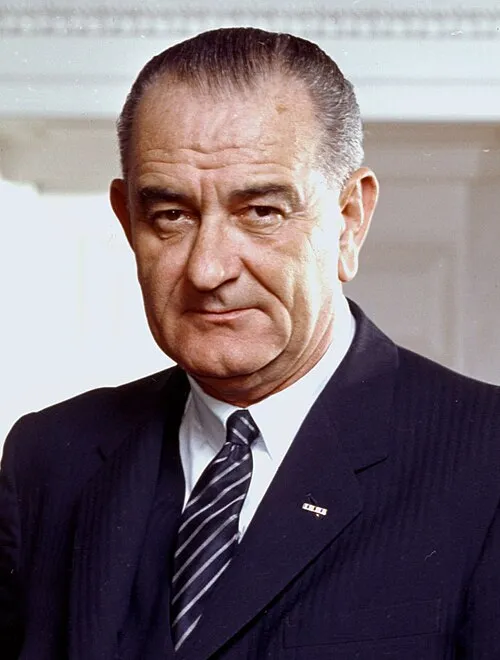
Lyndon Baines Johnson was born on August 27, 1908, in the Hill Country of central Texas near Stonewall, the eldest of five children of Sam Ealy Johnson Jr., a farmer and Texas state legislator, and Rebekah Baines Johnson, a schoolteacher. He grew up in modest circumstances in Johnson City, Texas — a town his grandfather helped found — witnessing his father's financial decline and political career at close range. After graduating from Southwest Texas State Teachers College in 1930, he taught public school briefly in Houston before finding his true calling in politics, working as a congressional aide in Washington and winning election to the US House of Representatives from Texas's 10th district in a 1937 special election. He served in the House through 1948, developing relationships and political skills that he would deploy with extraordinary force throughout the rest of his career.
LBJ's rise through the Senate was the most striking demonstration of political skill in twentieth-century American legislative history. Elected to the Senate in 1948 in a contested election (known as 'Landslide Lyndon' for his 87-vote margin), he became Senate Majority Whip in 1951, Senate Minority Leader in 1953, and Senate Majority Leader in 1955 — acquiring more power more quickly than any senator in history. His technique — the 'Johnson Treatment,' described by contemporaries as a combination of physical intimidation (he was 6'3" and used his height deliberately), information use (he collected every piece of information about every senator's needs, fears, and ambitions), and relentless personal persuasion — was legendary. He passed the first civil rights legislation since Reconstruction through the Senate in 1957 through a combination of tactical brilliance and personal pressure.
As President — he assumed office following John F. Kennedy's assassination in November 1963 and won re-election in 1964 in a landslide of 61% of the popular vote against Barry Goldwater — LBJ pursued and achieved the most ambitious domestic legislative agenda since FDR's New Deal. The Civil Rights Act of 1964, signed July 2, prohibited discrimination based on race, color, religion, sex, or national origin; the Voting Rights Act of 1965, signed August 6, prohibited discriminatory voting practices; the Social Security Act of 1965 created Medicare and Medicaid; the Elementary and Secondary Education Act provided federal aid to public education; the Higher Education Act, the Housing and Urban Development Act, the Immigration and Nationality Act — the Great Society program was the most complete expansion of federal social provision in American history, and its central achievements remain in place today.
Vietnam destroyed the Johnson presidency and ultimately Johnson himself. He inherited a limited US military commitment in Southeast Asia from Kennedy and escalated it — through the manufactured Gulf of Tonkin incident in 1964 — to a full-scale war that eventually involved 550,000 American troops and produced 58,000 American deaths, alongside hundreds of thousands of Vietnamese casualties. As the war grew increasingly unpopular and seemingly unwinnable, the credibility gap between the administration's optimistic public statements and the evident reality in the field became the defining political crisis of the decade. Johnson announced in March 1968 that he would not seek re-election. He retired to his Texas ranch and died of a heart attack on January 22, 1973 — the day after the Vietnam ceasefire agreement was announced, as if he had held on for that particular piece of closure. He remains among the most consequential and most paradoxical figures in American political history: the champion of civil rights who devastated Southeast Asia.