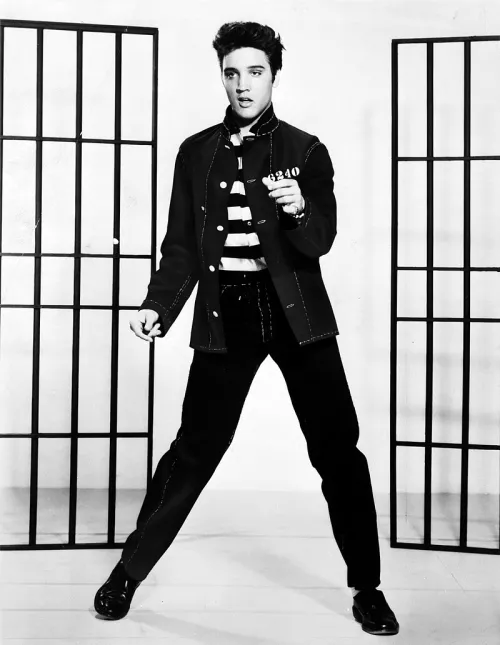
Elvis Aaron Presley was born on January 8, 1935, in Tupelo, Mississippi, the surviving twin (his brother Jesse Garon was stillborn), to Vernon Elvis Presley, a sharecropper and factory worker who was jailed for check forgery when Elvis was three, and Gladys Love Smith Presley, to whom Elvis remained deeply, almost obsessively devoted throughout his life. The family was poor, deeply religious (Assembly of God), and devoted to music — Elvis grew up hearing the gospel music of his church, the rhythm and blues from Black churches and radio stations, and the country music of the Mississippi Delta. This convergence of traditions — which American segregation had previously kept carefully separated — was what Elvis would synthesize.
The Presley family relocated to Memphis in 1948 when Elvis was thirteen, and his high school years in Memphis exposed him to the city's extraordinary musical culture: Beale Street, the radio stations that played everything, Sun Records on Union Avenue. He graduated from L.C. Humes High School in 1953, worked briefly as a truck driver, and recorded his first commercial sides at Sun Records in 1954 under producer Sam Phillips, who had famously said he could make a million dollars if he could find a white man who sang with the Black sound. Elvis was that white man — though the formulation is crude and the actual achievement more complex.
The 1954-1956 period was one of the most explosive creative bursts in popular music history. 'That's All Right,' 'Mystery Train,' 'Good Rockin' Tonight,' and then after his move to RCA, 'Heartbreak Hotel,' 'Hound Dog,' 'Jailhouse Rock' — each record redefined what was possible in American popular music, and the television performances (particularly on The Ed Sullivan Show) created a cultural eruption that older generations experienced as threatening and younger generations experienced as liberation. His hip movements, borrowed from Black gospel performers he had observed, were both physically exciting and racially transgressive in ways that 1950s America found electrifying.
Elvis Presley's later career — the Hollywood films, the Army service (1958-1960), the Las Vegas residencies, the increasingly isolated last years — has been read as the story of a talent imprisoned by management and commercial machinery. His 1968 television special, known as the '68 Comeback Special, demonstrated that the original talent was entirely intact. His death on August 16, 1977, at age forty-two, from cardiac arrhythmia related to polypharmacy and years of physical deterioration, was experienced by a generation as the end of an era. Graceland, his Memphis estate, receives over half a million visitors annually and remains one of the most visited private homes in the United States.