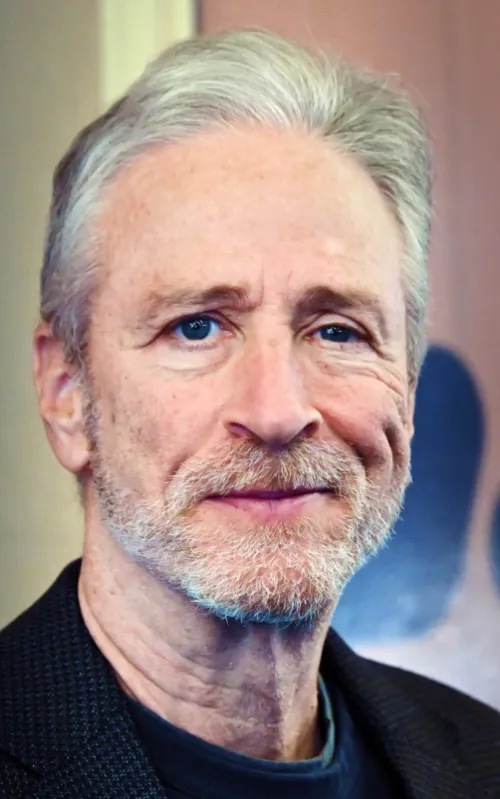
Jonathan Stuart Leibowitz was born on November 28, 1962, in New York City and raised in Lawrenceville, New Jersey. His parents divorced when he was eleven — an event he has cited repeatedly as formative — and he grew up primarily with his mother, Marian. He attended the College of William & Mary in Virginia, where he played soccer and majored in psychology, graduating in 1984. The psychology training proved directly useful: his comedy has always been more diagnostic than performative, oriented toward understanding why people believe and do what they do rather than simply mocking the results. After college he worked as a contingency planner for the New Jersey Department of Human Services, a bartender, a puppeteer for a New Jersey State Department of Education project for children with disabilities, and a contract workers' coordinator before finding his way into stand-up comedy in the late 1980s.
His early stand-up career in New York, followed by talk show appearances and a short-lived MTV show (The Jon Stewart Show, 1993–1995), established his fundamental comic persona: the exasperated intelligent person watching the American political and media establishment perform its rituals with a combination of self-serving dishonesty and breathtaking incompetence, and finding the gap between performance and reality not merely entertaining but politically significant. When he took over The Daily Show from Craig Kilborn in January 1999, the show was a mildly successful cable comedy. Within three years, it had become the most important political satire vehicle in American media.
Stewart's sixteen-year tenure as The Daily Show host (1999–2015) coincided with the post-9/11 intensification of American political polarization and the simultaneous erosion of trust in mainstream media institutions. His show became the venue where the contradiction between those institutions' claims to objectivity and their actual performance of those claims was examined most systematically and most entertainingly. His 2004 appearance on CNN's Crossfire — in which he confronted hosts Tucker Carlson and Paul Begala live on air and accused them of 'hurting America' by reducing political discourse to theatrical conflict — was the most dramatic single example of a comedy host publicly holding a media institution to an accountability standard it had not anticipated from the context. CNN canceled Crossfire four months later.
Stewart's ENTP quality is most visible in his greatest professional strength: the ability to hold a complex argument in his head and deliver it through comedy that is also a genuine intellectual proposition, not merely an entertaining analogy. His show worked not because it was funny (though it was) but because it was analytically rigorous — the jokes were always the surface expression of a specific argument about how political and media institutions actually functioned versus how they claimed to function. His post-Daily Show work — the film Irresistible (2020) and his advocacy for the 9/11 Victim Compensation Fund, which involved years of congressional testimony — revealed the ENTP's characteristic trajectory: from satirical observer to direct participant, from mocking the system to attempting to operate within it.