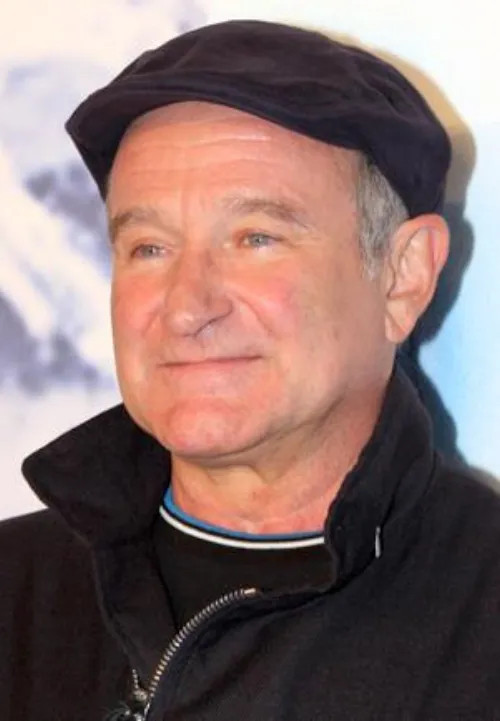
Robin McLaurin Williams was born on July 21, 1951, in Chicago, Illinois, to Robert Fitzgerald Williams, a senior Ford Motor Company executive, and Laurie McLaurin. An only child for most of his childhood, he grew up in wealthy suburbs of Detroit and later San Francisco — comfortable materially but isolated socially, entertaining himself through a rich inner fantasy life and voices. His extraordinary mimicry and ability to inhabit other characters was in place from early childhood, a coping mechanism for loneliness that became the foundation of a career. He attended the College of Marin, where a drama teacher encouraged him to study acting seriously. He was accepted to Juilliard on a full scholarship — in the same entering class as Christopher Reeve — and studied there for two years before Juilliard's legendary director John Houseman told him he had nothing more to teach him.
Williams moved to San Francisco and began performing stand-up comedy in the late 1970s, developing the improvisational, stream-of-consciousness style that would define his performing life — a torrent of voices, characters, cultural references, and emotional shifts so rapid that audiences could barely keep up. His performance as Mork in a single episode of Happy Days generated enough response that he was given his own series, Mork & Mindy (1978-1982), which made him a national star. The television exposure and his subsequent stand-up tours established him as the most kinetic, surprising, and exhaustingly creative comedian working. His first major film role in Popeye was a mismatch, but Good Morning, Vietnam (1987) — where his improvisational gifts were given free rein within a serious dramatic context — demonstrated that the comedy and the humanity were inseparable.
The range of Williams' film career was extraordinary: the anarchic comedian of Aladdin and Mrs. Doubtfire, the inspirational teacher of Dead Poets Society, the tender therapist of Good Will Hunting (Academy Award for Best Supporting Actor), the darkly comic genius of The Fisher King and One Hour Photo. In each case he brought something that could not be scripted — the sense that you were watching genuine creative energy rather than prepared performance. He was simultaneously the highest-paid comedian in Hollywood and one of its most serious actors. His generosity was legendary: he routinely improvised additional material for co-stars, gave away salary to support crew members in need, and visited Walter Reed Army Medical Center to entertain wounded soldiers for years.
Williams' ENFP nature was the engine of everything — the creativity, the empathy, the inability to sustain boredom, the simultaneous joy and darkness. ENFPs experience the world with unusual intensity on both ends: their capacity for joy is matched by their vulnerability to depression, and Williams' decades-long struggle with substance abuse and depression was the shadow of the same sensitivity that made him the most emotionally generous performer of his generation. He died by suicide on August 11, 2014, at 63 — later discovered to have been suffering from Lewy body dementia. His death prompted the largest public conversation about celebrity mental health in a generation, and his legacy includes both the extraordinary breadth of work he created and the permission he gave millions to take mental health seriously.