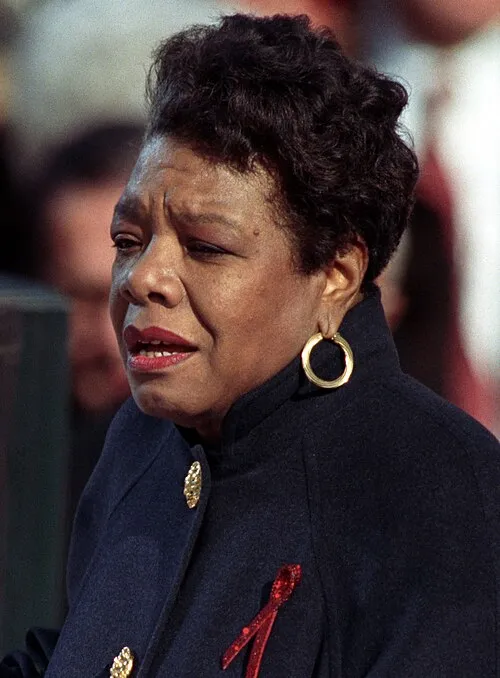
Maya Angelou, born Marguerite Annie Johnson on April 4, 1928, in St. Louis, Missouri, lived one of the most remarkable lives in American literary history — a life that moved from extraordinary trauma to extraordinary triumph with a resilience that can only be understood as a fundamental commitment to surviving in order to speak. When she was eight years old, her mother's boyfriend raped her. When she told her family who had done it, the man was killed — likely by her uncles. Believing her words had caused the murder, Angelou stopped speaking. She was mute for five years, communicating only through notes and gestures. This silence was not defeat but protection; and during those years she read voraciously — memorizing entire works of Dickens, Shakespeare, Poe — developing the extraordinary ear for language that would define her life's work.
Angelou's life before becoming a celebrated author was almost impossibly varied. She was San Francisco's first Black streetcar conductor. She was a professional dancer and calypso singer who performed in clubs. She was a madam. She was a nightclub performer who toured Europe with Porgy and Bess. She was an editor at an English-language newspaper in Egypt. She was a television writer in Ghana. She was a coordinator for the Southern Christian Leadership Conference at Martin Luther King Jr.'s request. Each of these lives provided both material for her later writing and evidence of her ENFJ genius for connection — the ability to enter any environment, understand its people, and find her place within it while always remaining essentially herself.
In 1969, at 41, Angelou published I Know Why the Caged Bird Sings, the first in what would become a seven-volume autobiography — the first autobiography by an African American woman to become a mainstream bestseller. The book's frank treatment of childhood sexual trauma, racism, and survival was controversial and meaningful in equal measure. It remained on the New York Times bestseller list for two years and has never gone out of print. At Bill Clinton's inauguration in 1993, she read her poem 'On the Pulse of Morning,' making her only the second poet to read at a presidential inauguration and introducing her voice to a global audience of millions. She received the Presidential Medal of Freedom in 2011 from Barack Obama.
Angelou's ENFJ nature was expressed through her extraordinary gift for making others feel seen, heard, and more capable than they believed themselves to be. As a professor at Wake Forest University for three decades, she never met with students in her office — she always met them in the university's common spaces, refusing the hierarchy of institutional distance. Her famous dictum — 'People will forget what you said, people will forget what you did, but people will never forget how you made them feel' — is the ENFJ's credo expressed as wisdom. She understood that her gift was not merely literary but relational: the capacity to use language to create the experience of being genuinely known, a gift she deployed through her writing, her teaching, and her presence in equal measure.