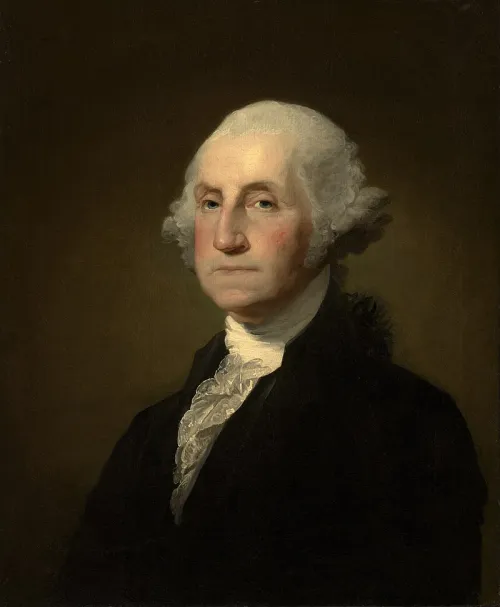
George Washington - ISTJ Personality Type

George WashingtonISTJ - 管理者

1st US President

出身

USA

タイピングの信頼性

広く認められた

Quick Facts

Born
February 22, 1732
Birthplace
Westmoreland County, Virginia, British America
Nationality
American
Height
6'2" (188 cm)
Zodiac Sign
Education
Self-educated; surveying apprenticeship
Known For
1st U.S. PresidentCommander of Continental ArmyConstitutional Convention presidentFarewell Address

Who is George Washington?

George Washington was born on February 22, 1732, in Westmoreland County, Virginia, in the British American colonies, to Augustine Washington, a planter, and Mary Ball Washington. His father died when he was eleven, leaving the family in moderate rather than wealthy circumstances. He was largely self-educated, developing proficiency in mathematics and surveying — practical skills that served him in the frontier work that began his public career. His older half-brother Lawrence's connections opened doors; Washington began surveying Virginia's western territory at sixteen and was appointed Adjutant General of Virginia at twenty-one. His early military experience in the French and Indian War — including the disastrous defeat at Fort Necessity and the harrowing retreat with Braddock — provided formative lessons in military logistics, command, and the importance of discipline under fire.

Washington's military reputation was built on endurance, judgment, and the ability to maintain cohesion in catastrophic circumstances more than on brilliant tactical victories. His marriage to the wealthy widow Martha Custis in 1759 established him as one of Virginia's leading planters and a member of the colonial elite. He served in the Virginia House of Burgesses and grew increasingly convinced that British colonial policy was fundamentally unjust. When the Continental Congress appointed him Commander-in-Chief of the Continental Army in 1775, he was the natural choice not because he had won great battles but because he represented the qualities the crisis demanded: steadiness, personal integrity, organizational capability, and the willingness to serve without personal aggrandizement.

Washington's military command of the Revolutionary War is best understood as a sustained exercise in strategic patience. He lost more battles than he won — Long Island, Kip's Bay, Fort Washington, Brandywine, Germantown. But he understood that the goal was not to defeat the British Army in open battle but to keep his army in the field long enough for British political will to erode and for French support to arrive. Valley Forge — the brutal winter of 1777-1778, which he shared with his troops — became the defining symbol of his leadership: the general who endured what his men endured, who held the enterprise together through sheer force of personal commitment when rational calculation suggested surrender.

Washington's ISTJ nature is the key to his historical significance. The ISTJ's defining qualities — absolute fidelity to duty over personal preference, the patient application of proven methods, the refusal to seek personal glory at the expense of institutional integrity — made him the ideal founder for a new republic. His voluntary relinquishment of military command in 1783, and then of the presidency after two terms in 1797, were ISTJ acts of supreme consequence: demonstrations that the new republic's institutions were larger than any individual, that power could be exercised and then returned. These decisions, more than any battle, made him the essential founder.
George WashingtonのISTJ性格タイプ

George Washingtonは1st US Presidentとしての活動で知られており、ISTJ性格タイプ(管理者)の典型的な特性を示しています。この性格プロファイルは、世界の認識と意思決定のプロセスを形成するユニークな認知機能の組み合わせによって特徴づけられています。

George Washingtonにおける主要なISTJの特性

ISTJとして、George Washingtonはこの性格タイプに関連するコアな特性を示しています。これらの特性は、1st US Presidentとしての成功と公的なペルソナに重要な役割を果たしてきました。彼らの性格タイプを理解することで、その動機、強み、そして専門分野にもたらすユニークな視点についての洞察が得られます。

George WashingtonがISTJと判定される理由

ISTJ性格タイプはMyers-Briggsの16性格タイプの一つで、George Washingtonの公的な行動、意思決定パターン、コミュニケーションスタイルはこの分類に密接に一致しています。George WashingtonのようなISTJの人々は、問題解決と対人関係への独特なアプローチで知られています。

George Washington's Political Career

1753

Military Career Begins

Appointed Adjutant General of Virginia; begins frontier military service

1775

Commander-in-Chief

Appointed by Continental Congress to lead Continental Army against British

1781

Yorktown

Decisive victory with French allies ends major British military operations

1789

First U.S. President

Unanimously elected first President of the United States

1797

Voluntary Retirement

Declines third term; sets precedent for peaceful transfer of power

George Washington's Mystic Profile

Discover George Washington's cosmic connections through zodiac, tarot, crystals, and spirit animals.

pisces

Zodiac Prediction

Pisces is the sign of the sacrificial servant — the one who dissolves their personal desires in service of something larger, who acts from a sense of duty to the collective rather than personal ambition. Washington's Pisces energy is most visible in his remarkable two-act abdication: surrendering military command in 1783 and then surrendering the presidency in 1797. Each of these acts cost him personally and benefited everyone else — the ISTJ/Pisces combination at its most historically consequential. Pisces also rules the dissolving of the boundary between self and legacy, and Washington has been so thoroughly absorbed into American national mythology that the actual man is difficult to see clearly — the Pisces dissolution of individual into symbol.

🃏

the emperor

Tarot Card Match

The Emperor is the card of sovereign authority exercised in service of order and stability — power that is not self-serving but structural, designed to create the conditions under which others can flourish. Washington captured this archetype with unusual completeness: the general who could have been king and chose not to be, the president who established the precedents that would govern successors for centuries. The Emperor's gift is exactly what Washington gave: the demonstration that power can be exercised responsibly and then returned, that the institution is greater than any individual.

💎

granite

Crystal Match

Granite — not a flashy crystal but the most reliable of stones, the foundation material of civilizations, formed under enormous pressure over vast time into something of extraordinary permanence and structural integrity — rings true with Washington's essential nature. Granite does not shimmer or shift; it endures. Washington's steadiness through the catastrophes of the Revolutionary War — the retreats, the losses, the frozen winters — is granite energy: the refusal to break under pressures that broke everything around him.

🦁

bald-eagle

Spirit Animal

The bald eagle — America's own national symbol, chosen for its combination of power and nobility, its ability to see great distances with extraordinary clarity, its solitary sovereignty — is Washington's spirit animal in the most historically appropriate sense. The eagle sees from heights where the details resolve into patterns, where the strategic landscape becomes visible; Washington's greatest gift was exactly this high-altitude strategic vision: the ability to see that the goal was to outlast British political will, not to defeat British military force. The eagle does not panic; it soars, it observes, and then it acts with complete commitment.

もっと多くの著名なISTJの人物

この分析について

George Washingtonのこの性格タイプ分析は、公開情報、インタビュー、伝記、および行動観察に基づいています。ISTJのタイピングは、性格タイプ愛好家と専門家による推測的評価であり、特段の記述がない限り公式に確認されたものではありません。性格は複雑で多面的であり、公的なペルソナは私的な性格と異なる場合があります。