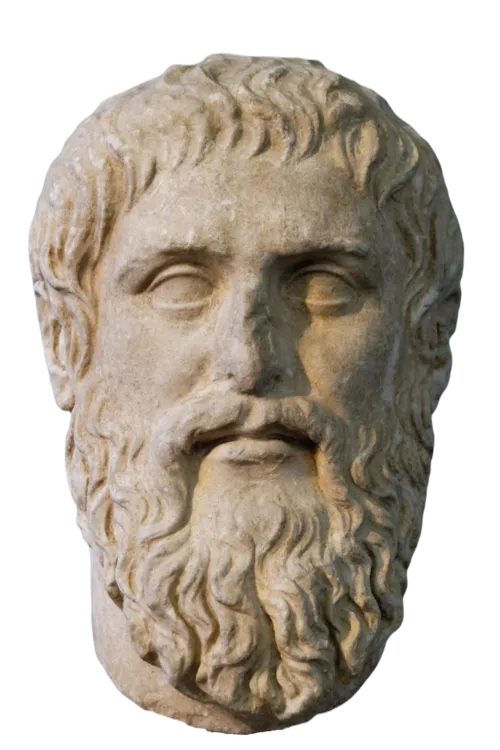
Plato was born in approximately 428 BCE in Athens, into an aristocratic family with deep roots in Athenian political life. His father Ariston was said to descend from the early kings of Athens; his mother Perictione was related to Solon, the famous Athenian lawgiver and poet. His birth name was Aristocles; the name 'Plato' — meaning 'broad-shouldered' in Greek — was allegedly given by his wrestling teacher, a detail that suggests he was not only the greatest philosopher in Western history but also physically imposing enough to require a nickname derived from his body. As a young man of aristocratic background in Athens, he received an education in gymnastics, music, and rhetoric appropriate to his class. The decisive encounter of his life came when he met Socrates, probably when he was around twenty years old.
The relationship with Socrates transformed Plato's intellectual life and defined the trajectory of his philosophical work. He followed Socrates for nearly a decade, witnessing his method of philosophical interrogation — the famous Socratic dialectic, in which understanding is pursued not through lecturing but through systematic questioning that reveals the contradictions in one's existing beliefs — and experiencing firsthand its effects on its practitioners and on the city. The execution of Socrates by Athens in 399 BCE, on charges of impiety and corrupting the youth, was the catastrophic event around which Plato's entire subsequent philosophical project organized itself. The trial and death of his teacher made Plato a deeply political philosopher: the question of justice — what it is, whether it is achievable, and what kind of political arrangement is most likely to produce it — became the organizing question of his mature thought.
In approximately 387 BCE, Plato founded the Academy in Athens — the first institution in the Western world devoted to philosophical inquiry and scientific investigation, and the model for every university that has followed. He ran the Academy for the remaining four decades of his life, wrote thirty-six dialogues and thirteen letters (though the authenticity of some is disputed), and produced what is arguably the single most detailed and consequential body of philosophical work in the Western tradition. The Republic — his extended meditation on justice, the ideal state, the nature of the soul, the theory of knowledge, and the relationship between philosophy and political power — contains the Allegory of the Cave, the Divided Line, the theory of the Form of the Good, and the argument for philosopher-kings, all ideas that have structured Western philosophical debate for twenty-four centuries.
Plato's INFJ quality is visible throughout his method and his conclusions: the conviction that the most important things cannot be directly seen but must be approached through systematic disciplined inquiry; the belief that the inner world of the mind is more real than the outer world of appearances; the sense of urgent responsibility toward those who have not yet emerged from their intellectual cave; and the willingness to take the most uncomfortable political positions — including the argument that democracy, as Athens practiced it, was not capable of producing justice — in service of the longest possible view of what human excellence might require. He died in approximately 348 BCE, at the age of approximately eighty, reputedly while attending a wedding feast.