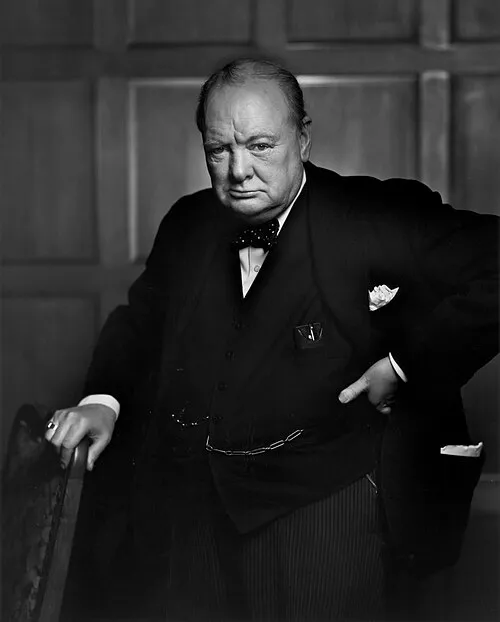
Winston Churchill - ESTP Personality Type

Winston ChurchillESTP - 起業家

Former UK Prime Minister

出身

UK

タイピングの信頼性

一般的なタイピング

Quick Facts

Born
November 30, 1874
Birthplace
Blenheim Palace, Oxfordshire, UK
Nationality
British
Height
5'6" (168 cm)
Zodiac Sign
Education
Harrow School; Royal Military College, Sandhurst
Known For
WWII leadershipNever surrender speechesNobel Prize LiteratureIron Curtain speech

Who is Winston Churchill?

Winston Leonard Spencer Churchill was born on November 30, 1874, at Blenheim Palace in Oxfordshire — the ancestral home of the Dukes of Marlborough — the son of Lord Randolph Churchill, a prominent Conservative politician, and Jennie Jerome, an American socialite. His childhood was marked by relative parental neglect — his parents were consumed by London society, and Winston was raised primarily by his nanny Elizabeth Everest, to whom he remained devoted — and by a learning style that his schoolmasters found difficult. He was a poor student at Eton's rival Harrow School before finding his element at the Royal Military College, Sandhurst.

Churchill's early career was shaped by the Victorian soldier-journalist archetype: he combined military service with dispatches to newspapers, creating a public profile from his military adventures in Cuba, India, Sudan, and South Africa that would have been impossible for an officer without his journalistic facility. His escape from Boer captivity in 1899 made him briefly famous throughout the British Empire. He entered Parliament in 1900 and began what would prove to be one of the most turbulent and consequential political careers in British history: multiple party switches, a disastrous responsibility for the Gallipoli campaign in World War I, years in the political wilderness during the 1930s when his warnings about Hitler's intentions were dismissed as alarmism.

Churchill's appointment as Prime Minister on May 10, 1940 — the same day Germany invaded France and the Low Countries — placed him at the center of what would be either the last act of British civilization or its finest hour. The speeches he delivered in the summer of 1940 — 'We shall fight on the beaches,' 'Their finest hour,' 'Never in the field of human conflict was so much owed by so many to so few' — were not merely rhetoric but acts of political will, redefining what was possible by refusing to accept the definition that circumstances seemed to be imposing. His partnership with Roosevelt and his management of the relationship with Stalin in the Grand Alliance that defeated Nazi Germany were exercises in diplomatic skill as remarkable as his oratory.

Churchill was voted out of office in 1945, in the general election called immediately after Germany's surrender — a shock to himself and to international observers that the British public chose this moment to remove their war leader. He returned as Prime Minister from 1951 to 1955, during which time he gave his Iron Curtain speech (actually 1946) and continued to influence the shape of postwar Europe. He was awarded the Nobel Prize in Literature in 1953, for his historical writings as much as his oratory. He died on January 24, 1965, at age ninety, and was given a state funeral attended by representatives of 112 countries.
Winston ChurchillのESTP性格タイプ

Winston ChurchillはFormer UK Prime Ministerとしての活動で知られており、ESTP性格タイプ(起業家)の典型的な特性を示しています。この性格プロファイルは、世界の認識と意思決定のプロセスを形成するユニークな認知機能の組み合わせによって特徴づけられています。

Winston Churchillにおける主要なESTPの特性

ESTPとして、Winston Churchillはこの性格タイプに関連するコアな特性を示しています。これらの特性は、Former UK Prime Ministerとしての成功と公的なペルソナに重要な役割を果たしてきました。彼らの性格タイプを理解することで、その動機、強み、そして専門分野にもたらすユニークな視点についての洞察が得られます。

Winston ChurchillがESTPと判定される理由

ESTP性格タイプはMyers-Briggsの16性格タイプの一つで、Winston Churchillの公的な行動、意思決定パターン、コミュニケーションスタイルはこの分類に密接に一致しています。Winston ChurchillのようなESTPの人々は、問題解決と対人関係への独特なアプローチで知られています。

Winston Churchill's Political Career

1940

Appointed Prime Minister

Led Britain through its darkest hour

1940

Battle of Britain speeches

Oratory that changed the course of the war

1946

Iron Curtain speech

Named and defined the Cold War era

1951

Second term as Prime Minister

Led postwar Britain

1953

Nobel Prize in Literature

Recognized for historical and memoir writing

Awards & Recognition

\u2605Nobel Prize in Literature (1953)\u2605Knight of the Garter (1953)\u2605Honorary United States Citizenship (1963)\u2605Order of the Garter (1953)

Winston Churchill's Mystic Profile

Discover Winston Churchill's cosmic connections through zodiac, tarot, crystals, and spirit animals.

sagittarius

Zodiac Prediction

Winston Churchill's Sagittarius sun is the philosophical fire that turned historical crisis into opportunity for the kind of expansive, visionary leadership that only certain moments in history require. Sagittarius rules the philosopher-adventurer, the one who can hold the largest possible view when others are blinded by immediate circumstance, the archer who aims at the distant target while others are preoccupied with obstacles at their feet. Churchill's Sagittarian quality was his ability to frame the war in civilizational terms — not merely as a military conflict but as a struggle between ways of life — and to communicate that framing with such force and clarity that it became the operative reality for millions of people who needed a story they could fight for.

🃏

the emperor

Tarot Card Match

The Emperor — the tarot archetype of the sovereign will, of the authority that imposes order on chaos through the force of character and the clarity of purpose — is Churchill's card in its most historically consequential expression. The Emperor's domain is not merely physical territory but the domain of meaning: he defines what things signify, what the stakes are, what the story is. Churchill's wartime speeches were Emperor acts: the redefinition of the situation's meaning, the imposition of a narrative (we are the island fortress; we will never surrender; this is our finest hour) on a situation that could equally have been narrated as defeat. The Emperor creates the reality in which his rule is possible — and Churchill created, through language, the reality in which British resistance was possible.

💎

gold

Crystal Match

Gold — the metal of sovereignty, of the enduring value that does not tarnish, of the material that has represented authority and excellence across every human civilization — is Churchill's element. Gold is associated with solar energy, with the Leo-adjacent quality of natural authority, and with the willingness to be seen fully and to bear the weight of that visibility. Churchill's authority was gold authority: not the silver of diplomacy and accommodation, but the gold of absolute commitment to what he believed was true and right, regardless of the political cost. Gold also represents the long view — it maintains its value across centuries — and Churchill's reputation has proven similarly durable.

🦁

bulldog

Spirit Animal

The bulldog — the British national dog, the animal of determined grip once applied, of the face that seems designed to express defiant determination, and of the legendary quality of refusing to release what it has once taken hold of — is Churchill's spirit animal, and the association is so obvious that it has become cliché without becoming untrue. Churchill recognized the connection himself, reportedly owning bulldogs and noting the resemblance with characteristically self-aware humor. The bulldog's most essential quality is not aggression but persistence: it does not attack readily, but once it has committed, it does not release. Churchill's commitment to British resistance, once made in those key weeks of 1940, was precisely this quality: the grip that would not be broken.

もっと多くの著名なESTPの人物

この分析について

Winston Churchillのこの性格タイプ分析は、公開情報、インタビュー、伝記、および行動観察に基づいています。ESTPのタイピングは、性格タイプ愛好家と専門家による推測的評価であり、特段の記述がない限り公式に確認されたものではありません。性格は複雑で多面的であり、公的なペルソナは私的な性格と異なる場合があります。