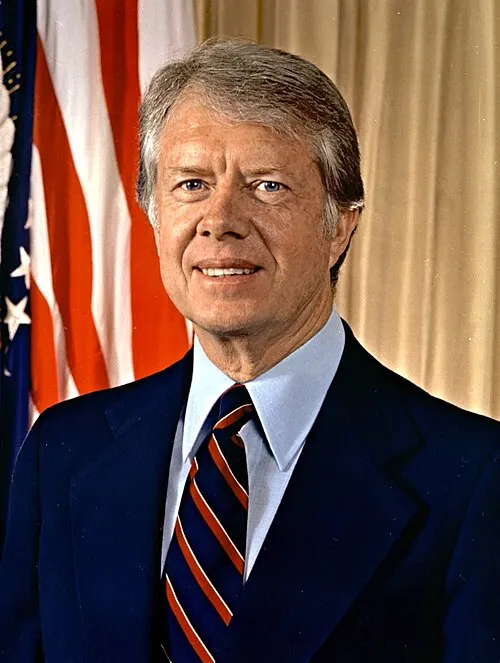
James Earl Carter Jr. was born on October 1, 1924, in Plains, Georgia — the first US president born in a hospital. His father, James Earl Carter Sr., was a peanut farmer and local businessman; his mother, Lillian Gordy Carter, was a registered nurse who, at age 68, joined the Peace Corps and served in India. Plains, Georgia, in the 1930s, was deeply segregated, and Carter grew up in a community of predominantly Black sharecroppers; his playmates were Black, his early childhood companions and influences were Black, and he later cited these formative relationships as foundational to the racial equity commitments that would shape his political career. He attended Georgia Southwestern College and the Georgia Institute of Technology before receiving an appointment to the United States Naval Academy, from which he graduated in 1946, serving as a junior officer in the Navy and eventually under Admiral Hyman Rickover, the father of the nuclear submarine program.
Carter left the Navy in 1953, after his father's death, to return to Plains and save the family peanut farm from financial difficulty. He built it into a successful agribusiness while becoming involved in local politics and civil rights — he was one of the few white members of the Plains school board to oppose segregation. Elected to the Georgia State Senate in 1962 and as Governor of Georgia in 1970, he governed in ways that surprised those who had expected a conventional Southern Democrat, ending official racial discrimination in state government and hanging a portrait of Martin Luther King Jr. in the State Capitol — an act of genuine courage in Georgia at that time. He declared his presidential candidacy in 1975, running as a Washington outsider against the post-Watergate tide of distrust in established political figures, and defeated incumbent Gerald Ford in November 1976.
Carter's presidency (1977-1981) was marked by genuine diplomatic achievements and severe political difficulties. The Camp David Accords of 1978 — in which Carter personally mediated 13 days of intensive negotiations between Israeli Prime Minister Menachem Begin and Egyptian President Anwar Sadat — produced the first peace treaty between Israel and an Arab nation, an achievement of historic significance for which Begin and Sadat shared the Nobel Peace Prize. He established the Department of Energy and the Department of Education, completed the Panama Canal Treaties returning control of the canal to Panama, and advanced significant environmental legislation. The Iranian hostage crisis — 444 days during which 52 American diplomats were held captive in Tehran following the Iranian Revolution — and severe economic difficulties (high inflation, oil shortages) defined public perception of his presidency and contributed to his decisive defeat by Ronald Reagan in 1980.
Jimmy Carter's post-presidential career has been widely regarded as the most significant and admirable in American history. Working through the Carter Center, founded in 1982, he monitored more than 100 elections across the globe, contributed to the eradication of Guinea worm disease (from 3.5 million cases to fewer than 15 annually), and engaged in diplomatic interventions in North Korea, Haiti, and Sudan. He taught Sunday school at Maranatha Baptist Church in Plains for decades, welcoming hundreds of visitors each week to a simple wooden pew. He and Rosalynn Carter worked with Habitat for Humanity for decades, building houses alongside volunteers. He received the Nobel Peace Prize in 2002, with the Nobel Committee explicitly referencing his post-presidential humanitarian work. He died on December 29, 2024, at the age of 100 — the longest-lived president in American history — leaving a legacy that may be more remarkable for what he did after leaving office than for what he accomplished within it.