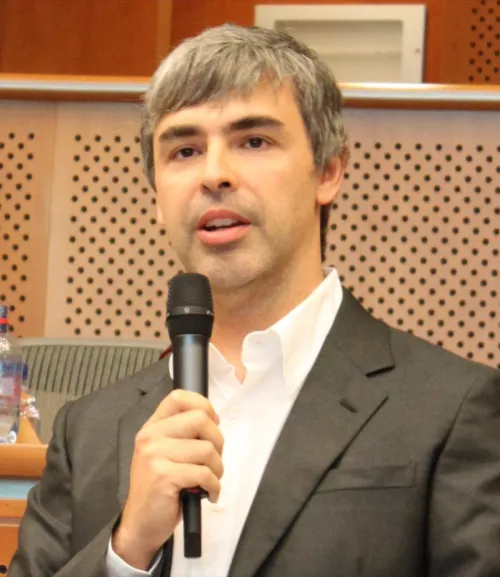
Lawrence Edward Page was born on March 26, 1973, in East Lansing, Michigan, into an academic household — his father Carl Page was a computer science and artificial intelligence professor, and his mother Gloria taught computer programming. Growing up surrounded by computers and scientific thinking, Page absorbed the idea that systems can be understood, modeled, and improved through rigorous analysis. He has often cited the influence of his father's academic rigor and his early access to computing at a time when most children his age had never touched a keyboard. At the University of Michigan, he graduated with honors in computer engineering and arrived at Stanford for a PhD program that would never be completed for the best possible reason.
At Stanford, Page was introduced to fellow grad student Sergey Brin, and together they developed the PageRank algorithm — a system for ranking web pages based on the number and quality of links pointing to them, mimicking academic citation practices. The insight was powerful in its elegant simplicity: the value of a page could be determined not by its content alone but by who chose to link to it. BackRub, as the search engine was initially called, was renamed Google (a play on 'googol' — the number 10 to the power of 100, reflecting the vast scale of the web's information) and incorporated in 1998 from a garage in Menlo Park.
Google's growth under Page and Brin was one of the defining technological stories of the early twenty-first century. Page served as CEO until 2001, when he ceded operational control to Eric Schmidt while remaining the visionary force behind the company's technical direction. He returned as CEO in 2011, embarking on a series of ambitious 'moonshot' projects — Google Glass, self-driving cars, fiber internet, longevity research — that reflected his foundational belief that companies should pursue meaningful impact rather than incremental improvement. In 2015, he restructured Google as a subsidiary of Alphabet Inc., creating a holding company structure that could house multiple independent ventures.
Page shows the INTP's characteristic orientation toward systems: not products or experiences, but the underlying logical structures that govern how things work. His famous impatience with incrementalism — captured in his 'ten times better' philosophy, the belief that a 10% improvement is harder than a 10x improvement because it requires competing within existing paradigms — reflects the INTP's instinct that most constraints are mental rather than physical. He is notoriously private, giving very few public speeches, and has largely withdrawn from public life since 2019, a thoroughly INTP response to a world that kept demanding performance from a man who finds performance uninteresting.