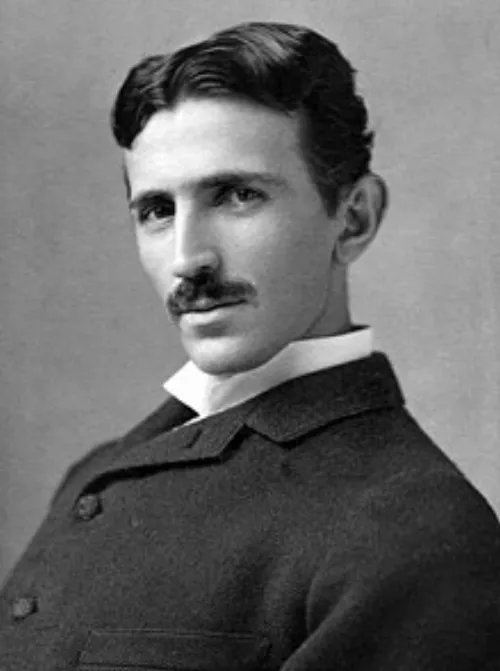
Nikola Tesla was born during a lightning storm on the stroke of midnight between July 9 and 10, 1856, in the village of Smiljan in the Austrian Empire (present-day Croatia). According to family legend, the midwife declared the lightning a bad omen, saying the child would be a 'child of darkness,' to which his mother replied, 'No. He will be a child of light.' His father, Milutin, was a Serbian Orthodox priest and writer; his mother, Đuka, was an inventor of household tools and possessed an extraordinary memory — traits Tesla would inherit in extraordinary measure.
Tesla studied engineering at Graz University of Technology and physics at the University of Prague, though he never formally graduated from either. Working at the Budapest Telephone Exchange in 1882, he had his legendary epiphany while walking through a park: the complete design for an alternating current motor flashed into his mind fully formed, and he drew the diagrams in the dirt with a stick. He emigrated to the United States in 1884 with little more than a letter of recommendation to Thomas Edison. His brief employment with Edison ended bitterly when Edison allegedly reneged on a promised $50,000 bonus, igniting one of history's greatest technological rivalries.
Tesla's alternating current system ultimately triumphed over Edison's direct current in the 'War of Currents,' powering the 1893 World's Columbian Exposition and the first hydroelectric power plant at Niagara Falls. His inventions and patents numbered over 300 and included the Tesla coil, radio technology (for which he held the original patent, not Marconi), fluorescent lighting, and early X-ray imaging. He conducted legendary demonstrations of wireless electricity at his Colorado Springs laboratory, where he generated artificial lightning bolts over 100 feet long. His Wardenclyffe Tower project aimed to transmit free wireless energy globally — a vision that was simply too far ahead of its time.
Tesla was the INTJ inventor archetype in its purest form. He could visualize complete machines in his mind with such precision that he claimed to test-run them mentally before building physical prototypes. His obsessive daily routines — walking exactly the same number of blocks, requiring hotel rooms divisible by three, dining at the same restaurant at the same time — reflect the INTJ's need for systematic control over their environment. His inability to commercialize his inventions, his discomfort with business relationships, and his preference for solitary work in his laboratory over social engagements all point to a mind completely consumed by its internal vision, with little energy left for the external world's demands.