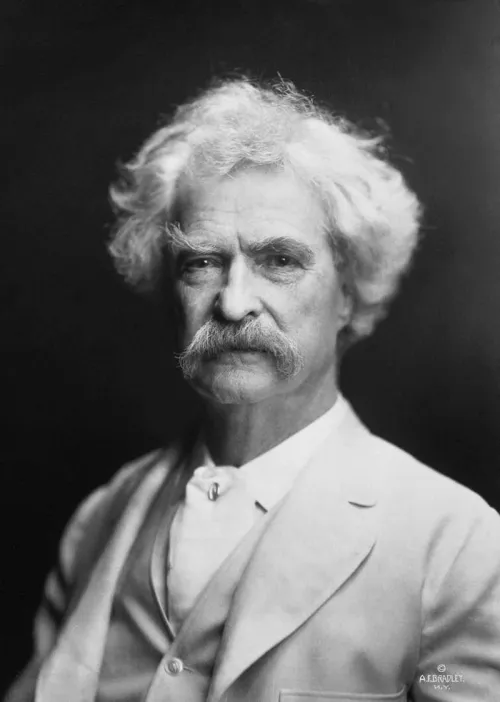
Samuel Langhorne Clemens was born on November 30, 1835, in Florida, Missouri, the sixth of seven children of John Marshall Clemens, a Virginia-born lawyer and judge, and Jane Lampton, a Kentucky native. The family moved to Hannibal, Missouri, a small town on the Mississippi River, when he was four — and it was the river, with its steamboats and its complex social world of commerce, slavery, adventure, and violence, that would be the primary imaginative source for his greatest work. His father died when he was eleven, and he was apprenticed to a printer almost immediately. By fifteen he was working for his brother Orion's newspaper, contributing humorous sketches under pseudonyms, and by eighteen he had left Hannibal permanently, working as an itinerant printer in St. Louis, New York, Philadelphia, and Cincinnati.
The years between 1857 and 1861, when Clemens worked as a licensed steamboat pilot on the Mississippi, represented his most formative adult education. The river required an absolute command of an extraordinarily complex and constantly changing system of information — depths, currents, snags, weather patterns, the mood and behavior of different kinds of human beings in stressful situations — and gave him a professional confidence and an acute observational ability that translated directly into his literary voice. The pen name Mark Twain, which he adopted for good in 1863, came from the river: 'mark twain' was the leadsman's call indicating two fathoms of depth, safe water for a steamboat. He began his literary career in Nevada after the Civil War, writing for newspapers with a combination of comic exaggeration, precise social observation, and a particular gift for rendering spoken American English that no previous American writer had achieved.
The Adventures of Tom Sawyer (1876) and Adventures of Huckleberry Finn (1884) established Twain as the defining voice of American fiction in the nineteenth century. Huckleberry Finn — in which a white boy and an escaped Black man float down the Mississippi River together, navigating the moral universe of the antebellum South — is the novel that Ernest Hemingway claimed all modern American literature descended from. Its achievement is technical as much as moral: Twain gave Huck a voice so precisely calibrated to the rhythms and moral contradictions of uneducated white Southern speech that the character could hold simultaneously the genuine warmth of his friendship with Jim and the inherited racial assumptions of his culture, creating a portrait of American moral consciousness that remains disturbing precisely because Huck is a good person. A Connecticut Yankee in King Arthur's Court (1889) and The Adventures of Tom Sawyer (1876) added social satire and time-travel to his range.
Twain's ENTP quality manifested most directly in his public persona as the great American satirist: the person whose role in the culture was to say what everyone was thinking and no one could quite get away with saying, dressed in enough humor to pass the censor of social convention. His lectures — enormously popular across three continents — were essentially extended improvisational performances of wit and observation, where the audience never knew quite where he was going until he arrived. His famous aphorisms — 'The reports of my death are greatly exaggerated,' 'It's easier to fool people than to convince them they have been fooled,' 'A person who won't read has no advantage over one who can't read' — are ENTP formulations: paradoxes designed to produce sudden clarity by reversing the expected relationship between their elements. He died on April 21, 1910, having correctly predicted that he would arrive and depart with Halley's Comet.