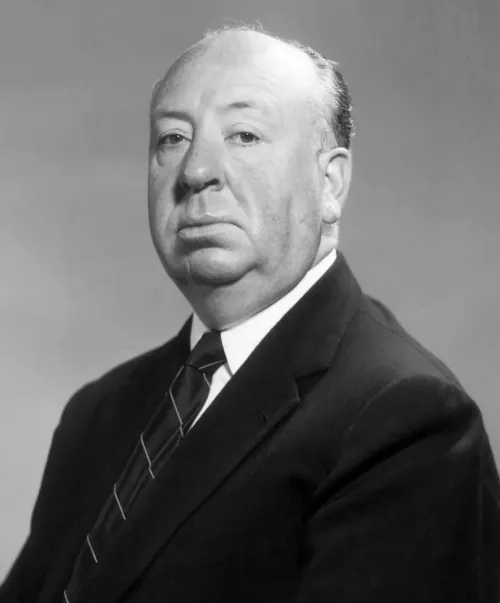
Alfred Joseph Hitchcock was born on August 13, 1899, in Leytonstone, in the East End of London, the youngest of three children of a greengrocer and poulterer. His childhood was marked by strict Catholic schooling and, he later claimed, an episode at age five when his father sent him to the local police station with a note instructing the officer to lock him in a cell for five minutes as a lesson in the consequences of misbehavior. Whether literally true or retrospectively mythologized, the story captures something essential about Hitchcock's adult preoccupations: the arbitrary exercise of institutional authority, the guilt of innocence, the horror of confinement. He was fat, friendless, and deeply introverted as a child, and these qualities — never entirely overcome — became the engine of one of cinema's most meticulously constructed bodies of work.
Hitchcock entered the film industry in 1919 as a title-card designer for a silent film company, working his way through increasingly senior roles in art direction, screenwriting, and editing before directing his first film at twenty-five. The Lodger: A Story of the London Fog (1927) — a proto-thriller about a Jack the Ripper-type suspect — established his fundamental thematic territory immediately: the wrong man, the suspicious appearance of guilt, the mechanisms of surveillance and suspicion. His British films of the 1930s established his international reputation; his move to Hollywood under David O. Selznick in 1939 gave him resources that transformed his technical capabilities. Rebecca (1940) won the Academy Award for Best Picture.
Strangers on a Train (1951), Rear Window (1954), Vertigo (1958), North by Northwest (1959), Psycho (1960), and The Birds (1963) represent a body of work that permanently changed what cinema could do with fear, desire, and audience psychology. Hitchcock understood before any theorist articulated it that the film audience and the film's voyeuristic protagonist were in the same position: watching, powerless to intervene, complicit in what they observed. He used this awareness as a structural principle. Psycho violated every genre convention about where major stars appear in a film's structure, essentially destroying the audience's ability to rely on conventional narrative signals. Rear Window made its audience genuine voyeurs and then implicated them in the moral consequences of what they'd seen.
Hitchcock is the ENTP as total intellectual architect of audience experience: a director who approached filmmaking as an exercise in applied psychology, systematically studying which images, sounds, narrative structures, and editing rhythms produced which specific audience responses, and deploying this knowledge with remarkable precision. He was famously dismissive of actors — not from contempt but from a full theory of cinema in which the actor's expressive instrument was one tool among many, less important than camera angle, cutting rhythm, or Bernard Herrmann's score. He gave four television documentaries about his methods, wrote essays, and gave interviews of remarkable candor about the mechanisms of his craft — the ENTP's characteristic desire to explain not just the work but the system of thought behind it.