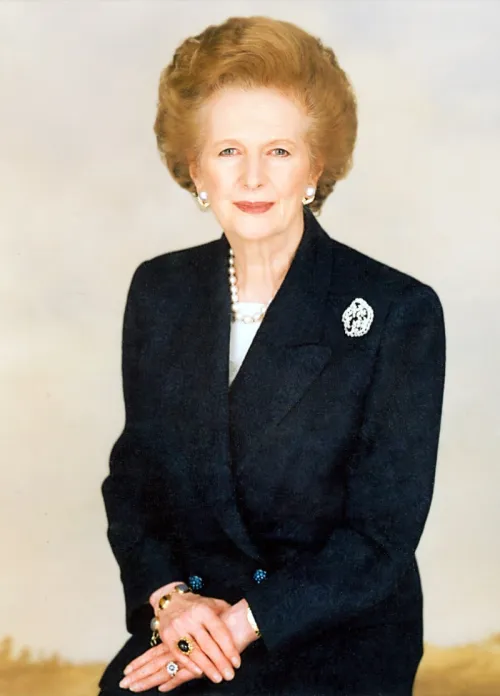
Margaret Hilda Roberts was born on October 13, 1925, in Grantham, Lincolnshire, above her father's grocery shop. Her father, Alderman Alfred Roberts, was the dominant influence of her life: a devout Methodist lay preacher, local politician, and self-made businessman who instilled in his daughter a fierce conviction that individual responsibility was a moral category, not merely an economic one. She won a scholarship to Somerville College, Oxford, to study chemistry — the only woman in her year — and became president of the Conservative Association, demonstrating from the outset that scientific training and political ambition were equally fundamental parts of her identity. She qualified as a barrister at Lincoln's Inn and married Denis Thatcher, a wealthy businessman whose financial security freed her from the constraint of needing political office to survive — a freedom that made her extraordinarily difficult to intimidate.
In 1979, after years of patient parliamentary work and an audacious bid for the Conservative Party leadership that most insiders had dismissed as reckless, Margaret Thatcher became Britain's first female Prime Minister. She inherited a country battered by stagflation, union militancy, and the accumulated contradictions of post-war consensus politics. Her response was not incremental adjustment but structural transformation: she set interest rates high enough to strangle inflation regardless of the unemployment consequences, announced the privatization of nationalized industries from British Telecom to British Gas, and used the 1982 Falklands War — a conflict many in her Cabinet wanted to settle diplomatically — to rediscover the military force of national purpose. The victory transformed her political authority into something close to personal dominance.
Thatcher's most significant domestic confrontation was the 1984-85 miners' strike, a year-long battle with Arthur Scargill's National Union of Mineworkers that she had prepared for meticulously, stockpiling coal and reorganizing the police response over three years before deliberately provoking the confrontation. Her victory broke not only the miners' union but the broader principle of trade union veto power over government economic policy — a structural shift in British labor relations from which the unions have never fully recovered. Simultaneously, her deregulation of the London financial markets (the 'Big Bang' of 1986) transformed the City into a global financial center and attracted the foreign capital that sustained her economic model even as it entrenched the regional inequalities that would define Britain's political geography for a generation.
Thatcher's foreign policy achievements were substantial and lasting: her personal alliance with Ronald Reagan gave Anglo-American conservatism its philosophical coherence; her relationship with Mikhail Gorbachev — she declared him 'a man I can do business with' before anyone in the West took him seriously — helped accelerate the Cold War's end. She was ousted by her own Cabinet in November 1990, when poll tax unpopularity and European policy divisions made her a liability. She wept in the car leaving Downing Street for the last time — one of the only public displays of genuine emotion from a leader whose ENTJ qualities included the near-total subordination of personal sentiment to strategic calculation. She died from a stroke on April 8, 2013, the most controversial British leader since Churchill and the one whose impact on her country's social fabric is most hotly disputed to this day.