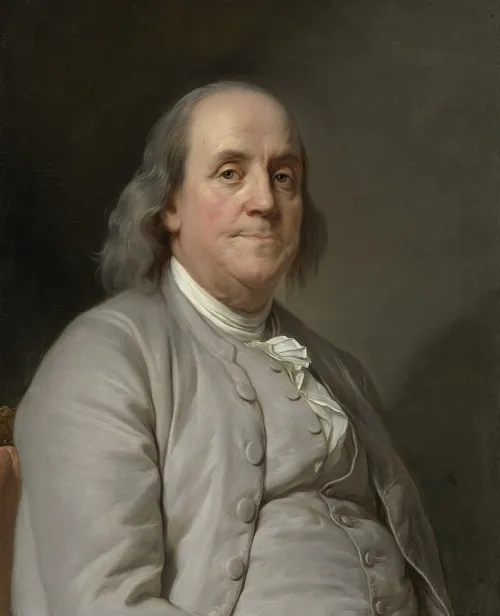
Benjamin Franklin was born on January 17, 1706, in Boston, Massachusetts, the fifteenth of seventeen children of Josiah Franklin, a candle and soap maker, and Abiah Folger. His family could only afford two years of formal schooling, but Franklin was a voracious self-educator who read everything he could acquire. At twelve, he was apprenticed to his older brother James's printing shop, where he secretly submitted anonymous essays to his brother's newspaper under the pseudonym 'Silence Dogood' — witty, satirical dispatches from a fictional middle-aged widow that became hugely popular until James discovered their authorship and was furious. At seventeen, Franklin ran away to Philadelphia, arriving with almost nothing, and within a year had established himself as a skilled printer with a small but growing reputation.
In Philadelphia, Franklin built institutions with a systematic creativity that makes no other Founding Father look quite so versatile or so practically oriented. He founded the first public lending library in America (1731), the American Philosophical Society (1743), the College of Philadelphia which became the University of Pennsylvania (1751), and the Pennsylvania Hospital (1751). He redesigned the postal system as Postmaster General and made it profitable for the first time. His Pennsylvania Gazette became the most widely read newspaper in the colonies. His Poor Richard's Almanack — published annually from 1732 to 1758 under the pseudonym Richard Saunders — sold ten thousand copies annually and made him wealthy through its blend of practical wisdom, astrological tables, and wit that has never entirely gone out of circulation.
Franklin's scientific work in electricity was not a hobby but a rigorous experimental program that placed him in the first rank of international science. His demonstration that lightning was electrical in nature — using a kite, a key, and a storm — led directly to the invention of the lightning rod, which saved thousands of buildings and ships from fire. He identified positive and negative charge, invented the concept of the electrical capacitor, and corresponded with the leading scientists of Europe as a peer. The Royal Society awarded him the Copley Medal, its highest honor, in 1753. His diplomatic career in France during the Revolutionary War — where his wit, charm, and scientific celebrity made him the most famous American in Europe — proved strategically essential to securing French military support that arguably decided the war.
Franklin is the ENTP's most complete historical avatar: a person whose intellectual curiosity was so thorough and so restless that he could not confine himself to any single domain. He was simultaneously a skilled tradesman, a successful entrepreneur, a civic architect, a scientist of international standing, a diplomat of genuine brilliance, a moralist who distrusted moralism, and a writer whose aphorisms have survived three centuries of quotation. His most famous self-improvement project — a systematic program of cultivating thirteen virtues, recorded in a notebook — he acknowledged he could never complete because he kept finding new virtues to pursue and old ones he'd forgotten to practice. This is the ENTP's essential condition: the vision is always ahead of the execution, and the execution is always more interesting than the completion.