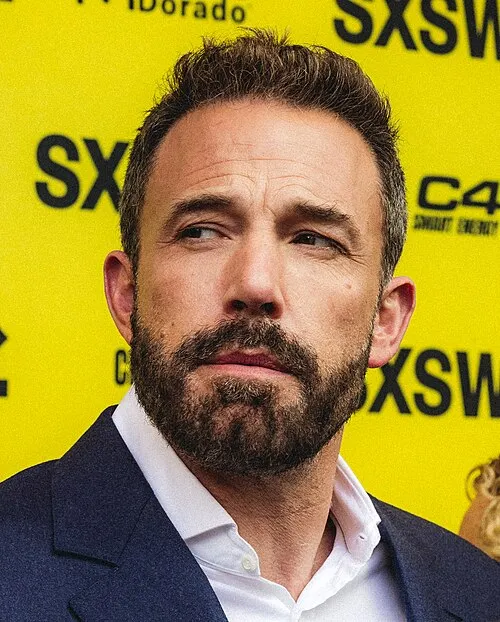
Benjamin Géza Affleck-Boldt was born on August 15, 1972, in Berkeley, California, and grew up in Cambridge, Massachusetts, the child of a teacher mother and a father who struggled with alcoholism. He met Matt Damon at age eight; their friendship, intellectual partnership, and mutual ambition to make something significant in film would define both their careers. He studied at the University of Vermont and Occidental College without completing a degree, his focus increasingly on the screenwriting and acting work that he and Damon were pursuing together. Cambridge's proximity to Boston made the city — its working-class neighborhoods, its complicated relationship with violence and opportunity — a permanent part of his creative imagination.
Affleck and Damon wrote Good Will Hunting while working as actors with limited opportunities, pitching it to studios for years before Harvey Weinstein's Miramax produced it in 1997. Directed by Gus Van Sant and starring Damon as the genius janitor and Affleck as his best friend Chuckie, the film won two Academy Awards — including Best Original Screenplay for Affleck and Damon — and remains the defining work of Affleck's early career. The subsequent decade brought large commercial films — Armageddon, Pearl Harbor, Daredevil — that were commercially significant but critically deflating, and a period where Affleck became more famous for tabloid coverage than for his work. He was considered by many to be a cautionary tale about Hollywood excess.
Affleck's directorial debut Gone Baby Gone (2007) was a revelation — a rigorously controlled, morally serious crime film set in Boston that demonstrated a filmmaker of genuine skill and vision. The Town (2010) confirmed his directorial talent, and Argo (2012) — the true-story thriller about the CIA's use of a fake science fiction film to rescue American hostages from Iran — won the Academy Award for Best Picture, with Affleck winning the Directors Guild and Producers Guild Awards despite not receiving an Oscar nomination for directing. The omission generated considerable commentary. He returned to acting in major franchise films — Batman in the DC Extended Universe, Justice League — while continuing to struggle publicly with addiction, ultimately being transparent about multiple stints in rehabilitation.
Affleck's ENFJ nature is most visible in his directorial work, which consistently returns to questions of community, loyalty, and the moral weight of the choices made by ordinary people in difficult circumstances. Gone Baby Gone, The Town, and Argo all examine what individuals owe each other — to friends, to communities, to strangers whose lives intersect with their own. The ENFJ director is drawn to these questions not abstractly but viscerally: the specific, textured experience of the social bonds that hold communities together or tear them apart. His transparency about his addiction — unusual among major Hollywood figures — reflects the ENFJ's instinct toward authenticity even when it is personally costly.