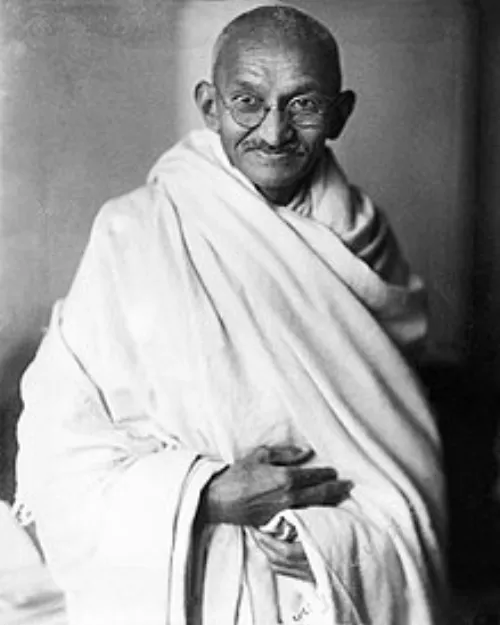
Mahatma Gandhi - INFJ Personality Type

Mahatma GandhiINFJ - Conseiller

Independence Leader

Origine

India

Confiance du Typage

largement accepté

Quick Facts

Born
October 2, 1869
Birthplace
Porbandar, Kathiawar Agency, British India
Nationality
Indian
Height
5'5" (165 cm)
Zodiac Sign
Education
Inner Temple, London (Barrister at Law)
Known For
Nonviolent Resistance (Satyagraha)Indian Independence MovementSalt MarchSpinning WheelInfluence on MLK & Mandela

Who is Mahatma Gandhi?

Mohandas Karamchand Gandhi was born on October 2, 1869, in Porbandar, a coastal city in present-day Gujarat, India, into a family of the Modh Bania caste. His father, Karamchand Gandhi, served as the diwan (chief minister) of Porbandar and several other small principalities; his mother, Putlibai, was a deeply religious woman whose practice of Jain fasting and vow-keeping left a deep impression on her son. Gandhi was a shy, unprepossessing child who struggled academically and was married by arrangement at thirteen to Kasturba Makanji, with whom he would remain married for sixty-two years. At nineteen, against family opposition and despite a Brahmin warning that ocean travel would result in his loss of caste, he sailed to London to study law at the Inner Temple, where he was called to the bar in 1891.

His first attempt to establish a legal practice in India failed; in 1893 he accepted a one-year contract to work for an Indian law firm in Natal, South Africa. What happened in South Africa over the next twenty-one years transformed both Gandhi and the history of political resistance. Within a week of arriving, he was thrown off a train at Pietermaritzburg for refusing to move to a third-class carriage despite holding a first-class ticket — an experience he later identified as the most formative of his life. He resolved not to leave South Africa until he had fought the injustice he had encountered, and the fight lasted two decades. He organized the Natal Indian Congress in 1894, developed his first campaigns of nonviolent resistance (which he called Satyagraha — 'truth-force' or 'soul-force'), led the 1907 campaign against compulsory registration of Indians, and was imprisoned multiple times.

Returning to India in 1915, Gandhi was greeted as a hero by the Indian National Congress but spent his first year traveling the country to understand it from within rather than from the perspective of the educated class that dominated Congress. He led the Champaran agitation of 1917 against British indigo plantation farmers, the Khilafat movement of 1919, and the Non-Cooperation Movement of 1920–1922 — the first nationwide campaign of mass civil disobedience against British rule. The Salt March of 1930 — a 240-mile walk to the sea at Dandi to protest the British salt monopoly — became one of the most celebrated acts of political theater in world history, demonstrating that the entire apparatus of colonial taxation could be challenged by the simple act of individuals making their own salt.

Gandhi's INFJ quality manifested most completely in his conviction that the means of achieving a goal were inseparable from the nature of the goal itself — that violence could not produce a just peace any more than lying could produce an honest relationship. This was not a pragmatic calculation but a philosophical conviction rooted in his understanding of truth as a living force that operated through human action. He was assassinated on January 30, 1948, by Nathuram Godse, a Hindu nationalist who considered his commitment to Muslim-Hindu unity treasonous to Hindu India. His influence on Martin Luther King Jr. and Nelson Mandela — who explicitly credited Gandhi's nonviolent methodology as foundational to their own — means that his strategic contribution to twentieth-century liberation movements extends far beyond India's independence.
Type de Personnalité INFJ de Mahatma Gandhi

Mahatma Gandhi, connu(e) pour son travail en tant que Independence Leader, présente les traits classiques d'un type de personnalité INFJ - Conseiller. Ce profil de personnalité est caractérisé par une combinaison unique de fonctions cognitives qui façonnent la façon dont ils perçoivent le monde et prennent des décisions.

Traits INFJ Clés chez Mahatma Gandhi

En tant que INFJ, Mahatma Gandhi démontre les caractéristiques fondamentales associées à ce type de personnalité.

Pourquoi Mahatma Gandhi est Typé comme INFJ

Le type de personnalité INFJ est l'un des 16 types Myers-Briggs, et le comportement public de Mahatma Gandhi, les schémas de prise de décision et le style de communication s'alignent étroitement avec cette classification.

Mahatma Gandhi's Political Career

1893-1914

South African Resistance

Founded Natal Indian Congress; developed Satyagraha

1917

Champaran Campaign

First successful civil disobedience in India

1920-1922

Non-Cooperation Movement

First nationwide campaign against British rule

1930

Salt March

240-mile march to Dandi; 60,000 arrested

1942

Quit India Movement

Final major campaign for independence

1947

Indian Independence

Partition; Gandhi fasted for Hindu-Muslim peace

Awards & Recognition

\u2605UN International Day of Non-Violence (October 2, his birthday) (2007)\u2605Time magazine Person of the Century (runner-up) (1999)

Mahatma Gandhi's Mystic Profile

Discover Mahatma Gandhi's cosmic connections through zodiac, tarot, crystals, and spirit animals.

libra

Zodiac Prediction

As a Libra, Mahatma Gandhi reflected the sign's highest aspiration: the pursuit of perfect justice through the most scrupulously balanced means. Libra rules the scales of truth, the conviction that the process of seeking justice must itself be just — that the means cannot be separated from the ends without corrupting both. Gandhi's satyagraha was a Libran political philosophy made into practice: you win not by defeating your opponent but by forcing them to see the imbalance they have created and appealing to their own conscience to correct it. Libra's great challenge is that it requires the opponent to have a conscience — which is why Gandhi's methods worked against the British and why he acknowledged they might not work against a Hitler.

🃏

justice

Tarot Card Match

The Justice card — the twelfth card of the Major Arcana — depicts a figure holding scales in one hand and a sword in the other: the balanced assessment of truth and the willingness to act on that assessment when necessary. Gandhi's entire political life was a meditation on Justice: how it is achieved, what it costs, and what it means to pursue it without becoming what one is fighting against. He held the sword of consequence and the scales of truth simultaneously, never allowing one to overbalance the other.

💎

clear quartz

Crystal Match

Clear quartz — the master amplifier, the stone of absolute clarity and the magnification of whatever intention is channeled through it — connects with Gandhi's fundamental spiritual methodology. Satyagraha literally means 'truth-force,' and Gandhi's conviction was that truth, properly concentrated and directed through disciplined human action, was more powerful than any physical force that could be brought against it. Clear quartz is the stone of that conviction: the amplification of the signal of truth through the clarity of intention.

🦁

elephant

Spirit Animal

The elephant carries enormous natural authority through the quality of its presence rather than through the display of aggression — it simply is what it is, and what it is commands respect. Gandhi's authority was exactly this: not the authority of power or violence but the authority of someone who had so completely aligned his life with his values that the alignment itself became a form of power that colonial force could not dissolve. The elephant also has a long memory — Gandhi held the long-term vision across decades of incremental, costly, unglamorous work — and the elephant's patience is of the same quality as Gandhi's.

Plus de Personnalités INFJ Célèbres

À Propos de Cette Analyse

Cette analyse du type de personnalité de Mahatma Gandhi est basée sur des informations publiquement disponibles, des interviews et des observations comportementales.