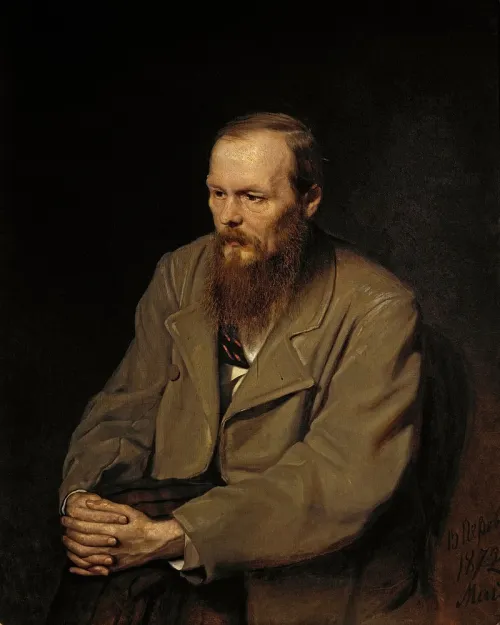
Fyodor Dostoevsky - INFJ Personality Type

Fyodor DostoevskyINFJ - Conseiller

Author

Origine

Russia

Confiance du Typage

largement accepté

Quick Facts

Born
November 11, 1821
Birthplace
Moscow, Russia
Nationality
Russian
Height
5'5" (165 cm)
Zodiac Sign
Education
Main Engineering School, Saint Petersburg
Known For
Crime and PunishmentThe Brothers KaramazovThe IdiotNotes from UndergroundThe Possessed

Who is Fyodor Dostoevsky?

Fyodor Mikhailovich Dostoevsky was born on November 11, 1821, in Moscow, the second of seven children of Mikhail Dostoevsky, a physician at the Mariinsky Hospital for the Poor, and Maria Nechayeva. He grew up in a household of modest means but intense intellectual and religious life: his father was demanding, emotionally repressive, and deeply religious; his mother was warm and affectionate, the source of the storytelling culture that shaped his imagination. His mother died of tuberculosis when he was fifteen, and his father was murdered by his own serfs three years later — a parricide that would become one of the central preoccupations of his most ambitious novel. He was educated at the Main Engineering School in Saint Petersburg, graduating as a military engineer in 1843 but resigning his commission almost immediately to pursue writing.

His first novel, Poor Folk (1845), was recognized by the critic Vissarion Belinsky as a masterpiece and Dostoevsky as a major new voice in Russian literature. The confidence this generated led him to a passionate engagement with the utopian socialist Petrashevsky Circle — a group that discussed forbidden European liberal political philosophy — for which he was arrested in 1849. The experience that followed was among the most consequential in the history of literature: he was subjected to a mock execution — brought to the scaffold, the death sentence read, and then, at the last moment, informed that his sentence had been commuted to four years of hard labor in a Siberian prison camp. The psychological impact of those minutes of anticipated death, and of the four subsequent years in Omsk prison among murderers and thieves, transformed his philosophy and his art.

From prison he emerged with epilepsy (or possibly its symptoms became undeniable in the extreme conditions), a transformed understanding of human nature, and a strong Orthodox Christian faith that replaced his earlier socialism. Notes from Underground (1864) — published after a period of journalistic work and the deaths of both his first wife and his brother — is the first existentialist novel in world literature: the Underground Man's savage self-examination inaugurated a tradition of literary self-analysis that runs through Kafka, Camus, and Sartre. Crime and Punishment (1866), The Idiot (1869), Demons (1872), and The Brothers Karamazov (1880) represent one of the most extraordinary creative outputs in literary history, especially given that they were largely written under financial pressure, gambling addiction, and the management of severe epilepsy.

Dostoevsky's INFJ quality permeates every page of his work: the relentless plunge into the most painful and most authentic dimensions of human psychology; the conviction that spiritual truth was more real than social reality; the ability to hold simultaneously the most radical intellectual challenges to faith and the most compelling defenses of it; and the sense of absolute urgency in the moral questions he explored — as if the fate of individual souls, and of Russian civilization, depended on getting the answers right. His novels are not entertainment that contains ideas but ideas that have chosen the form of entertainment because only narrative can hold simultaneously the argument and its refutation, the faith and its doubt, the crime and its punishment.
Type de Personnalité INFJ de Fyodor Dostoevsky

Fyodor Dostoevsky, connu(e) pour son travail en tant que Author, présente les traits classiques d'un type de personnalité INFJ - Conseiller. Ce profil de personnalité est caractérisé par une combinaison unique de fonctions cognitives qui façonnent la façon dont ils perçoivent le monde et prennent des décisions.

Traits INFJ Clés chez Fyodor Dostoevsky

En tant que INFJ, Fyodor Dostoevsky démontre les caractéristiques fondamentales associées à ce type de personnalité.

Pourquoi Fyodor Dostoevsky est Typé comme INFJ

Le type de personnalité INFJ est l'un des 16 types Myers-Briggs, et le comportement public de Fyodor Dostoevsky, les schémas de prise de décision et le style de communication s'alignent étroitement avec cette classification.

Fyodor Dostoevsky's Notable Works

1845

Poor Folk

Recognized immediately as masterpiece by leading critic Belinsky

1849

Mock Execution & Siberian Imprisonment

4 years hard labor; transformed his philosophy

1864

Notes from Underground

First existentialist novel in world literature

1866

Crime and Punishment

Written to pay gambling debts; became a classic

1880

The Brothers Karamazov

Final masterpiece; called 'the supreme achievement of the novel form'

Awards & Recognition

\u2605Pushkin speech — unanimous acclaim of the Russian literary world (1880)

Fyodor Dostoevsky's Mystic Profile

Discover Fyodor Dostoevsky's cosmic connections through zodiac, tarot, crystals, and spirit animals.

scorpio

Zodiac Prediction

As a Scorpio, Fyodor Dostoevsky inhabited the sign's most extreme and most essential territory: the descent into the darkest dimensions of human psychology in search of what is most real. Scorpio rules death, transformation, and the hidden life of the psyche, and Dostoevsky went there not once but repeatedly — in his mock execution, in his years of Siberian imprisonment, in his gambling addiction, in the deaths of his wives and children, and most importantly in the interior lives of his characters, who explore murder, atonement, nihilism, and the existence of God with a ferocity that suggests the questions were literally matters of life and death for their author.

🃏

the moon

Tarot Card Match

The Moon card depicts the hidden landscape of the unconscious — the world that appears when the light of ordinary reason is replaced by the more ambiguous light of dream and instinct. Dostoevsky's novels are Moon territory: they operate in the spaces between conscious and unconscious, between the stated motivation and the real one, between the crime committed and the punishment that the criminal inflicts upon himself before any external consequence arrives. The Moon is associated with the Scorpionic depth that finds what daylight leaves hidden.

💎

garnet

Crystal Match

Garnet — the deep red stone of passion, commitment, and the energy that sustains through the darkest conditions — rings true with Dostoevsky's extraordinary creative persistence through conditions that would have silenced most writers: poverty, epilepsy, gambling addiction, imprisonment, bereavement. Garnet is the stone of someone who has committed completely to their vision and who finds in that commitment the energy to continue when every circumstance argues for stopping. It is the stone of fire maintained through winter.

🦁

wolf

Spirit Animal

The wolf navigates darkness by instinct and maintains fierce loyalty to the pack's survival — which in Dostoevsky's case was not a literal pack but his characters, toward whom he maintained a ferocious empathetic loyalty even as he led them into the most terrible situations his imagination could devise. The wolf howls at the moon — at what is hidden and mysterious — and Dostoevsky's novels are sustained howls at exactly these questions: the mystery of evil, the existence of God, the persistence of love in conditions that should destroy it.

Plus de Personnalités INFJ Célèbres

À Propos de Cette Analyse

Cette analyse du type de personnalité de Fyodor Dostoevsky est basée sur des informations publiquement disponibles, des interviews et des observations comportementales.