Ernest Hemingway - ESTP Personality Type

Ernest HemingwayESTP - Dynamo

Author

Origine

USA

Confiance du Typage

largement accepté

Quick Facts

Born
July 21, 1899
Birthplace
Oak Park, Illinois, USA
Nationality
American
Height
6'0" (183 cm)
Zodiac Sign
Education
Oak Park and River Forest High School; no college
Known For
The Old Man and the SeaNobel Prize LiteratureMinimalist prose styleThe Sun Also Rises

Who is Ernest Hemingway?

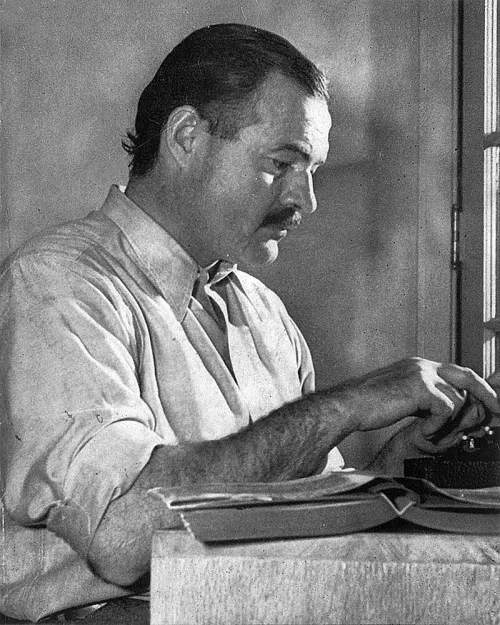
Ernest Miller Hemingway was born on July 21, 1899, in Oak Park, Illinois, a prosperous suburb of Chicago, to Clarence Hemingway, a physician with a passion for the outdoors, and Grace Hall Hemingway, an opera singer and music teacher. His childhood divided between his father's world of hunting, fishing, and outdoor life in northern Michigan and his mother's world of culture and performance gave him the dual sensibility — the physical and the aesthetic — that would define his work. He graduated from high school in 1917 and, unable to enlist due to poor eyesight, took a job as a cub reporter at the Kansas City Star, where he absorbed the newspaper's style guide — short sentences, active verbs, concrete specificity — that would shape his literary style.

Hemingway's experience as an ambulance driver for the Italian Red Cross during World War I — he was severely wounded near Fossalta di Piave in 1918, receiving over 200 shrapnel fragments in his legs — became the foundational experience of his early writing. His return to America, his move to Paris in 1921 as a foreign correspondent for the Toronto Star, and his immersion in the expatriate literary world of the 1920s — he knew Gertrude Stein, F. Scott Fitzgerald, Ezra Pound, and James Joyce — produced the Lost Generation milieu that his early work would define. The Sun Also Rises (1926) and A Farewell to Arms (1929) established him as the defining voice of his literary generation.

Hemingway's prose style — the iceberg theory of omission, the short declarative sentence, the surface simplicity that requires depth of the reader — was both technically fresh and immediately influential. He had understood something about how literary language could work that previous writers had not articulated: that what is left out creates the emotional weight that what is said cannot carry alone. His subjects — war, love, death, masculinity, the natural world, courage in the face of inevitable defeat — were as consistent as his style, and together they created a literary world that is immediately recognizable as Hemingway regardless of where the reader enters it.

Hemingway's later life was marked by the extraordinary public legend he had cultivated — the big-game hunter, the deep-sea fisherman, the war correspondent who had covered four conflicts, the Nobel laureate of 1954 — alongside deteriorating physical and mental health. His final novel, The Old Man and the Sea (1952), won the Pulitzer Prize and contributed to his Nobel Prize; A Moveable Feast, his memoir of Paris in the 1920s, was published posthumously in 1964. He died on July 2, 1961, of a self-inflicted gunshot wound, at his home in Ketchum, Idaho, two weeks after his sixty-second birthday. His influence on American prose style remains pervasive and largely unacknowledged, precisely because it has been so thoroughly absorbed.

Type de Personnalité ESTP de Ernest Hemingway

Ernest Hemingway, connu(e) pour son travail en tant que Author, présente les traits classiques d'un type de personnalité ESTP - Dynamo. Ce profil de personnalité est caractérisé par une combinaison unique de fonctions cognitives qui façonnent la façon dont ils perçoivent le monde et prennent des décisions.

Traits ESTP Clés chez Ernest Hemingway

En tant que ESTP, Ernest Hemingway démontre les caractéristiques fondamentales associées à ce type de personnalité.

Pourquoi Ernest Hemingway est Typé comme ESTP

Le type de personnalité ESTP est l'un des 16 types Myers-Briggs, et le comportement public de Ernest Hemingway, les schémas de prise de décision et le style de communication s'alignent étroitement avec cette classification.

Ernest Hemingway's Notable Works

1926

The Sun Also Rises

Defining Lost Generation novel

1929

A Farewell to Arms

WWI masterwork

1940

For Whom the Bell Tolls

Spanish Civil War epic

1952

The Old Man and the Sea

Pulitzer Prize winner

1954

Nobel Prize in Literature

Swedish Academy recognition

Awards & Recognition

\u2605Nobel Prize in Literature (1954)\u2605Pulitzer Prize for Fiction (The Old Man and the Sea) (1953)\u2605Medal of Merit from Italy (1947)\u2605Bronze Star (1947)

Ernest Hemingway's Mystic Profile

Discover Ernest Hemingway's cosmic connections through zodiac, tarot, crystals, and spirit animals.

cancer

Zodiac Prediction

Ernest Hemingway's Cancer sun is the hidden foundation of his most powerful writing: the sign of memory, of the wound that doesn't heal, of the emotional depth that his famously stoic surface worked so hard to conceal. Cancer rules the interior life — the feelings that cannot be shown directly but must be expressed obliquely, through the physical world, through action, through what is not said. Hemingway's iceberg theory of prose — where the dignity of movement of an iceberg is due to only one-eighth of it being above water — is Cancer aesthetics: the enormous feeling held below the surface, the small visible fact that implies the vast invisible depth. His writing about masculinity and courage is the writing of a Cancer who understood that the deepest feeling must be most carefully guarded.

🃏

the emperor

Tarot Card Match

The Emperor — the tarot archetype of authority, of the domain defined and ruled, of the one who imposes order on chaos through the force of will and the establishment of clear principles — is Hemingway's card. The Emperor rules his territory absolutely, defining what is permitted within it. Hemingway's literary authority worked exactly this way: he defined the territory of literary modernism, established what was allowed (directness, concrete specificity, earned emotion) and what was forbidden (sentimentality, abstraction, the adverb), and enforced these principles through example and through the force of his critical personality. Within his aesthetic domain, the rules were clear and the consequences of breaking them severe.

💎

red jasper

Crystal Match

Red jasper — the stone of physical courage, of the warrior who acts rather than reflects, of the grounded earth energy that keeps the spirit connected to the body and the body equal to its trials — is Hemingway's crystal. Red jasper is the stone of one who has faced the worst that the physical world can offer and has not flinched — or has flinched and returned. It is a stone of the body's wisdom, of survival knowledge held in muscle and bone rather than in abstract understanding. Hemingway's writing is red jasper writing: physically grounded, earned through experience, communicating the truth of represented existence rather than the theories of those who have avoided it.

🦁

bull

Spirit Animal

The bull — the animal of power, of the force that cannot be redirected without enormous effort, of the creature who moves through the world according to its own momentum — is Hemingway's spirit animal. His fascination with bullfighting — the corrida was for him a genuine art form and a genuine metaphor for the human confrontation with death — reflects this identification: the bull's power and courage in the face of its inevitable defeat was the clearest image he found for the human condition. The bull enters the arena already doomed; its dignity lies entirely in how it meets what cannot be avoided. This was Hemingway's philosophy: not the avoidance of death but the quality of confrontation with it.

Plus de Personnalités ESTP Célèbres

À Propos de Cette Analyse

Cette analyse du type de personnalité de Ernest Hemingway est basée sur des informations publiquement disponibles, des interviews et des observations comportementales.