Martin Luther - ENFJ Personality Type

Martin LutherENFJ - Mentor

Religious Reformer

Origine

Germany

Confiance du Typage

largement accepté

Quick Facts

Born
November 10, 1483
Birthplace
Eisleben, Holy Roman Empire (modern Germany)
Nationality
German
Height
5'8" (173 cm)
Zodiac Sign
Education
University of Erfurt (law, then theology)
Known For
Protestant Reformation95 ThesesBible translation to GermanLutheran Church founder

Who is Martin Luther?

Martin Luther was born on November 10, 1483, in Eisleben, in the Holy Roman Empire, to Hans Luther, a copper miner who rose to become a smelter and local businessman, and Margarethe Ziegler. His father's ambition shaped Luther's upbringing: Hans Luther wanted his son to become a lawyer and invested significantly in his education. Luther attended Latin schools in Mansfeld, Magdeburg, and Eisenach before enrolling at the University of Erfurt, one of the finest universities in the Holy Roman Empire, where he earned his bachelor's and master's degrees. In 1505, he was about to begin law school when a violent thunderstorm caught him in the open — terrified by lightning, he vowed to Saint Anne that he would become a monk if he survived, and kept his vow over his father's furious objections.

Luther entered the Augustinian monastery at Erfurt and pursued theology with the same intense drive that had characterized his academic career. Despite becoming a monk, celebrating his first Mass, and receiving a doctorate in theology, Luther remained in powerful spiritual anguish — unable to reconcile his sense of his own sinfulness with the Catholic Church's system of penance and indulgences. His study of Paul's Letter to the Romans eventually crystallized into what he called the 'tower experience': the sudden understanding that salvation comes through faith alone (sola fide), not through works or the purchase of indulgences. This insight was not merely theological — it was an ENFJ's personal liberation from a system he experienced as spiritually fraudulent, a liberation he immediately felt compelled to share.

On October 31, 1517, Luther nailed (or posted) his 95 Theses to the door of the Castle Church in Wittenberg — a list of propositions for academic debate challenging the theology and practice of indulgences. Thanks to the printing press, his theses spread across Germany within weeks and across Europe within months. Luther had not intended to found a new church; he intended to reform the one he was in. But the Church's response — demanding recantation, ultimately excommunicating him at the Diet of Worms in 1521 — forced him into a position where his conscience would not allow him to retract. 'Here I stand; I can do no other' may be apocryphal, but it captures the essential Luther: the ENFJ who, having identified what he believes to be true and just, cannot suppress it regardless of institutional cost.

Luther's translation of the New Testament into German (1522), completed in just 11 weeks while hiding at Wartburg Castle, was among the most consequential acts of cultural translation in Western history — it effectively created modern German as a literary language and made scripture accessible to ordinary people for the first time. The Protestant Reformation he ignited reshaped European civilization: wars, new nations, new educational systems, new conceptions of individual conscience and religious authority all emerged from the movement his 95 Theses set in motion. As an ENFJ, Luther's gift was his ability to articulate what millions of ordinary Europeans were already feeling — that the Church's corruption was spiritually bankrupt — in language they could understand and act on. His charisma, his prolific writing, his ability to inspire and organize a continent-wide movement mark him as one of history's most consequential ENFJs.
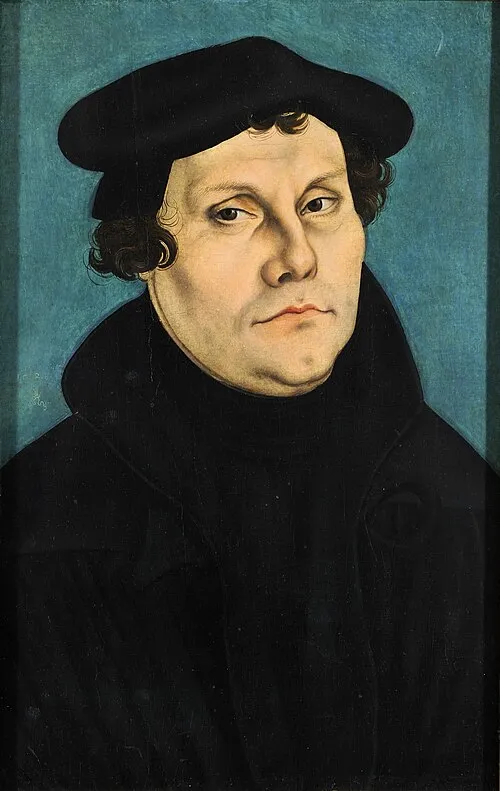

Type de Personnalité ENFJ de Martin Luther

Martin Luther, connu(e) pour son travail en tant que Religious Reformer, présente les traits classiques d'un type de personnalité ENFJ - Mentor. Ce profil de personnalité est caractérisé par une combinaison unique de fonctions cognitives qui façonnent la façon dont ils perçoivent le monde et prennent des décisions.

Traits ENFJ Clés chez Martin Luther

En tant que ENFJ, Martin Luther démontre les caractéristiques fondamentales associées à ce type de personnalité.

Pourquoi Martin Luther est Typé comme ENFJ

Le type de personnalité ENFJ est l'un des 16 types Myers-Briggs, et le comportement public de Martin Luther, les schémas de prise de décision et le style de communication s'alignent étroitement avec cette classification.

Martin Luther's Notable Works

1517

95 Theses

Posted at Wittenberg, igniting the Protestant Reformation across Europe

1521

Diet of Worms

Refused to recant before Holy Roman Emperor Charles V; excommunicated from Catholic Church

1522

New Testament in German

Revolutionary translation making scripture accessible to ordinary German speakers

1534

Complete Bible in German

Full Old and New Testament translation standardizing modern German language

1529

Luther's Catechisms

Small and Large Catechisms become foundational Lutheran educational texts

Martin Luther's Mystic Profile

Discover Martin Luther's cosmic connections through zodiac, tarot, crystals, and spirit animals.

scorpio

Zodiac Prediction

Scorpio is the sign of transformation through death and rebirth, of confronting what is hidden, of refusing to accept comfortable lies when the truth — however disruptive — demands acknowledgment. Luther's Scorpio energy is evident in the ferocity of his spiritual searching: he would not accept the comfortable institutional answers available to him, insisting on pressing into the darkest corners of his own sinfulness until he found something he could actually believe. Scorpios transform through confrontation, and Luther confronted the most powerful institution in Western civilization with his 95 Theses — not from recklessness but from the Scorpio's inability to pretend that what he sees to be true is not true. Scorpio rules revelation, and Luther's gift was revealing — making visible what had been deliberately obscured.

🃏

the tower

Tarot Card Match

The Tower is the tarot's card of sudden, lightning-bolt revelation that destroys false structures to make room for what is true. Luther was literally struck by lightning that changed the course of his life, and then spent the next three decades being the lightning bolt that struck the Church's edifices of corruption and institutional self-protection. The Tower's destruction is not nihilistic — it is the necessary clearing of what has become structurally corrupt so that something genuine can be built in its place. The Protestant churches, the modern university system, literacy movements across Europe — these were what grew in the space The Tower cleared.

💎

obsidian

Crystal Match

Obsidian — volcanic glass formed when lava meets water, simultaneously razor-sharp and opaque, a stone of truth-telling and protection — connects with Luther's nature. Obsidian has been used across cultures as a mirror for seeing what is hidden, including the hidden aspects of oneself, and as a tool for cutting cleanly through illusion. Luther's spiritual practice was obsidian work: looking without flinching at his own sinfulness, at the Church's corruption, at the gap between claimed Christian values and institutional behavior. Obsidian gives the courage to see and say what is true, regardless of comfort.

🦁

wolf

Spirit Animal

The wolf — pack animal, territorial, possessing extraordinary endurance for the long pursuit, deeply loyal to its own while ferocious in its defense of pack territory — captures Luther's essential nature. He was simultaneously communal (the reformer who inspired thousands to join his movement) and ferociously individualistic (the theologian who would not bend even under the pressure of excommunication and imperial condemnation). The wolf's howl — the announcement of presence and conviction that carries across enormous distances — is Luther's 95 Theses: a declaration that could not be unheard.

Plus de Personnalités ENFJ Célèbres

À Propos de Cette Analyse

Cette analyse du type de personnalité de Martin Luther est basée sur des informations publiquement disponibles, des interviews et des observations comportementales.