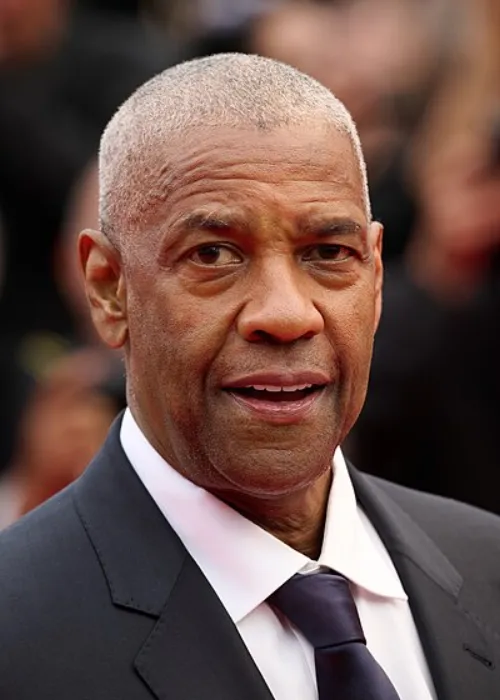
Denzel Hayes Washington Jr. was born on December 28, 1954, in Mount Vernon, New York, to Denzel Hayes Washington Sr., a Pentecostal minister, and Lennis, who owned a beauty salon. His parents' divorce when he was fourteen was a disruption that sent him, briefly, toward trouble — he has described the boys' club in his neighborhood as a gateway to the street. His mother insisted he attend the Oakland Military Academy, and then the Boys Harbor youth organization camp in East Hampton, where a counselor identified his potential and redirected it. He attended Fordham University, initially studying journalism before discovering acting in his junior year through a drama class that gave him his first experience of the stage.
Washington's professional career began in theatre and television, with a breakthrough role on the medical drama St. Elsewhere (1982-1988) as Dr. Philip Chandler. His film career ascended steadily — A Soldier's Story, Cry Freedom (Golden Globe nomination), The Mighty Quinn — until Glory (1989), in which he played Private Trip, an escaped slave fighting in the Union Army's first Black regiment. His performance was so devastating — the scene in which Trip is flogged while tears fall silently — that it earned him his first Academy Award for Best Supporting Actor. It remains one of the finest performances in American cinema.
The subsequent decades cemented his position as the most respected American film actor of his generation: Malcolm X (1992), Philadelphia (1993, playing the lawyer defending Tom Hanks' AIDS patient), The Hurricane (1999), Remember the Titans (2000), Training Day (2001, for which he won Best Actor — playing a corrupt detective with terrifying authenticity), Man on Fire, Déjà Vu, American Gangster, Flight, Equalizer, Ma Rainey's Black Bottom, The Tragedy of Macbeth. Each performance is characterized by the same quality: total commitment to the specific human truth of the character, no matter how uncomfortable that truth might be. He has received ten Academy Award nominations.
Washington's ISTJ nature explains the unusual quality of his career — the consistency, the craftsmanship, the refusal to take easy paths when more demanding ones are available. ISTJs bring the same absolute commitment to their craft that they bring to every other obligation; Washington has described himself as someone who treats acting as work, who prepares methodically, who is not interested in celebrity but in the quality of what he creates. His deep Christian faith, his long marriage (since 1983), and his consistent refusal to participate in Hollywood's social scene reflect the ISTJ's preference for genuine substance over performed identity. He has said his goal is simply to be a good actor; by any measure, he has achieved something more.