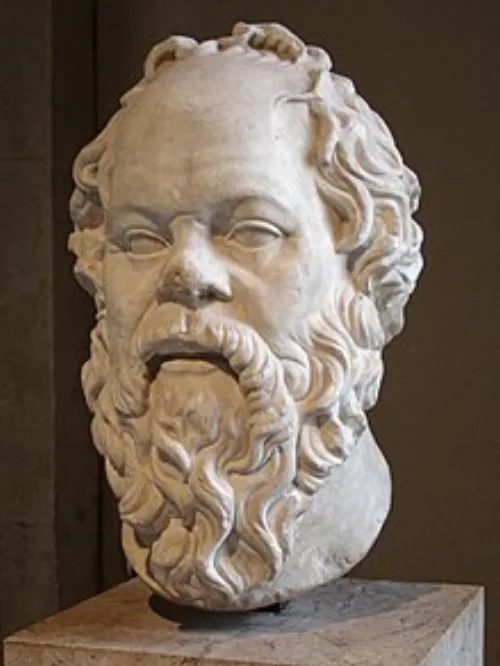
Socrates was born around 470 BCE in Athens, the son of a stonemason and a midwife. He received a basic Athenian education in music, gymnastics, and grammar, and may have worked as a stonemason in his youth — ancient sources suggest he carved the draped Graces on the Acropolis road. What distinguished him from contemporaries was not academic training but a relentless intellectual curiosity that drove him to spend his days in conversation, systematically interrogating everyone from politicians to craftsmen to poets about the nature of virtue, justice, courage, and piety. He wrote nothing himself — everything we know comes through his students, primarily Plato and Xenophon.
The Socratic method — the practice of asking probing questions to expose contradictions in interlocutors' beliefs — was not merely a rhetorical technique but a philosophical conviction: genuine knowledge begins in the recognition of one's own ignorance. The Oracle at Delphi had declared that no man was wiser than Socrates; when Socrates investigated this claim by questioning those reputed to be wise, he concluded that the Oracle meant only that he, unlike them, was aware of his own ignorance. This foundational humility — that intellectual honesty requires constant questioning — is the purest expression of the INTP's dominant Introverted Thinking: the relentless internal auditing of one's own belief systems.
Socrates was a bizarre figure in Athenian public life — ugly by Athenian standards (contemporaries compared him to Silenus, a satyr-like creature), dressed shabbily, and frequently found in the marketplace or at drinking parties engaged in earnest philosophical discussion with anyone who would participate. He refused payment for his teaching, a gesture of integrity that set him apart from the Sophists who charged fees for instruction in rhetoric and persuasion. His magnetic intellectual presence attracted a devoted circle of young Athenians, including Plato, Alcibiades, Xenophon, and Critias — several of whom went on to play dramatic and sometimes destructive roles in Athenian politics.
In 399 BCE, Socrates was tried by an Athenian jury of 501 citizens and convicted of impiety (failing to acknowledge the city's gods) and corrupting the youth. In his defense — the Apology, as recorded by Plato — he refused to beg for mercy, refused to propose exile as an alternative, and ultimately drank the hemlock with apparent philosophical serenity. His death transformed him from a troublesome local philosopher into the martyred founder of Western rational inquiry. The INTP's willingness to follow logic wherever it leads, regardless of social or personal cost, was taken to its ultimate conclusion: Socrates chose death over intellectual capitulation.