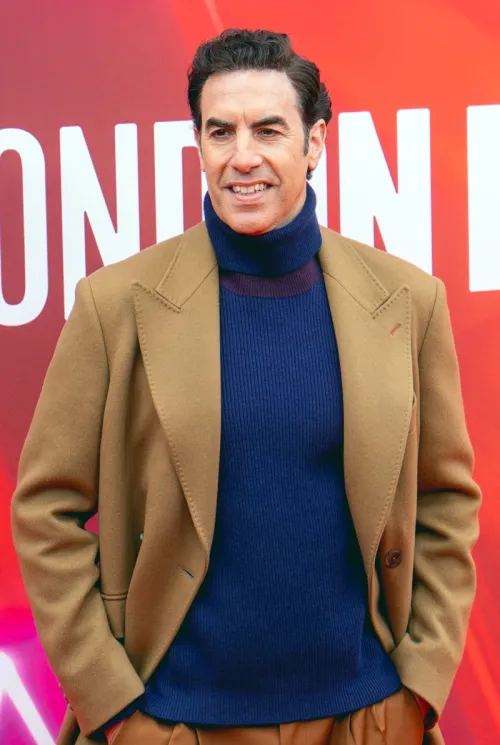
Sacha Noam Baron Cohen was born on October 13, 1971, in Hammersmith, London, into a Jewish family of mixed British and Israeli heritage. His father Gerald owned a clothing boutique; his mother Daniella ran a dance school. He attended the private Haberdashers' Aske's Boys' School and subsequently Christ's College, Cambridge, where he read History and completed his undergraduate thesis on the role of Jews in the American civil rights movement. It was at Cambridge that he began developing character comedy in the college revue tradition, and where the improvisational instinct that would define his adult career found its first sustained outlet. He was drawn from early on to a specific question: what happens to ordinary people's behavior when the social constraints that normally govern interaction are temporarily removed by an unusual interlocutor?
The Ali G character — a white British man performing a caricature of Black British 'Ali G' street culture — began on The 11 O'Clock Show in 1998 and migrated to The Ali G Show (2000–2004), which became a cultural phenomenon. The character's power was not satirical in the conventional sense: it worked by creating a social situation in which Ali G's interview subjects — politicians, academics, celebrities — found themselves unable or unwilling to correct his fundamental misunderstandings without appearing condescending, and so proceeded to answer absurd questions in complete seriousness. This was the Baron Cohen method distilled: use a character to create a situation so socially awkward that normal human defenses fail, and document what emerges. Borat: Cultural Learnings of America for Make Benefit Glorious Nation of Kazakhstan (2006) applied this method at feature-film scale, producing a film that simultaneously earned $262 million worldwide and generated serious academic discussion about what it revealed about American prejudice.
Bruno (2009) and The Dictator (2012) continued his exploration of extreme social discomfort as a mechanism for revelation, though the methodology grew more expensive to execute as he became too recognizable to use in genuine public situations. His transition to dramatic roles — Sweeney Todd (voice, 2007), Les Misérables (2012) as Thénardier, and his remarkably contained and technically precise work in serious dramas — demonstrated a range that his character-comedy work had not entirely predicted. His Amazon series Who Is America? (2018) showed his political satire reaching new levels of methodological sophistication, duping politicians including a senior Republican congressman into recording pro-gun messaging targeting toddlers. The legal, logistical, and social risks involved in his working method are genuinely significant.
Baron Cohen is the ENTP's satirical genius in its most extreme and deliberate form. His working method — spending months developing a character's psychological world in complete detail before deploying it publicly — reflects the ENTP's characteristic combination of elaborate intellectual architecture and improvisational execution. Every public encounter is a debate, conducted not through arguable propositions but through carefully engineered social situations designed to expose the gap between people's stated beliefs and their actual behavior. He is also the ENTP whose curiosity is fundamentally ethical rather than merely intellectual: his greatest work consistently reveals not that people are hypocrites but that the social structures that elicit hypocrisy are more powerful than most people recognize — and that consciousness of that power is the first step toward its dissolution.