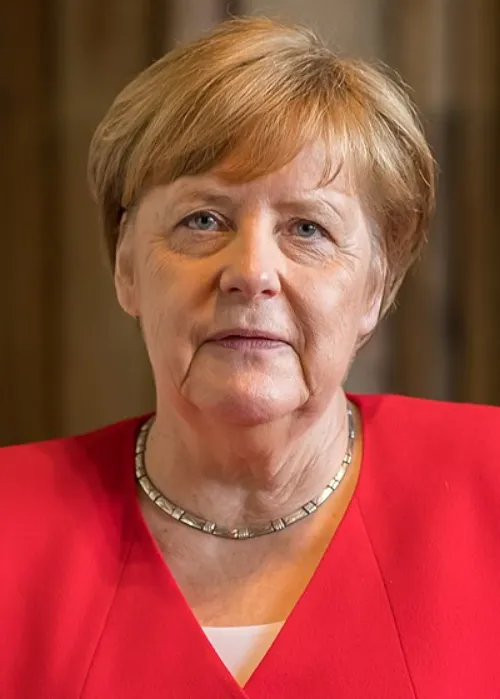
Angela Dorothea Merkel, née Kasner, was born on July 17, 1954, in Hamburg, West Germany, and grew up in East Germany — an unusual trajectory for a future Western leader, as her father Horst Kasner was a Lutheran pastor who deliberately moved his family from West to East Germany shortly after her birth. Growing up in communist East Germany gave Merkel a quality of pragmatic realism, a willingness to work within whatever system is actually present rather than lamenting the system that would be ideal, and an acute sensitivity to political manipulation — the skills of someone who learned from childhood how to navigate a controlled political environment without being consumed by it. She studied physics at Leipzig University, earning a doctorate in 1978.
Merkel remained in the East German Academy of Sciences until the Wall fell in 1989, joining the movement that became the Christian Democratic Union party in 1990 and entering the newly unified German parliament in the first post-unification election. Her rise through German politics was so swift that it surprised the established politicians who had initially underestimated her — a pattern that would repeat throughout her career. She served as Minister for Women and Youth and then Minister for the Environment under Helmut Kohl, who called her 'my girl' — a casual condescension that reflected the widespread failure to recognize what she was becoming. In 2000, she succeeded him as leader of the CDU.
Merkel served as Chancellor of Germany from 2005 to 2021 — sixteen years, the longest tenure of any EU leader — navigating the Euro crisis, the refugee crisis of 2015 (in which she maintained Germany's welcome of over a million asylum seekers against considerable political opposition), the 2008 financial crisis, and the COVID-19 pandemic. She was consistently rated the world's most powerful woman. Her governing style was characterized by extreme caution, coalition-building, meticulous preparation, and a willingness to hold unpopular positions she believed were correct — particularly on the refugee crisis and on German energy policy. She earned the nickname 'Mutti' (Mummy) — a somewhat condescending but ultimately affectionate tribute to her maternal steadiness.
Merkel's ISTJ nature is the template for her political success: the physicist's commitment to evidence-based analysis, the methodical preparation that left her consistently better informed than her interlocutors, the absolute trustworthiness that made her Germany's and Europe's most reliable anchor during successive crises, and the willingness to maintain unpopular positions if the evidence supported them. Unlike many political leaders, she derived no apparent pleasure from the performance of power — her public communication was notably uncharismatic by the standards of the media age, which paradoxically contributed to her trustworthiness. Her departure in 2021 was experienced across Europe as the departure of something irreplaceable.