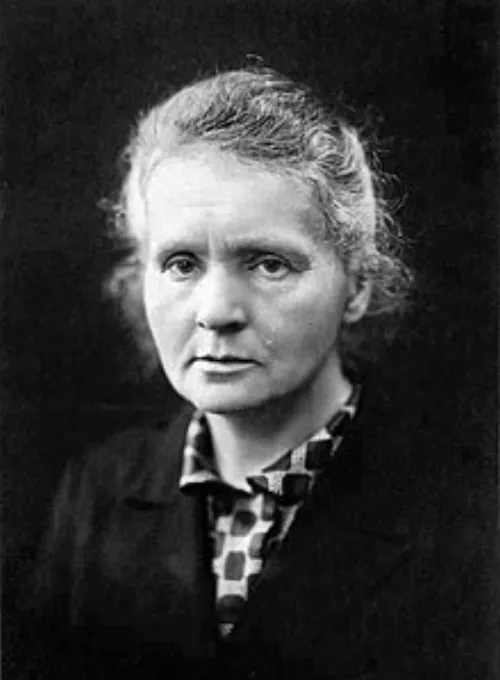
Maria Sklodowska was born on November 7, 1867, in Warsaw, then under Russian rule, the youngest of five children in an educated but financially struggling family. From childhood, she displayed exceptional academic ability and a focused, almost austere dedication to learning — traits that would define her entire life. Under Russian occupation, higher education for women in Warsaw was illegal, but Maria and her sister Bronia attended the clandestine 'Flying University,' which secretly educated women in rotating private apartments. Maria worked as a governess for years, sending money to Bronia for medical school in Paris, with the agreement that Bronia would reciprocate. In 1891, at twenty-four, Maria finally arrived in Paris, enrolled at the Sorbonne as 'Marie,' and quickly distinguished herself as one of the finest physics students the university had seen.
Marie Curie's scientific career accelerated when she met Pierre Curie, a brilliant physicist who would become her scientific partner and husband. Their collaboration was extraordinary — a rare meeting of two INTP-adjacent minds, both consumed by the pursuit of understanding over recognition. Together they investigated the mysterious phenomenon that Henri Becquerel had observed in uranium — what Marie would name 'radioactivity.' Working in a leaking shed with primitive equipment, in conditions that regularly made them ill, they isolated two new elements: polonium (named for Marie's occupied homeland) and radium. In 1903, Marie became the first woman to win a Nobel Prize — in Physics, shared with Pierre and Becquerel.
When Pierre was killed in a street accident in 1906, Marie could easily have retreated into grief. Instead, she took over his professorship at the Sorbonne — becoming the first female professor in the institution's history — and continued her research with renewed intensity. In 1911, she won a second Nobel Prize, this time in Chemistry, for her work isolating radium. No scientist before or since has won the Nobel Prize in two different scientific disciplines. During World War I, she developed mobile X-ray units (nicknamed 'petites Curies') that brought battlefield diagnosis to the front lines, personally operating them and training radiologists.
Curie was quintessentially INTP in her absolute subordination of personal comfort to intellectual pursuit. She was famously indifferent to recognition, money, and social convention — refusing to patent the radium isolation process so that other researchers could benefit freely, and declining most awards and honorary memberships. Her insatiable need to understand the mechanism behind phenomena, her extraordinary tolerance for tedium (she spent years manually processing tons of pitchblende ore), and her preference for facts over fame all define the INTP at its most elevated. She died in 1934 of aplastic anemia — almost certainly caused by decades of radiation exposure — her lab notebooks so radioactive they remain in lead-lined boxes to this day.