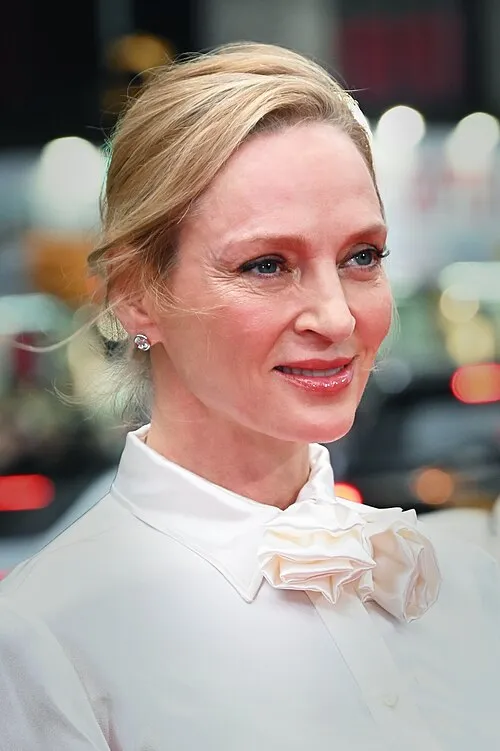
Uma Karuna Thurman was born on April 29, 1970, in Boston, Massachusetts, the daughter of Robert Thurman, the first American to be ordained as a Tibetan Buddhist monk and later a Columbia University professor, and Nena von Schlebrügge, a Swedish model who had been married to Timothy Leary. She was raised in a Buddhist household in Woodstock, New York, and in Massachusetts, the middle of five children — an upbringing that was intellectually unusual and spiritually distinctive. She was visually striking from childhood and began modeling at 15, leaving school before graduation to work professionally — a decision that took her to New York and eventually to Los Angeles, where she made her film debut at 17 in Kiss Daddy Goodnight (1987). Her breakthrough came with Dangerous Liaisons (1988), directed by Stephen Frears, in which she played the innocent Cécile de Volanges manipulated by Glenn Close and John Malkovich's social predators.
Uma Thurman's collaboration with Quentin Tarantino produced the performances that define her career. In Pulp Fiction (1994), she played Mia Wallace — the mob boss's wife whose overdose scene is one of cinema's most viscerally effective sequences, and whose chemistry with John Travolta in the twist contest at Jack Rabbit Slim's created one of the decade's most iconic film moments. The role earned her an Academy Award nomination for Best Supporting Actress. Kill Bill: Volume 1 (2003) and Kill Bill: Volume 2 (2004) — in which she played The Bride, a former assassin seeking revenge against those who destroyed her life on her wedding day — were explicitly conceived by Tarantino as a vehicle for Thurman's particular combination of physical presence, emotional intelligence, and willingness to commit completely to demanding material. She trained extensively in martial arts for the role and performed many of her own stunts.
Uma Thurman's personal life has included two marriages — to Gary Oldman (1990-1992) and to actor-director Ethan Hawke (1998-2004), with whom she has two children, Maya and Levon — and a relationship with financier Arpad Busson with whom she has a third child. She came to public attention in 2018 as one of the women who publicly described experiences of sexual assault and misconduct by Harvey Weinstein, telling the New York Times about an assault at the Savoy Hotel in London and describing the way the power dynamics of the film industry had made it difficult to respond in the moment. Her account was notable for its combination of personal honesty, self-scrutiny (she acknowledged the complicated ways she had responded at the time), and the controlled fury of someone who had spent years deciding how to engage with the public record.
Thurman's career since Kill Bill has been more intermittent than her peak years, reflecting both the limited opportunities available to women of a certain age in Hollywood and her own selectivity about the work she pursues. She appeared in the television series Imposters (2017-2018), the Hulu series Chambers (2019), and in various films including Gattaca (1997), The Avengers (1998, a commercial catastrophe), Be Cool (2005), and My Super Ex-Girlfriend (2006). She has maintained a public presence that is more thoughtful and less celebrity-focused than many of her generation, and has written publicly about mental health and her relationship with her Buddhist upbringing. She is, by any measure, one of the more genuinely interesting film actors of her generation: possessed of a very large talent that has been deployed unevenly by a system that didn't always know what to do with someone who resisted easy categorization.