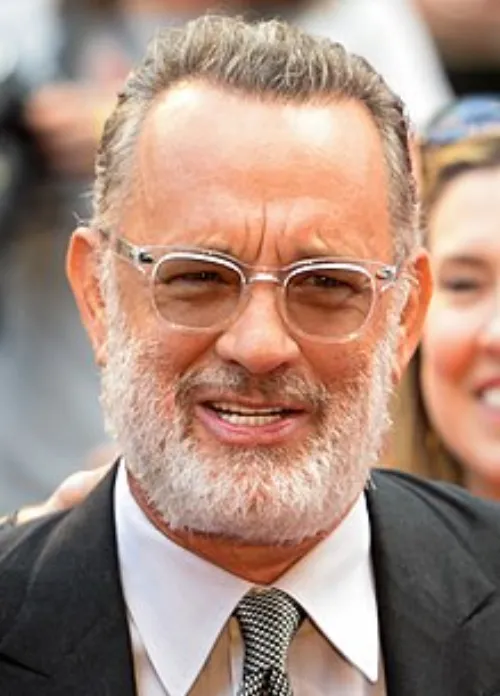
Thomas Jeffrey Hanks was born on July 9, 1956, in Concord, California, the third of four children of Amos Hanks, a cook, and Janet Frager, a hospital worker. His parents divorced when he was five, and he subsequently lived primarily with his father, moving frequently as his father remarried. By high school, Hanks had attended schools in five different cities — a peripatetic childhood that gave him a particular skill at reading rooms and adapting to new social environments quickly. He was not a natural extrovert but a careful observer who had learned to locate the emotional temperature of any new situation. At Chabot College, he saw a production of The Cherry Orchard and experienced a sudden, complete conviction that theater was the thing he needed to do. He transferred to California State University Sacramento to study theater, left after a year to follow an internship at the Great Lakes Theater Festival in Cleveland, and never returned to finish his degree.
Hanks's early career in television — Bosom Buddies (1980–1982), where he played one of two men disguising themselves as women to live in an all-female residence — established his fundamental screen presence: a person of genuine warmth and comic timing who seemed always to be thinking behind his eyes. His early film work in Splash (1984) and Bachelor Party (1984) confirmed his commercial viability. Big (1988) — in which he played a thirteen-year-old boy inhabiting an adult body — was the first film to reveal the full range of his instrument: the physical comedy and the genuine emotional depth operating simultaneously, the childlike openness existing within the adult intelligence, the innocence that was also a form of wisdom.
Philadelphia (1993) and Forrest Gump (1994) produced back-to-back Academy Awards for Best Actor — the first person to achieve this since Spencer Tracy in 1937 and 1938. Philadelphia required him to disappear inside AIDS-era stigma and legal drama while maintaining the emotional truth of a man claiming his dignity in the face of extinction. Forrest Gump demanded something technically more unusual: a performance of genuine childlike immediacy that somehow carried the entire emotional weight of American history from the 1950s through the 1980s without irony, condescension, or sentimentality. Saving Private Ryan (1998) and Cast Away (2000) — the latter requiring him to perform opposite a volleyball named Wilson for the majority of a two-hour film — demonstrated a range that increasingly seemed to have no visible ceiling. He received his sixth Academy Award nomination for Captain Phillips (2013).
Tom Hanks's ENTP quality manifests differently from the type's stereotypical profile. He is not the aggressive debater or the contrarian provocateur — he is the ENTP whose intellectual curiosity expresses itself as empathy, whose facility with ideas manifests as the ability to inhabit any human situation with complete conviction. His preparation for roles is systematic and exhaustive: he learned to play piano for Big, studied the law for Philadelphia, lost thirty pounds and let his beard grow untrimmed for Cast Away, mastered Somali-accented English for Captain Phillips. The curiosity that drives the ENTP type becomes, in Hanks, not the desire to argue about the world but the desire to understand and then capture it. His off-screen persona — his warmth, his humor, his apparent genuine decency — reflects the same quality: an ENTP who has channeled intellectual energy into human connection rather than intellectual dominance.