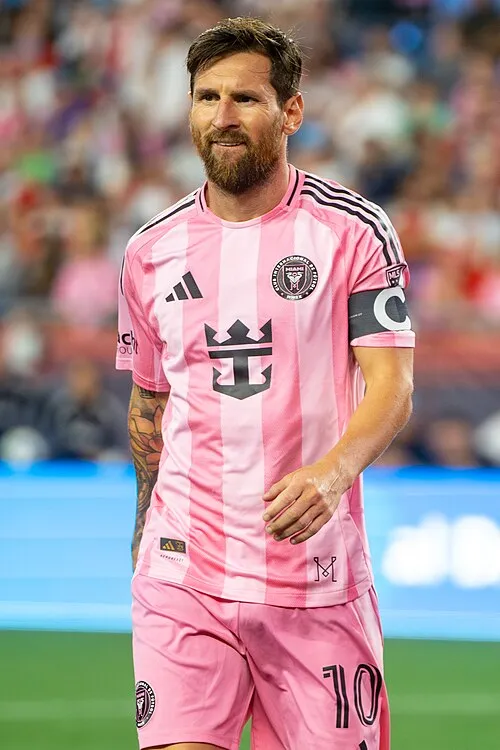
Lionel Andrés Messi was born on June 24, 1987, in Rosario, Argentina, the third of four children in a working-class family. His father Jorge worked in a steel factory; his mother Celia was a cleaner. Messi showed extraordinary football ability from the earliest age at which ability can be assessed — he was playing for his local club Grandoli at age four, and by age eight was playing for Newell's Old Boys, where his talent was so obvious that scouts from the major Buenos Aires clubs began to watch him. His exceptional skill came alongside a growth hormone deficiency that threatened to stunt his development permanently unless treated with expensive hormone therapy that his family could not afford.
FC Barcelona agreed to pay for Messi's medical treatment in exchange for his transfer to their youth academy, La Masia, at age thirteen. He relocated to Barcelona with his father, leaving behind his mother and siblings, adapting to a new country and culture while continuing his development under Barcelona's renowned youth system. He made his first team debut at age sixteen, scoring his first goal at seventeen, and by eighteen was a first team regular. His progression was so rapid that by 2009, at age twenty-two, he had won his first Ballon d'Or — awarded to the world's best football player — an award he would win eight times in total, more than any player in history.
The partnership with Ronaldinho and then with Xavi and Iniesta at Barcelona produced one of club football's most dominant eras: four consecutive Champions League titles were not achieved, but multiple Champions League wins (2006, 2009, 2011, 2015) and repeated La Liga and Copa del Rey victories established Barcelona's Messi-era squad as among the greatest club sides in football history. Messi's personal statistics — goals, assists, dribbles, chances created — regularly exceeded what any other player in the competition was achieving. His style was distinctive: low center of gravity, extraordinary balance, the ability to operate in small spaces at high speed, and a footballing intelligence that seemed to perceive the game in a different dimension than his peers.
The shadow over Messi's extraordinary club career was his national team results. Argentina, with Messi at its center, lost three major finals in four years — the 2014 World Cup, the 2015 and 2016 Copa América — and Messi's performances in those tournaments, while individually brilliant, were insufficient to overcome opponents. His temporary retirement from international football after the 2016 Copa América final loss was brief; he returned and continued to strive for the World Cup that would complete his legacy. The 2022 World Cup in Qatar provided it: Argentina's triumph, with Messi at the age of thirty-five performing at his highest level through the tournament, producing what many regarded as the greatest individual World Cup performance since Maradona in 1986.